Best Touchless Voltage Tester for Fast AC Screening
As an Amazon Associate we earn from qualifying purchases. Details
A touchless voltage tester can provide an initial AC-field indication before you choose the next appropriate electrical check. This comparison separates dedicated pens from two meters that include a non-contact function, then weighs range, category markings, alert behavior, and operating features. It helps you decide whether a simple pocket detector or a multifunction instrument better fits your task. Electricity at mains circuits can be lethal. Never read a silent indication as proof that wiring is safe to touch. Follow the selected instrument’s manual and local electrical requirements, match its CAT marking to the location, and assign panel or service work to a licensed electrician.
Quick answer
The first pick is a straightforward dedicated pen with a stated 50-1000V AC range. The second pick offers continuous self-test, audible or silent operation, and a stated CAT IV rating. The third pick reaches down to a listed 12V AC and includes cells. The fourth pick adds three sensitivity modes plus separate detection and tail lights. The fifth pick is a smart multimeter with a non-contact alert, while the sixth pick combines NCV with broader meter functions and USB-C power. Choose a dedicated pen for quick field screening; select a meter only when its additional measurements are relevant. In every case, verify the current listing, instrument label, and manual before use.
Decide between a pen and a multifunction tester
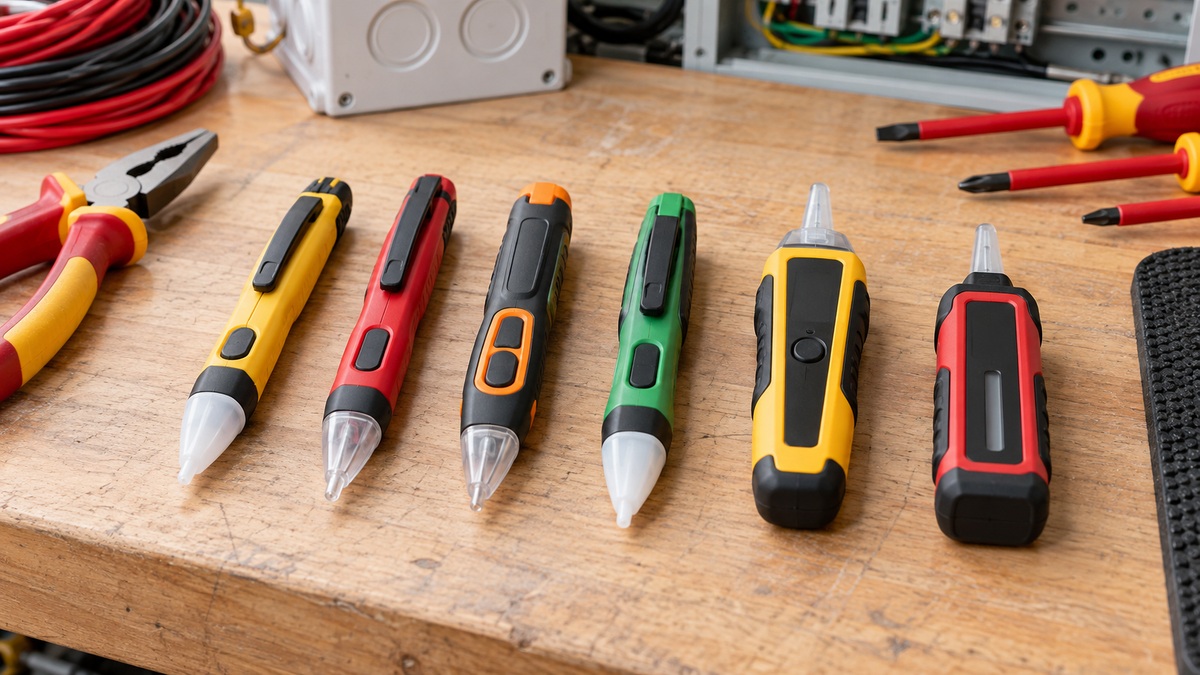
A dedicated touchless voltage tester is built around one primary interaction: bring the sensing end near the target and interpret the specified alert. The first four selections follow that pattern. Their differences are range, alert design, sensitivity controls, and readiness features. These products do not provide an exact voltage reading through their non-contact function.
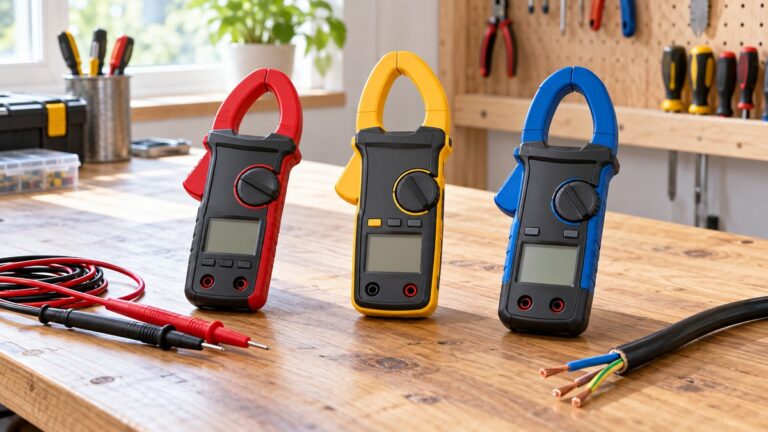
The fifth and sixth picks are meters with NCV included among other capabilities. Their bodies, displays, and controls suit a reader who also needs listed contact measurements. That added scope is not automatically better. If you only need an electric-field screen, a pen is easier to carry and presents fewer modes. If you require resistance, continuity, or numerical voltage measurements, a suitably rated meter may reduce duplicated tools. Our voltage tester pen comparison focuses on the slimmer format.
What changes the choice of tester
The declared AC window comes first
The first pen states 50-1000V AC. The second states a nominal 90 V AC to 1000 V AC sensing range, with a product bullet that also mentions 200 V to 1000 V AC. The third lists 12-1000V AC. The fourth title names 12V/48V/70V-1000V across its three ranges. These lower thresholds differ enough to change the shortlist.
Do not compare only the shared 1000V upper figure. A range is useful when it includes the intended signal and the tester is appropriate for the environment. Nor does a low threshold establish an exact reading. The alert reports detection rather than a measured number. For more dedicated options organized around this tool type, visit the contactless voltage tester guide.
Category information cannot be inferred from range
CAT is a measurement-category system for live circuits used in installation and equipment testing. Its classifications consider both available continuous energy and impulse voltage at the measurement point. Category and voltage range therefore answer different questions.
The second pick’s title states CAT IV, while the fifth lists CAT II 600V. The sixth specifies CAT.III 1000V and CAT.IV 600V. The first and fourth supplied specifications do not state a CAT category, and the third mentions CAT III600V only in a bullet. Never assume an unstated rating from the shape of the tester, its brand, or a 1000V range. Confirm the exact marking for the environment, and consult an electrician whenever the required category is uncertain.
Feedback needs to suit the setting
The first pen uses an LED and audible alert. The second has a red illuminated tip and beeper, with an audible/silent mode. The third distinguishes indications through alarm sounds and an LED. The fourth changes buzzer behavior across three sensitivity modes and supplies both a detection light and tail flashlight. The two meters add screens but still use visual and audible NCV alarms.
In a noisy area, visible feedback can be essential. In a location where sound is disruptive, the second pen’s silent option may be preferable. Separate lighting can also help identify the target before interpreting the alert. Select a feedback pattern you can recognize clearly, then use only the operating sequence in that model’s manual.
Readiness features reduce avoidable uncertainty
The second pick specifies continuous self-test, which gives it a clear readiness feature. The third and fifth list included AAA cells, while the sixth uses USB-C charging and states a 2-hour charge. The fourth describes a low-battery behavior: below 2.5V, its indicator flashes 3 times before automatic shutoff.
These details affect what you check before approaching a conductor. They do not eliminate the need for the manual’s prescribed confirmation sequence. A powered display or flashlight alone does not prove that the sensing function is operating correctly. If you want more purchasing context, read the home-use voltage tester guide before selecting a model.
Added meter functions should solve a real need
The fifth selection measures AC/DC voltage, resistance, and continuity, but its specification explicitly says it cannot measure current. It supplies 4000 counts, a 0.8 ~ 600 v measurable-voltage field, and test leads. The sixth lists 6000-count True RMS operation with voltage, current, resistance, capacitance, frequency, continuity, temperature, and NCV functions.
Those capabilities are relevant only if you will use contact measurements with a properly rated setup and documented procedure. A multifunction body is less pocketable than a detector pen, and more functions create more settings to understand. Beginners should not view a feature list as authorization to work on energized equipment. A licensed electrician should handle panel and service tasks.
Six touchless voltage tester selections
1. Klein Tools NCVT1P Voltage Tester, NCVT Pen, 50 to 1000V AC (Best simple pen)
Specs from the listing (checked 2026-10-11):
- Brand: KLEIN TOOLS
- Power Source: Battery Powered
- Style: NCVT
- Color: Orange/Black
Pros
- The dedicated pen format keeps the interaction focused on non-contact AC screening.
- Its listing identifies both visible and audible alerts.
Cons
- The supplied specifications do not state a CAT category.
Best for: A straightforward dedicated touchless pen
Skip if: You need a confirmed category or a threshold below 50V AC
View on Amazon (affiliate link)
2. Fluke 1AC II VoltAlert Non-Contact Voltage Tester, Pocket-Sized, 90-1000V AC, Audible Beeper, CAT (Best self-check)
Specs from the listing (checked 2026-10-11):
- Voltage sensing ranges: Nominally, 90 V AC to 1000 V AC
- Detector tip style: Flat-tip
- Batteries: 2 AAA alkaline batteries included; Typical battery life of greater than 1-year
- Item Weight: 59 g
Pros
- Continuous self-test provides an explicit readiness feature.
- Audible and silent modes let the user choose the alert sound.
Cons
- Its nominal lower sensing limit is 90 V AC, and another bullet mentions an alternate 200 V threshold.
Best for: A CAT-marked pen with self-test and silent operation
Skip if: Your intended signal requires a lower published threshold
View on Amazon (affiliate link)
3. Neoteck Non Contact Voltage Detector 12-1000V AC Voltage Tester (Best lower threshold pen)
Specs from the listing (checked 2026-10-11):
- Style: AC 12-1000V
- Item Weight: 65 g
- Item Dimensions: 6.3 x 0.79 x 0.79 inches
- Included Components: 2×1.5V AAA batteries
Pros
- The pen lists a 12-1000V AC range and light-plus-beep alerts.
- The package identifies 2×1.5V AAA batteries and a flashlight.
Cons
- The listing says the tester is not suitable for Christmas light testing.
Best for: A compact pen with a stated 12V AC starting point
Skip if: Christmas-light troubleshooting is the planned use
View on Amazon (affiliate link)
4. MXCOIRTP Voltage Tester, Non-Contact Voltage Detector, Electrical Tester, 3 Ranges AC (Best sensitivity control)
Specs from the listing (checked 2026-10-11):
- Style: Compact
- Model: MT01
- Warranty Description: 1 year warranty
- Included Components: Voltage Tester
Pros
- Three sensitivity modes support different stated detection thresholds.
- The low-battery sequence provides visible and audible warning before shutdown.
Cons
- No CAT category appears in the supplied specification fields.
Best for: Users who want three selectable sensitivity modes
Skip if: Your environment requires a category that cannot be confirmed
View on Amazon (affiliate link)
5. TM-510 Digital Multimeter, 4000 Counts, Smart Measurement, Auto-Ranging Voltmeter; Voltage Tester (Best basic meter combination)
Specs from the listing (checked 2026-10-11):
- Display: 4000 counts
- Measurable Voltage: 0.8 ~ 600 v
- Function: Measure AC/DC Voltage, Risistent, Continuity
- Note: CAN'T MEASURE CURRENT
Pros
- Smart auto mode covers the listed voltage, resistance, and continuity functions.
- The kit includes test leads, AAA batteries, a storage bag, and a manual.
Cons
- Its specification explicitly says it cannot measure current.
Best for: A basic smart meter that also includes NCV
Skip if: Current measurement is required
View on Amazon (affiliate link)
6. 2026 Upgraded FS899L Digital Multimeter, 6000 Counts True RMS Auto-Ranging AC/DC Voltage Tester (Best broad-function meter)
Specs from the listing (checked 2026-10-11):
- Specification Met: Cat.iii 1000v, Cat.iv 600v
- Measurement Type: Multimeter
- Power Source: Battery Powered
- Included Components: Instruction manual
Pros
- The meter combines NCV with the listed voltage, current, resistance, capacitance, frequency, continuity, and temperature functions.
- USB-C charging, a color screen, and a worklight support its multifunction format.
Cons
- Its extensive mode set is unnecessary for someone seeking only a pocket touchless tester.
Best for: A buyer who needs NCV within a broad multifunction meter
Skip if: A simple dedicated pen is the entire requirement
View on Amazon (affiliate link)
First pick: simple dedicated AC pen
The first choice is a dedicated NCVT pen with a stated 50 to 1000V AC range. Its compact purpose makes it the baseline option in this group: a reader gets a non-contact tester rather than a meter with NCV added. The listing identifies both visual and audible alerts, so the response is not limited to one sense.
This pick fits someone who values a direct pen interface and does not need multiple sensitivity settings or numerical measurements. Its supplied fields do not state a CAT category, which is a decisive limitation for any environment where a confirmed marking is required. Skip it if the category cannot be verified on the current listing and instrument. Also choose another option when your intended signal falls below the published 50V AC threshold.
Second pick: self-test and silent mode
The second pen lists a nominal range of 90 V AC to 1000 V AC. When it detects voltage, its tip glows red and a beeper sounds. Continuous self-test is the distinguishing feature, and an audible/silent setting gives the operator a choice about sound. The included components identify 2 AAA alkaline batteries, while the specification describes typical battery life as greater than 1-year.
Its title states CAT IV, making it the dedicated pen to shortlist when that declared category and a higher starting threshold fit the intended environment. Its listed weight is 59 g. Do not choose it for an application requiring a published threshold below 90 V AC. The bullet also presents an alternate 200 V to 1000 V AC range, so confirm which version and range the current page offers before ordering.
Third pick: lower starting threshold and compact dimensions
The third tester states a 12-1000V AC range. Audible beeps and an LED provide the indication, and its item highlight names outlets, switches, and circuit breakers. Its body is listed at 6.3 x 0.79 x 0.79 inches with a 65 g weight. The package description includes 2×1.5V AAA batteries and an emergency flashlight.
Choose this pen when the published 12V AC starting point, identified batteries, and slim dimensions align with the task. The same listing explicitly says it is not suitable for Christmas light testing, so that use should send you to another product. Although a bullet states CAT III600V, confirm the marking on the current item before mains use and never let that label substitute for the maker’s instructions.
Fourth pick: three sensitivity modes
The fourth dedicated pen is described with three ranges in its title: 12V/48V/70V-1000V. Its control cycles through low, medium, and high sensitivity, with the buzzer sounding 1 time, 2 times, or 3 times to identify the selected mode. The tester also has a detection light and a tail flashlight, but the tail light operates only while the tester is off.
Its low-battery behavior is unusually explicit. When battery voltage falls below 2.5V, the power indicator flashes 3 times, the buzzer sounds, and the tester shuts down. Select it when multiple sensitivity settings are useful and you are willing to learn their sequence. The supplied specifications do not state a CAT rating; skip it for a categorized environment unless that marking is confirmed elsewhere on the current product and tool.
Fifth pick: NCV within a smart multimeter
The fifth pick is a 4000-count smart digital multimeter that includes a non-contact voltage function with visual and audible alarms. Its smart auto mode handles AC/DC voltage, resistance, and continuity. The measurable-voltage field states 0.8 ~ 600 v, and the frequency response is listed as 40 Hz ~ 1 kHz True RMS. Its category statement is CAT II 600V.
The kit includes the meter, 2 test leads, 2 AAA batteries, a storage bag, and a manual. It suits a buyer who genuinely needs both an NCV screen and the listed contact measurements. The specification says it cannot measure current, so skip it if current measurement belongs on your task list. At 0.1 kg, it is also a different carry proposition from a narrow detector pen.
Sixth pick: broad meter functions and rechargeable power
The sixth choice is a 6000-count True RMS auto-ranging multimeter with NCV. Its listing includes AC/DC voltage, current, resistance, capacitance, continuity, frequency, temperature, and live-wire functions. A 4.8-inch color display, flashlight, and Data Hold address visibility and reading retention. USB-C charging is stated to take 2 hours for a full day of continuous field use.
The product specifies CAT.III 1000V and CAT.IV 600V, dual ceramic fuses, and overload protection. Choose it when the additional measurements, rechargeable design, and stated categories match a defined meter workflow. Skip it if you want only an uncomplicated touchless pen. Its larger feature set demands careful study of the manual and does not make live panel work appropriate for an unqualified user.
Side-by-side comparison table
| Pick | Format | Key stated window or measurement | Category statement | Defining feature |
|---|---|---|---|---|
| First | Dedicated pen | 50 to 1000V AC | Not stated | Simple visual and audible alert |
| Second | Dedicated pen | 90 V AC to 1000 V AC nominal | CAT IV in title | Continuous self-test and silent mode |
| Third | Dedicated pen | 12-1000V AC | CAT III600V in bullet | Included cells and compact body |
| Fourth | Dedicated pen | 12V/48V/70V-1000V | Not stated | Three sensitivity modes |
| Fifth | Smart multimeter | 0.8 ~ 600 v measurable voltage | CAT II 600V | NCV plus voltage, resistance, continuity |
| Sixth | True RMS multimeter | 6000 counts | CAT.III 1000V; CAT.IV 600V | Broad functions and USB-C power |
Use the table to eliminate mismatches rather than crown a universal winner. Someone needing a pocket screen gains little from the sixth pick’s extensive meter functions. A buyer requiring contact measurements should not expect the first pen to provide them. The listed category and operating environment must agree before convenience features enter the decision.
Practical buying scenarios
A homeowner seeking a compact screening pen should start with the third selection. Its 12-1000V AC statement, defined dimensions, included batteries, and flashlight make the package easy to understand. That recommendation changes if Christmas lights are the target because its listing excludes that use.
A technician who values ongoing readiness can compare the second selection’s continuous self-test with the fourth selection’s low-battery shutdown behavior. The second has a category statement and silent option. The fourth starts lower and offers three sensitivity modes, but no category appears in its supplied fields.
A student or hobbyist building one measurement kit may prefer the fifth meter. It covers several basic measurements and NCV while plainly excluding current. Someone needing the sixth pick’s broader function set must also be prepared to understand more modes, ranges, leads, and safety limitations.
Narrowing the format first, pens versus meters
Of the six picks, 4 are dedicated pens and 2 are meters that include NCV. The first four selections follow the pen pattern, while the fifth and sixth carry the added meter functions.
Start with the count: 4 pens + 2 meters = 6 picks. Confirm it by subtraction: 6 picks – 2 meters = 4 pens.
Convert the pen share: 4 ÷ 6 × 100 = 66.7%. Verify the percentage by multiplication: 6 × 66.7% = 4 picks, to the nearest whole pick.
Now calculate the meter share: 2 ÷ 6 × 100 = 33.3%. A reverse check gives 6 × 33.3% = 2 picks, to the nearest whole pick.
Both groups must rebuild the whole set. Check one: 66.7% + 33.3% = 100%. Check two: 100% – 66.7% = 33.3%.
Most of the picks here are dedicated pens, so a pen is the cleaner primary choice for a quick screen. The two meters still require a suitably rated instrument and documented procedure for any contact measurement. The arithmetic organizes the comparison; it does not decide whether any real electrical task is safe.
Errors to avoid before buying
Avoid using the word “touchless” as a safety guarantee. The detector prevents direct probe contact for its sensing action, but electricity remains dangerous. The instrument manual and local rules still govern the work.
Avoid assuming that a meter with NCV performs that function better than a dedicated pen. The comparison must use the declared range, alert style, category, and intended workflow. Extra measurement modes can be irrelevant overhead.
Avoid ignoring a contradictory or alternate range statement. The second pick gives a nominal 90 V AC lower limit and also mentions a 200 V alternate. Confirm the exact version before relying on either value.
Avoid overlooking a hard limitation. The fifth meter explicitly cannot measure current, the third pen excludes Christmas-light testing, and the fourth omits a category statement in the supplied specifications. Each fact can change the correct choice.
Avoid choosing a category by the highest printed voltage alone. CAT II, CAT III, and CAT IV refer to different installation contexts as well as stated voltage. When you cannot identify the required category confidently, stop and consult a licensed electrician.
FAQ
Should I buy a pen or a multimeter with NCV?
Buy a pen when the job is limited to a quick electric-field screen and pocket carry matters. Consider the fifth or sixth choice only if you also need their stated contact measurements. The fifth cannot measure current, while the sixth adds current, capacitance, frequency, and temperature. Whichever format you choose, its rating must match the intended circuit.
Which dedicated pen starts at the lowest listed voltage?
The third and fourth choices each include a 12V starting point in their listings. The fourth adds 48V and 70V thresholds across three sensitivity modes. The third gives one 12-1000V AC statement and includes AAA cells. Select between them by sensitivity controls and category confirmation, not by the shared lower number alone.
Why does the CAT marking matter on a touchless tester?
Measurement category classifies live electrical circuits by their installation context, including available energy and impulse exposure. It is separate from the detector’s sensing range. The second, fifth, and sixth picks state categories, while other supplied fields omit them. Never infer a category from a broad AC range; verify the marking for the actual location.
Does continuous self-test eliminate a manual check?
No. The second pick’s continuous self-test is a useful readiness feature, but it does not replace the operating and confirmation sequence in its manual. Use the instructions written for that exact tester. A glowing light, audible tone, or powered display should never be treated as blanket proof that every sensing function and application is appropriate.
Which option supports silent operation?
The second dedicated pen lists an audible/silent mode. Its normal detection response uses a red glowing tip and beeper, while silent operation can suit settings where sound is undesirable. Confirm the selected mode before approaching the target, and remember that this pen’s nominal sensing range begins at 90 V AC according to its specification.
Can the smart meter measure current?
The fifth choice cannot measure current; that restriction appears directly in its specification. It supports AC/DC voltage, resistance, continuity, and NCV instead. The sixth meter does list current among its functions. Do not choose between them solely by display size or count resolution; start with the measurements you actually require and the applicable category.
Is a silent NCV result proof that power is absent?
No. A silent result can never be your permission to touch wiring. Use the model-specific readiness checks, respect its stated sensing window, and follow the manufacturer’s manual. If a circuit involves a panel, service entrance, or an unclear category, step away and have a licensed electrician perform the work.
Bottom line
Choose the first pick for a basic 50-1000V AC pen, the second for self-test and silent mode, or the fourth for selectable sensitivity. Choose the fifth only when its listed basic meter functions suit your work, and the sixth when the broader measurement set is genuinely necessary. Match the category to the environment and never use a quiet NCV alert as proof that a conductor is safe.
Sources
- Measurement category: supports the explanation of CAT classifications and why category differs from sensing range.