Best Hand Held Digital Multimeter for Home and Auto Use
As an Amazon Associate we earn from qualifying purchases. Details
A hand held digital multimeter is the portable meter most homeowners, car owners, students and hobbyists reach for first when they need to check voltage, continuity, resistance or current. This guide helps you decide which handheld type fits your tasks, what safety rating to require, and when to stop and call a licensed electrician. You will compare display counts, manual or auto-ranging, AC and DC ranges, and CAT ratings drawn from the product listings. Work on mains circuits can kill. The meter CAT rating must suit the circuit, and panel or service work belongs to a licensed electrician. Read the decision rules, then match one of the five listed meters to your use.
Quick answer
Choose a hand held digital multimeter by task and CAT rating, not by extra features alone. For basic home and car checks such as batteries, fuses, outlets and continuity, a compact manual meter with 2000 Counts and CAT II 600 V protection may be enough if you avoid panel work. For broader home troubleshooting with temperature and capacitance, look for CAT III 600V and 1000V AC/DC capability with leads and thermocouple included. For auto-ranging convenience plus True RMS, choose a meter that states both in the listing. For higher-category work locations, only consider a meter that states CAT III 1000V and CAT IV 600V. Never use a meter without a stated CAT rating on household mains. Follow the instrument manual and local electrical rules.
What matters in a hand held digital multimeter
A handheld meter must be safe, readable and matched to the circuit. These five criteria change your choice.
1. CAT rating and voltage rating must match the location
Measurement category is a method of classification by the International Electrotechnical Commission of live electric circuits used in measurement and testing. The categories take into account the total continuous energy available at the given point of the circuit and the occurrence of impulse voltages. Measurement category II is for measurements performed on circuits directly connected to the low-voltage installation, while measurement category IV is for measurements performed at the source of the high-voltage installation. The required impulse withstand voltage varies from 500 V for lower categories to 12,000 V for CAT IV 1000 V. That is why a CAT II 600 V meter is not interchangeable with a CAT III 600V or CAT III 1000V meter. Quote CAT and voltage only from the listing or manual. If the listing does not state a CAT rating, do not call the meter safe for household mains. For help with outlet checks, see how to test an outlet with a multimeter.
2. Counts, ranging and display readability
Counts describe display resolution. A 2000 Counts display can show up to 1999 before changing range, while a 6000-count display shows finer steps before it changes range. This is a simplification; check the manual for accuracy specifications at each range. Manual selection requires you to turn the dial to the expected range. Auto-ranging selects the range for you. Auto-ranging saves time for beginners. Manual meters can teach range selection but need more care. A backlit LCD helps in dim areas. Data hold freezes a reading so you can move the meter to read it. Learn the basics in what a digital multimeter means.
3. Current, voltage and resistance ranges you will actually use
Most home and auto users measure DC voltage for batteries, AC voltage for outlets and cords, resistance and continuity for fuses and wiring, and small DC current for electronics. A meter that lists DC Voltage 200mV/2V/20V/200V/600V covers battery to mains-style levels on paper, but only use the mains ranges if the CAT rating suits the circuit. A meter that lists 10A AC/DC current covers many automotive and appliance checks. A 50 MOhms resistance range covers more electronics troubleshooting than a 20MΩ top range. Temperature, capacitance, frequency and diode test matter for HVAC and electronics. If you work on heating systems, see Fluke 116 for HVAC use.
4. True RMS for AC measurements
True RMS meters measure alternating current or voltage more accurately when the waveform is not a clean sine wave. That matters for motor drives, dimmers, electronic ballasts and some HVAC equipment. An averaging meter may read low on distorted waveforms. This is a simplification; the manual states accuracy limits. If the listing states True Root Mean Squared technology, you can plan on that feature. If the listing does not state True RMS, assume it is not claimed. For background on auto operation, see auto-ranging digital multimeter guide.
5. Leads, fuses, power and handheld design
Handheld design means you can hold the meter in one hand while placing probes with care, or stand it on a bench. Check Item Weight, Item Dimensions, lead type, fuse protection and battery type from the listing. A model that lists mA: F250 mA/250 V Fuse and 10 A: F10 A/250 V Fuse states its overcurrent protection. A model that lists CAT III/CAT IV safety caps on the leads states lead protection. A model powered by 2 x 1.5 V AAA Batteries differs from one that uses a 9V battery or USB-C rechargeable power. When you need a meter for home tasks only, compare meters for home use.
Products that fit this guide
These five are all portable digital multimeters drawn from the product listings. The cards appear here.
1. AstroAI Digital Multimeter Tester 2000 Counts with DC AC Voltmeter and Ohm Volt Amp Meter; Measures (Best for basic manual checks)
Specs from the listing (checked 2026-10-10):
- Range Selection: Manual
- Digital Display: 2000 Counts. The unit symbols will automatically appear according to the measured functions
- DC Voltage: 200mV/2V/20V/200V/600V ±(0.5%+3)
- AC Voltage: 200V/600V ±(0.8%+5)
- DC Current: 200µA/200mA/10A ±(1.2% +3)
- Resistance: 200Ω/2KΩ/20KΩ/200KΩ ±(1.0%+3);20MΩ ±(1.5%+3)
- Environmental Conditions: CAT II 600 V; CAT Ill 300 V
- Fuse Protection: mA: F250 mA/250 V Fuse;10 A: F10 A/250 V Fuse
- Item Weight: 0.15 kg
Pros
- Manual ranging with DC Voltage steps to 600V and DC Current to 10A stated in specs
- 2000 Counts display with backlight, data hold and continuity buzzer stated in listing
- Includes test leads, battery and manual with double fuse protection stated
Cons
- Manual ranging requires range selection skill and lacks auto-ranging convenience
- Listing shows CAT II 600 V level protection, so skip higher-category locations
Best for: Students and car owners doing batteries, fuses and continuity on suitable circuits
Skip if: You need auto-ranging, True RMS, capacitance, temperature, or higher CAT locations
View on Amazon (affiliate link)
2. Fluke 17B+ Digital Multimeter, for Electrical Applications, Measures AC/DC Voltage 1000V, Current (Best for home troubleshooting kit)
Specs from the listing (checked 2026-10-10):
- Brand: Fluke
- Item Weight: 470 g
- Item Dimensions: 8.46 x 2.76 x 5.91 inches
- Specification Met: Cat Iii 600v
- Included Components: 17B+ Digital Multimeter with TL75 Test Leads and K-Type Thermocouple Assembly
- Item Type Name: Fluke 17B+ Digital Multimeter, for Electrical Applications, Measures AC/DC Voltage 1000V, Current Measurements to 10A, Resistance, Continuity, Diode, Capacitance, Frequency, and Temperature Testing
Pros
- States AC/DC Voltage 1000V and Current Measurements to 10A for broad home use
- States Resistance, Continuity, Capacitance, Frequency, Diode and Temperature Testing
- Includes TL75 Test Leads and K-Type Thermocouple Assembly for HVAC checks
Cons
- Listing does not state auto-ranging or True RMS, so do not assume those features
- Stated CAT III 600V only, so skip service-equipment locations needing higher rating
Best for: Homeowners wanting one meter for outlets, appliances, capacitance and temperature
Skip if: You need stated True RMS, auto-ranging, or CAT III 1000V / CAT IV capability
View on Amazon (affiliate link)
3. Digital Multimeter Voltmeter Battery Voltage Multi Tester Continuity Ohm Volt Amp DC AC Current (Best for light learning use)
Specs from the listing (checked 2026-10-10):
- Item Weight: 166 g
- Item Dimensions: 5.51 x 2.56 x 1.18 inches
- Style: modern
- Color: Orange&Black
- Specification Met: Safety Standards Met
- Included Components: multimter
Pros
- Light 166 g handheld package with fold-out stand and protective orange shell
- Large backlit display with Data Hold for dim-area practice readings
- Includes leads, battery and manual and states overload protection on all ranges
Cons
- The listing does not state a CAT rating, so it cannot be confirmed for household mains
- DC current only is implied by features, so skip it if you need stated AC current
Best for: Beginners practicing batteries, resistance and continuity on low-voltage circuits
Skip if: You plan to measure household mains or need a stated CAT rating
View on Amazon (affiliate link)
4. Klein Tools MM420 Auto-Ranging TRMS Digital Multimeter (Best auto-ranging True RMS)
Specs from the listing (checked 2026-10-10):
- Style: Auto-Ranging
- Specification Met: Cat Iii 600v Safety Rating
- Item Highlight: 600V AC/DC Voltage, 10A AC/DC Current, 50 MOhms Resistance
- Item Weight: 14.56 ounces
- Item Dimensions: 9.33 x 5.08 x 3.82 inches
- Included Components: Digital Multimeter, Auto-Ranging, 600V
Pros
- States Auto-Ranging plus True Root Mean Squared technology for easier AC readings
- States 600V AC/DC, 10A AC/DC and 50 MOhms plus temperature and capacitance
- Lead-alert LEDs, lead holders, kickstand and 6.6-Foot drop build stated
Cons
- Large 9.33 x 5.08 x 3.82 inches package is less pocketable than compact meters
- 600V top voltage is lower than 1000V alternatives in this guide
Best for: DIYers wanting auto-ranging True RMS for home, HVAC and light-industrial spots
Skip if: You need 1000V range or the smallest carry size
View on Amazon (affiliate link)
5. 2026 Upgraded FS899L Digital Multimeter, 6000 Counts True RMS Auto-Ranging AC/DC Voltage Tester (Best for high CAT plus color screen)
Specs from the listing (checked 2026-10-10):
- Specification Met: Cat.iii 1000v, Cat.iv 600v
- Brand: ZMIWNIED
- Style: modern
- Compatible Devices: Appliances, Electronics, Vehicles, etc.
- Included Components: Instruction manual
Pros
- States Cat.iii 1000v, Cat.iv 600v with dual ceramic fuses and overload protection
- States 6000-count True RMS resolution with NCV, capacitance and frequency
- 4.8-inch color screen, flashlight, Data Hold and USB-C rechargeable power stated
Cons
- Specs provided do not state weight, dimensions or battery capacity, so fit is harder to judge
- Feature-rich menus may be more than a basic battery-and-fuse user needs
Best for: Users wanting high stated CAT ratings and fine resolution with rechargeable power
Skip if: You need stated dimensions, weight, or a simple manual dial layout
View on Amazon (affiliate link)
Compact manual meter for batteries, fuses and continuity
This first pick is a compact manual model with a blue case and battery powered operation. The listing states Range Selection as Manual and Digital Display as 2000 Counts, with Sample Speed of 3 Times Per Second. It measures AC/DC Voltage, DC Current, Resistance, and Diode, plus continuity buzzer and data hold. The listing states DC Voltage 200mV/2V/20V/200V/600V and AC Voltage 200V/600V, with DC Current 200µA/200mA/10A and Resistance to 20MΩ. It includes test leads, a battery and a user manual, with Item Weight of 0.15 kg. The environmental listings include CAT II 600 V protection and fuse protection details. It fits a student or car owner who wants simple checks on batteries, fuses and low-voltage wiring and who will learn manual range selection. Skip it if you want auto-ranging, True RMS, capacitance or temperature, or if you need to work beyond CAT II locations. Check the listing before use on any mains circuit.
Full-size meter with 1000V range, capacitance and temperature
The second pick is a full-size yellow digital multimeter for electrical applications. The listing states Measures AC/DC Voltage 1000V and Current Measurements to 10A, plus Resistance, Continuity, Diode, Capacitance, Frequency, and Temperature Testing. It includes TL75 Test Leads and K-Type Thermocouple Assembly, with Item Weight of 470 g and Item Dimensions of 8.46 x 2.76 x 5.91 inches. The listing states Specification Met as Cat Iii 600v and the bullets state CAT III 600V Safety Rating. Temperature measurement uses the included type K thermocouple. It fits a homeowner or hobbyist who wants one handheld meter for outlets, appliances, capacitance and heating or cooling checks without buying separate tools. Skip it if you need True RMS stated in the listing, auto-ranging stated in the listing, or a higher CAT rating for service equipment. Follow the manual and leave panel work to a licensed electrician.
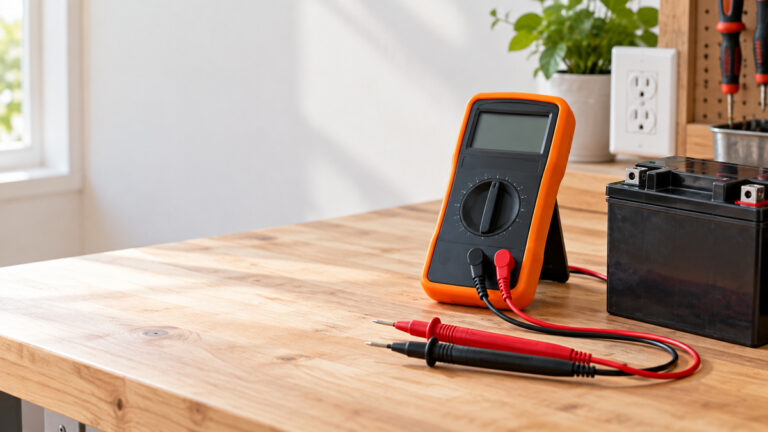
Simple orange meter with stand for beginners
The third pick is a modern orange and black meter with a fold-out stand and rubber cover. The listing states Style as modern and Color as Orange&Black, with Item Weight of 166 g and Item Dimensions of 5.51 x 2.56 x 1.18 inches. It measures AC/DC voltage, DC current, resistance, continuity test, diode and batteries, with a large backlit LCD and Data Hold. The listing states Specification Met as Safety Standards Met without naming a CAT rating, so the listing does not state a CAT rating. It fits a beginner who wants a light handheld meter to practice continuity, battery checks and resistance on de-energized or low-voltage circuits while learning probe placement. Skip it if you plan to measure household mains, because without a stated CAT rating you cannot confirm suitability for that use. Check the product listing and manual for limits before buying.
Auto-ranging True RMS meter with lead-alert and 2 m drop rating
The fourth pick is an auto-ranging model with True Root Mean Squared technology. The listing states Style as Auto-Ranging and Item Highlight as 600V AC/DC Voltage, 10A AC/DC Current, 50 MOhms Resistance. It also measures continuity, temperature, capacitance, frequency/duty cycle and diode test. The listing states Specification Met as Cat Iii 600v Safety Rating, Item Weight of 14.56 ounces, and Item Dimensions of 9.33 x 5.08 x 3.82 inches. It includes test leads with CAT III/CAT IV safety caps, thermocouple, instructions, and 2 x AAA batteries. Extra handheld details include LEDs that indicate proper test lead placement, test lead holders, kickstand and optional magnetic hanger support. It is built to withstand a 6.6-Foot (2 m) drop. It fits a DIYer who wants auto-ranging plus True RMS for home, HVAC and light-industrial locations stated in the listing. Skip it if you need 1000V capability or a pocket-size case, because this package is larger and limited to 600V.
Rechargeable 6000-count meter with color screen and high CAT ratings
The fifth pick is a modern rechargeable meter with color display and all-in-one functions. The listing states Specification Met as Cat.iii 1000v, Cat.iv 600v and Measurement Type as Multimeter. Bullets describe True RMS technology and 6000-count resolution for AC/DC voltage, current, resistance and capacitance, plus NCV detection, continuity, frequency and live-wire indication. It lists a 4.8-inch high-definition color screen, built-in flashlight and Data Hold, with USB-C rechargeable design and a 2-hour charge for field use. Included Components list an instruction manual, and bullets mention heavy-duty alligator clips for hands-free connection. It fits a user who wants high stated CAT ratings, finer 6000-count resolution and USB-C power in one handheld package. Skip it if you want stated battery type, dimensions and weight in the listing, because the listing does not state those details in the specifications provided. Confirm fuse type and lead ratings before mains use.
How to choose a hand held digital multimeter
Start with location, then function, then handling. This order prevents buying a meter that cannot be used where you need it.
Check the CAT rating first. For outlet, branch-circuit and appliance work in homes, many guides point to CAT III 600V as a minimum stated rating. For work at or near service equipment, higher categories apply. If the listing does not state a CAT rating, limit use to low-voltage, battery or classroom practice and do not use it on household mains. The transient withstand capability should be made known to the user under IEC 61010-1, so check the product listing and manual for that statement.
Then list the three measurements you will do most. Battery and auto work needs DC voltage and continuity; check the product listing for the exact DC range. Home troubleshooting adds AC voltage, resistance and diode test. HVAC and electronics add temperature, capacitance and frequency. Choose the shortest feature list that covers those tasks. Extra modes do not help if the voltage, current and CAT limits are wrong.
Then check ranging and counts. If you are new, auto-ranging reduces dial errors. If you choose manual, confirm the dial includes the ranges you need, such as 200mV through 600V for DC voltage. If you compare 2000 Counts with 6000-count resolution, remember higher counts give finer display steps, not automatically higher accuracy. Accuracy statements such as ±(0.5%+3) come from the listing and differ by range.
Then check current limits and fuses. A 10A top range is common in this group. Confirm whether AC and DC current are both listed. Confirm fuse ratings such as F250 mA/250 V and F10 A/250 V where stated. Never bypass a fuse and never measure current across a voltage source unless the manual describes that exact procedure.
Finally check handheld details. Compare Item Weight from 0.15 kg to 470 g, Item Dimensions, stand or kickstand, lead holders, backlight and power source. If you want pocket carry, review pocket-size options. If you want a bench instrument instead, see bench-type meters.
Planning example for choosing range and resolution
This heading gives one worked planning example. It uses a hypothetical scenario defined here, labelled our planning estimate, to show how range and counts affect what you see on screen. It does not change any product specification.
Scenario for our planning estimate: assume you plan to check a car battery and a household outlet circuit, but you will only measure the outlet if your meter CAT rating suits the circuit and you follow the manual and local rules. For this illustration only, assume the battery reads 12.6V and the outlet reads 121.5V.
Step 1: List assumed voltages. Use 12.6V for the charged battery and 121.5V for the outlet in this example.
Step 2: Compare to a manual DC range set. On a meter with DC Voltage steps of 200mV, 2V, 20V, 200V and 600V, the 20V range is the smallest range above 12.6V. Difference: 20 minus 12.6 equals 7.4V of headroom. Re-verified: 20.0 minus 12.6 equals 7.4.
Step 3: Compare AC range choice. On a meter with AC Voltage steps of 200V and 600V, the 200V range is the smallest range above 121.5V. Difference: 200 minus 121.5 equals 78.5V of headroom. Re-verified: 200.0 minus 121.5 equals 78.5.
Step 4: Show display steps in our planning estimate. Assume a 2000 Counts display can show 1999 steps on its present range. On the 20V range, one step is about 20 divided by 2000, which equals 0.01V. Calculation: 20 / 2000 = 0.01. Re-verified: 0.01 times 2000 equals 20. On the 200V range, one step is about 200 divided by 2000, which equals 0.1V. Calculation: 200 / 2000 = 0.1. Re-verified: 0.1 times 2000 equals 200.
Step 5: Compare to a 6000-count display in our planning estimate. On the 20V range, one step is about 20 divided by 6000, which equals 0.00333V. Calculation: 20 / 6000 = 0.003333, rounded to 0.00333V. Re-verified by multiplication: 0.003333 times 6000 equals 19.998, about 20. The 0.01V step is about three times larger than the 0.00333V step. Check: 0.003333 times 3 equals 0.009999, about 0.01. Re-verified: 0.01 divided by 0.003333 equals 3.0003, about 3.
Decision from this example: manual ranging works if you pick the next range above the expected reading, while 6000-count resolution gives smaller display steps than 2000 Counts. Buy auto-ranging if you want the meter to make that choice, and buy only a CAT rating that suits an outlet test. When in doubt, ask a professional.
Common mistakes when buying a handheld meter
- Buying with no stated CAT rating for mains use. Without a stated CAT rating, you cannot confirm the meter suits outlets or branch circuits. Choose a model that states CAT III 600V or higher for those locations, and check the listing.
- Confusing voltage range with safety rating. A listing that states 600V or 1000V range does not by itself prove a CAT rating. Both numbers must appear in the listing or manual before mains use.
- Choosing manual ranging without learning the dial. Wrong range can show overload or hide a reading. Beginners who do not want to manage 200mV through 600V steps should choose auto-ranging.
- Expecting current clamps or small DC current that is not listed. Clamp meters measure current without breaking the circuit, but handheld probe meters in this guide measure current through the leads up to 10A where stated. Confirm AC/DC current from the listing.
- Ignoring leads, fuses and power. Leads with CAT III/CAT IV safety caps, ceramic fuses where stated, and a known battery type such as 2 x AAA batteries or USB-C rechargeable power change daily use. If the listing does not state fuse ratings, ask before mains work.
Care, safety and how to learn
Store leads untangled and inspect them for cracks before each use. Replace damaged leads with the type the maker specifies. Remove the battery for long storage if the manual directs it. Keep the meter dry and within the stated temperature and humidity limits, such as 32-104 ° F where listed. Use the stand or hanger so the meter does not fall from a ladder or panel edge.
For learning, start on de-energized practice: continuity, resistance and battery DC voltage. Read the user manual first. For capacitor practice, follow how to test a capacitor. For basic voltage technique, study how to test voltage. For background on continuity checks, see 7-function continuity testing. Never open a panel or touch service conductors as a beginner. If readings look wrong, stop and ask a licensed electrician.
FAQ
What is the safest hand held digital multimeter for home outlets?
The safest choice is one that states a CAT rating that suits the circuit, with leads rated to match. Look for CAT III 600V or higher in the listing and manual, then follow the manual and local rules. A meter without a stated CAT rating should not be used on household mains.
What do counts mean on a handheld meter?
Counts describe how many display steps the meter can show before changing range. A 6000-count meter shows finer steps than a 2000 Counts meter on the same range. Counts alone do not set accuracy. Check the accuracy statement for each range in the listing.
Is auto-ranging better than manual for beginners?
Auto-ranging is usually easier because the meter selects the range. Manual meters require you to choose among steps such as 200mV, 2V, 20V, 200V and 600V. If you are new, auto-ranging plus data hold and backlight reduce errors.
Do I need True RMS in a hand held digital multimeter?
You need True RMS if you measure AC on circuits with distorted waveforms, such as motors, dimmers or some HVAC controls. If you only check batteries, fuses and simple continuity, True RMS matters less. Buy only a model that states True RMS in the listing if you need it.
Can these handheld meters measure car battery current?
Probe meters listed here measure DC current through the leads, often to 200mA and 10A where stated. That is different from a clamp that reads current without breaking the circuit. Disconnect and handle batteries safely, follow the manual, and never work on airbag or high-voltage hybrid or EV systems based on this guide.
Why does fuse protection matter?
Fuses help protect the meter and user if the meter is misconnected or overloaded on current ranges. Listings may state dual ceramic fuses, or mA: F250 mA/250 V Fuse with 10 A: F10 A/250 V Fuse. If the listing does not state fuse ratings, check the manual before current tests.
Pocket meter or full-size handheld: which should I choose?
Pocket meters travel well but may have fewer functions and smaller displays. Full-size handheld meters often add capacitance, temperature, stands and brighter backlights. Compare Item Weight and Item Dimensions in the listings, plus the CAT rating, before you decide.
When should I not use a hand held digital multimeter and call an electrician instead?
Call a licensed electrician for panel work, service equipment, repeated breaker trips, burning smells, or any reading you do not understand. Work on mains circuits can kill. This article is research information, not a substitute for professional work.
Bottom line
Choose by location first, then by features. Choose the compact 2000 Counts manual meter if you want basic battery, fuse and continuity practice and accept CAT II limits. Choose the orange beginner meter only for low-voltage learning if the lack of a stated CAT rating fits your plan. Choose the 1000V full-size meter if you want capacitance and temperature with CAT III 600V stated. Choose the auto-ranging True RMS meter if you want 600V AC/DC, 10A AC/DC and 50 MOhms with lead-alert aids. Choose the 6000-count rechargeable meter if you want a color screen and CAT III 1000V plus CAT IV 600V stated. Verify CAT, voltage, current and fuse details on the listing and manual before you buy.
Sources
- Measurement category: supports CAT definitions, energy and impulse voltage basis, and IEC 61010 withstand disclosure