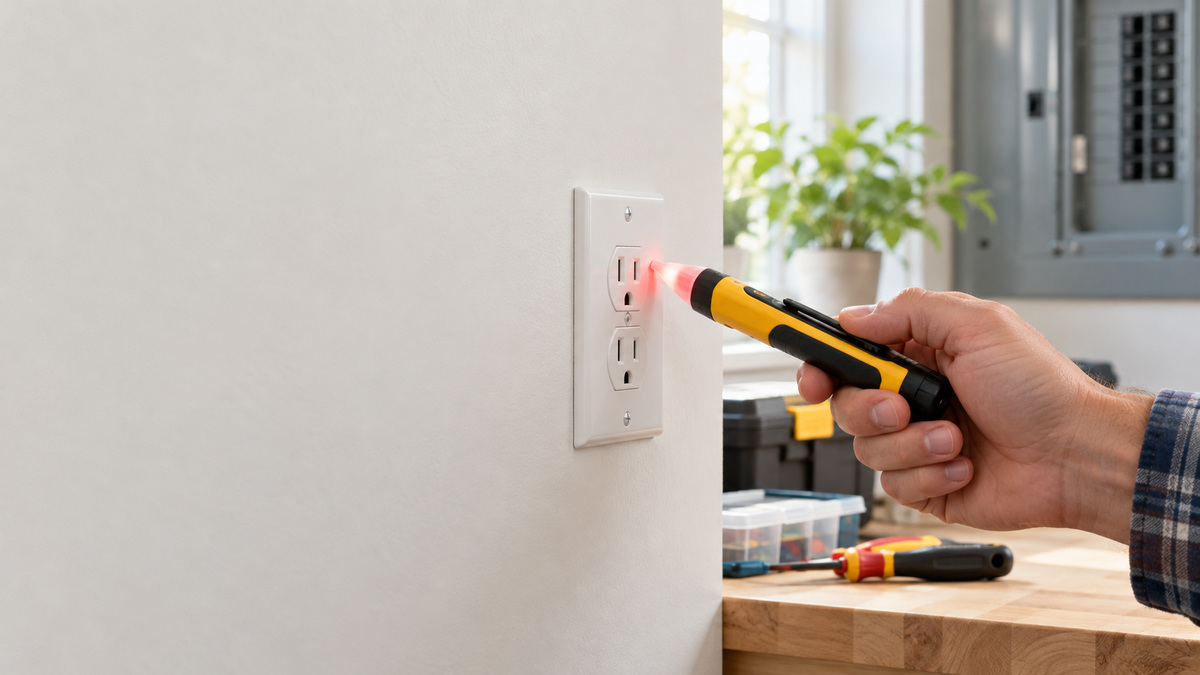
Best Contactless Voltage Tester for Home Electrical Checks
As an Amazon Associate we earn from qualifying purchases. Details
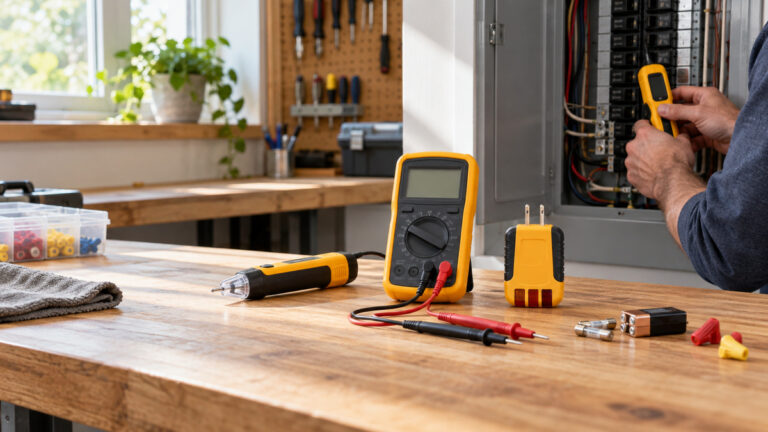
A contactless voltage tester lets you check for AC voltage without touching bare conductors. This guide helps you decide which pen fits outlets, switches, breakers, cords, and lighting checks around the home. You will see how sensing range, sensitivity modes, alarms, power, size, and CAT rating change the choice. Work on mains circuits can kill. Use the meter CAT rating to match the circuit, follow the instrument manual and local rules, and leave panel or service work to a licensed electrician.
Quick answer
If you want a simple high-range pen for home mains checks, start with the Fluke model with 90 V AC to 1000 V AC sensing and CAT IV 1000 V mentions. If you want lower-voltage sensing near 12 V AC, choose a dual-range pen such as the yowexa, Proster, AstroAI, Neoteck, or MXCOIRTP style. A non contact voltage tester does not prove a wire is dead. Test on a known live source first, then test the work location, then retest the known source. For breaker or service equipment, call a licensed electrician.
What matters for a contactless voltage tester
1. Sensing range and low-end pickup
A wider low end finds voltage on doorbells, thermostats, and control wiring. A higher low end reduces stray-voltage alerts. The Fluke listing states Nominally, 90 V AC to 1000 V AC. The Klein listing states 50 to 1000V AC. The Neoteck listing states 12-1000V AC. The yowexa listing states 12~1000V(High Sensitivity); 48~1000V(Low Sensitivity). The AstroAI listing states high sensitivity 12-1000V and low 70-1000V. Match the low end to the circuit you check most.
2. Sensitivity modes
Single-range pens are simpler. Dual or triple sensitivity helps separate live and neutral or find a break. The yowexa pen uses high and low sensitivity. The Proster pen lists High/Medium/Low selection. The MXCOIRTP pen uses three modes with buzzer counts. The AstroAI pen uses dual sensitivity with an S button. Do not switch sensitivity during detection on models that warn against it.
3. Alarm style and display
Look for sound plus light. Flashing color, beep rate, bar graph, or percentage can show signal strength. The Fluke uses tip glow plus beeper. The Klein uses green operational light plus flashing red and beep. The yowexa uses 1-3 signal indicators with faster beeps for stronger signals. The AstroAI adds screen backlight, analog bar, and percentage value. Bright alarms help in panels and attics.
4. CAT rating and intended location
Measurement category describes the circuit location and transient energy. Measurement category II covers circuits directly connected to the low-voltage installation. Measurement category IV covers measurements at the source of the high-voltage installation. The required impulse withstand voltage varies from 500 V to 12,000 V across categories. Check the listing before use. The Fluke flags mention CAT IV 1000 V. The yowexa states CAT III 1000V; CAT IV 600V. The AstroAI states Cat Iv 600v, Cat Iii 1000v. The Neoteck states CE CAT III600V. The Klein states Cat Iv 1000v. If the listing does not state a CAT rating, do not call the meter safe for household mains.
5. Power, light, and carry design
Most pens use 2 AAA batteries. Auto-off saves power. A flashlight helps in dark boxes. A pocket clip helps carry. The Klein lists auto power-off and 6.6-Foot (2 m) drop protection. The Neoteck includes LED flashlight and pocket clip. The yowexa includes LED flashlight, auto shutoff, and pocket clip. The Proster includes LED torch and auto power-off. The MXCOIRTP includes detection light and tail flashlight. The AstroAI turns off after 5 minutes without signal or input.
How to choose a voltage tester for home use
Start with the job. For standard outlets, switches, cords, and breakers, any 50 V to 1000 V or 90 V to 1000 V pen works as a first check — check the listing for the exact range. For low-voltage wiring, choose a pen with low-end AC sensing and adjustable sensitivity. For noisy boxes with many wires, adjustable sensitivity and signal-strength lights help isolate the live conductor.
A common rule of thumb is to verify the tester every time: live-dead-live. That means test a known live outlet, test the circuit you will touch, then test the known live outlet again. This is a common rule of thumb, not a guarantee. Phantom voltage can still cause a non voltage contact tester to beep near dead wires. If results are unclear, stop and use a voltage tester for home use or a voltage meter tester with direct contact, or call an electrician.
Do not use a contactless pen on DC automotive circuits or hybrid and EV high-voltage systems unless the listing states DC detection. Most picks here state AC voltage only. For car work, disconnect and handle batteries safely and read the manual. See also best automotive non contact dc voltage tester and non contact voltage tester vs multimeter.
1. Fluke 1AC II VoltAlert Non-Contact Voltage Tester, Pocket-Sized, 90-1000V AC, Audible Beeper, CAT (Best overall)
Specs from the listing (checked 2026-10-10):
- Brand: Fluke
- Voltage sensing ranges: Nominally, 90 V AC to 1000 V AC
- Item Weight: 59 g
- Batteries: 2 AAA alkaline batteries included; Typical battery life of greater than 1-year
- Detector tip style: Flat-tip
- Light source: One high intensity red LED
Pros
- 90-1000V AC range stated for mains screening
- Tip glows red plus beeper with continuous self-test
- 2 AAA alkaline batteries included with greater than 1-year typical life
Cons
- High 90V low end misses low-voltage AC circuits
Best for: Homeowners wanting a simple high-range AC screening pen
Skip if: You need low-voltage sensing or a built-in flashlight
View on Amazon (affiliate link)
2. Klein Tools NCVT1P Voltage Tester, NCVT Pen, 50 to 1000V AC (Best simple pen)
Specs from the listing (checked 2026-10-10):
- Brand: KLEIN TOOLS
- Item Weight: 22.68 g
- Item Dimensions: 5.5 x 0.72 x 1 inches
- Specification Met: Cat Iv 1000v
- Included Components: Instructions and 2 x AAA 1.5 Volt Batteries
Pros
- 50 to 1000V AC range covers standard outlet checks
- Green run light plus flashing red and beeping alert
- 22.68 g with pocket clip and auto power-off
Cons
- No low-voltage mode or flashlight stated
Best for: Renters wanting clear run versus alarm indication
Skip if: You need low-voltage sensing
View on Amazon (affiliate link)
3. Neoteck Non Contact Voltage Detector 12-1000V AC Voltage Tester (Best low-voltage pickup)
Specs from the listing (checked 2026-10-10):
- Brand: Neoteck
- Style: AC 12-1000V
- Item Weight: 65 g
- Item Dimensions: 6.3 x 0.79 x 0.79 inches
- Included Components: 2×1.5V AAA batteries
Pros
- 12-1000V AC low end for doorbell and control wiring
- Live and null wire distinction by alarm and LED level
- LED flashlight plus pocket clip at 65 g
Cons
- Single range with no adjustable sensitivity to tame false alerts
Best for: DIYers wanting low-end AC sensing with a light
Skip if: You need CAT IV for service-area locations
View on Amazon (affiliate link)
4. Non Contact Voltage Tester Pen, AC 12/48-1000V Electric Tester Pen (Best dual sensitivity)
Specs from the listing (checked 2026-10-10):
- Brand: yowexa
- AC Voltage Range: 12~1000V(High Sensitivity); 48~1000V(Low Sensitivity)
- Safety Level: CAT.III 1000V; CAT.IV 600V
- Frequency: 50Hz/60Hz
- Item Weight: 45 g
Pros
- Dual sensitivity 12V high and 48V low modes stated
- 1-3 signal indicators with faster beeps for stronger fields
- CAT III 1000V and CAT IV 600V with flashlight and auto shutoff
Cons
- Requires selecting sensitivity before detection, not during
Best for: Users tracing live versus neutral in crowded boxes
Skip if: You want one-button use with no mode selection
View on Amazon (affiliate link)
5. Proster Non-Contact Voltage Tester Pen Adjustable 12-1000V/48-1000V (Best adjustable sensitivity)
Specs from the listing (checked 2026-10-10):
- Brand: Proster
- Item Dimensions: 6.38 x 0.91 x 1.1 inches
- Specification Met: CE
- Included Components: 1 x Non-contact Voltage Tester Pen; 2 x 1.5V AAA Batteries; 1 x User Manual
- Model: TOPPST224
Pros
- Three sensitivity levels with 48-1000V default and 12-1000V option
- Audible and visual alarm plus LED torch and low-battery LED
- Auto power-off with ABS and PVC housing and pocket clip
Cons
- Listing does not state a CAT rating for mains locations
Best for: Users wanting finer High Medium Low control
Skip if: You need a stated CAT III or CAT IV rating
View on Amazon (affiliate link)
6. MXCOIRTP Voltage Tester, Non-Contact Voltage Detector, Electrical Tester, 3 Ranges AC (Best compact)
Specs from the listing (checked 2026-10-10):
- Brand: MXCOIRTP
- Model: MT01
- Warranty Description: 1 year warranty
- Included Components: Voltage Tester
- Style: Compact
Pros
- Three sensitivity modes with buzzer-count indication
- Detection light plus tail flashlight for dark areas
- Compact pen-hook design with low-battery shutoff logic
Cons
- Listing does not state weight, size, or CAT rating
Best for: Tool-pouch carry where short size matters
Skip if: You need stated CAT rating, weight, or dimensions
View on Amazon (affiliate link)
7. AstroAI VTS1000H Voltage Tester with Screwdriver, Non-Contact Electrical Tester, Dual Range AC (Best with display)
Specs from the listing (checked 2026-10-10):
- Brand: AstroAI
- Model: VTS1000H
- Item Weight: 85 g
- Item Dimensions: 7.01 x 1.97 x 1.38 inches
- Specification Met: Cat Iv 600v, Cat Iii 1000v
Pros
- Screen with analog bar and percentage plus red backlight
- Dual 12-1000V high and 70-1000V low ranges with S button
- Screwdriver tail, flashlight, storage bag, 5-minute auto-off
Cons
- Heaviest listed weight at 85 g and higher 70V low-mode floor
Best for: Users wanting visual signal strength plus driver function
Skip if: You want the lightest pen or lowest low-range floor
View on Amazon (affiliate link)
Picks: what each pen offers
Fluke 1AC II VoltAlert — simple high-range AC pen
This is a pocket-sized pen for AC mains presence checks. The listing states Voltage sensing ranges Nominally, 90 V AC to 1000 V AC. The flags mention CAT IV 1000 V Operating Temperature and CAT IV Rating. Item Weight is 59 g. Batteries are 2 AAA alkaline batteries included with Typical battery life of greater than 1-year. The tip uses Flat-tip style and One high intensity red LED.
Use it to check cables, breakers, fixtures, and non-contact outlets before you open a box. The tip glows red and a beeper sounds when voltage is detected. Continuous self-test runs in the background. Audible/Silent mode helps in quiet homes. The high 90 V low end means fewer low-voltage alerts, but it will miss low-voltage control circuits — check the listing for limits. The listing dimensions are 10.24 x 7.5 x 1.46 inches, which reads as package size, so check the listing for pen length. Who should skip it: anyone who needs low-voltage sensing or a flashlight should choose a dual-range pen.
Klein Tools NCVT1P — 50 V pen with run and alert lights
This pen suits renters and homeowners who want clear run versus alarm colors. The listing states 50 to 1000V AC power detection range. Item Weight is 22.68 g. Item Dimensions are 5.5 x 0.72 x 1 inches. Specification is Cat Iv 1000v. Included Components are Instructions and 2 x AAA 1.5 Volt Batteries.
The LED shows green when operational and flashes red with beeping when voltage is detected. It detects AC voltage in cables, cords, circuit breakers, lighting fixtures, switches, non-tamper-resistant outlets, and wires. Auto power-off conserves batteries. The clip fits a shirt pocket. Drop protection is listed as 6.6-Foot (2 m). The single 50 V low end is simpler than adjustable pens but less flexible for break finding. Who should skip it: buyers who need low-voltage sensing or a built-in flashlight should skip it.
Neoteck PM8908C — 12 V pen with flashlight
This pen fits DIY users who want low-end sensing plus light in boxes. The listing states 12-1000V AC range. Item Weight is 65 g. Item Dimensions are 6.3 x 0.79 x 0.79 inches. Specification is CE. Included Components are 2×1.5V AAA batteries. Bullets list CE CAT III600V RoHS Certificate.
It distinguishes live and null wires through alarm sound and LED level. The LED shines when voltage is detected. It also acts as an emergency flashlight for outlets, switches, and circuit breakers. Use it on circuit breakers, lighting fixtures, switches, outlets, and wires where stated. The note says Not Suitable for Christmas Light Testing. The single-range design is simpler but cannot step down sensitivity for crowded boxes. The listing does not state auto-off time, so check the listing. Who should skip it: anyone working near service equipment who needs CAT IV should skip it.
yowexa YW-322 — dual-sensitivity pen with signal lights
This pen fits users who want high and low sensitivity in one tool. The listing states 12~1000V(High Sensitivity); 48~1000V(Low Sensitivity). Frequency is 50Hz/60Hz. Safety Level is CAT.III 1000V; CAT.IV 600V. Item Weight is 45 g. Item Dimensions are 5.95 x 1 x 1.1 inches. Power Supply is 2 x 1.5V AAA batteries(Included).
Select sensitivity before detection and avoid switching during detection. For live versus neutral ID, compare signal strength near two wires or socket holes; stronger signal suggests live in that comparison. Alarm uses sound and light alarm with 1-3 signal indicators by strength. Faster beeps and more lights mean stronger or closer AC source. Extras include breakpoint find, flashlight, low-battery alert, auto shutoff, and pocket clip. For AC voltage checks only; test on a known live source before use. Who should skip it: anyone who wants one-button use without selecting sensitivity should skip it.
Proster PST224 — three-level sensitivity pen
This pen fits users who work in crowded boxes and want finer control. The listing states default range 48-1000V and 12-1000V by adjusting sensitivity. Item Dimensions are 6.38 x 0.91 x 1.1 inches. Specification is CE. Included Components are 1 x Non-contact Voltage Tester Pen; 2 x 1.5V AAA Batteries; 1 x User Manual.
It offers High/Medium/Low sensitivity with audible visual alarm and LED torch. Short press the S button to adjust sensitivity; long press to turn flashlight on or off. Live and neutral can be distinguished at close range. Auto power-off conserves energy. Low-voltage LED warns when battery replacement is due. Housing uses ABS and PVC material with pocket clip. The listing does not state a CAT rating, so do not call it safe for household mains. Who should skip it: buyers who need a stated CAT III or CAT IV rating should skip it.
MXCOIRTP MT01 — three-mode pen with tail light
This compact pen fits tool pouches where length matters. Bullets state 3 Sensitivity Modes with buzzer counts: low is buzzer 1 time, medium is buzzer 2 times, high is buzzer 3 times. Bullets list AC 12V/48V/70V-1000V in the title. Warranty is 1 year warranty. Included Components are Voltage Tester. Brand is MXCOIRTP and Model is MT01.
The NCV sensing probe checks wires, outlets, or switches without contact. Detection light and tail flashlight help in dark areas; the tail flashlight can only be turned on when the tester is off. Pocket-sized pen hook aids carry. When battery voltage is lower than 2.5V, the power indicator flashes 3 times and the buzzer buzzes then shuts off. The listing does not state dimensions, weight, or a CAT rating, so check the listing before mains use. Who should skip it: anyone who needs stated CAT rating, weight, or size on the listing should skip it.
AstroAI VTS1000H — screen pen with screwdriver tail
This tool fits users who want a display plus a driver for cover screws. The listing states high sensitivity 12-1000V and low sensitivity 70-1000V. Specification is Cat Iv 600v, Cat Iii 1000v. Item Weight is 85 g. Item Dimensions are 7.01 x 1.97 x 1.38 inches. Included Components are voltage tester, AAA batteries, user manual, storage Bag.
When voltage is detected, the tip emits red light, screen backlight turns red, and alarm sounds. The screen analog bar, percentage value, and buzzer volume rise with stronger signal or closer distance. Adjust sensitivity with the S button. The tail has a high-strength steel screwdriver. Backlit screen and flashlight help in dark areas. Auto-off occurs after 5 minutes without signal or input. It can differentiate live and neutral wires in cables and at outlets, switches, and junctions. The 70 V low-sensitivity floor is higher than some dual-range pens. Who should skip it: users who want the lightest pen or lowest low-range floor should skip it.
Comparison table built only from listing data
| Pen | Sensing range stated | CAT / spec stated | Weight | Size stated | Power / extras |
|---|---|---|---|---|---|
| Fluke 1AC II | Nominally, 90 V AC to 1000 V AC | CAT IV mentions; CAT IV Rating | 59 g | 10.24 x 7.5 x 1.46 inches | 2 AAA alkaline batteries included; red LED; beeper; self-test |
| Klein NCVT1P | 50 to 1000V AC | Cat Iv 1000v | 22.68 g | 5.5 x 0.72 x 1 inches | 2 x AAA 1.5 Volt Batteries; green/red LED; auto power-off; 6.6-Foot (2 m) drop |
| Neoteck PM8908C | 12-1000V AC | CE; CE CAT III600V in bullets | 65 g | 6.3 x 0.79 x 0.79 inches | 2×1.5V AAA batteries; LED flashlight; pocket clip |
| yowexa YW-322 | 12~1000V High; 48~1000V Low | CAT.III 1000V; CAT.IV 600V; CE | 45 g | 5.95 x 1 x 1.1 inches | 2 x 1.5V AAA batteries(Included); 50Hz/60Hz; flashlight; auto shutoff |
| Proster PST224 | 48-1000V default; 12-1000V adjustable | CE; no CAT stated | Listing does not state weight | 6.38 x 0.91 x 1.1 inches | 2 x 1.5V AAA Batteries; LED torch; auto power-off |
| MXCOIRTP MT01 | AC 12V/48V/70V-1000V title | No CAT stated | Listing does not state weight | Listing does not state size | Battery alert at lower than 2.5V; detection light; tail flashlight |
| AstroAI VTS1000H | High 12-1000V; Low 70-1000V | Cat Iv 600v, Cat Iii 1000v | 85 g | 7.01 x 1.97 x 1.38 inches | AAA batteries; screen with bar and percentage; flashlight; 5-minute auto-off |
How to use a non contact voltage tester safely
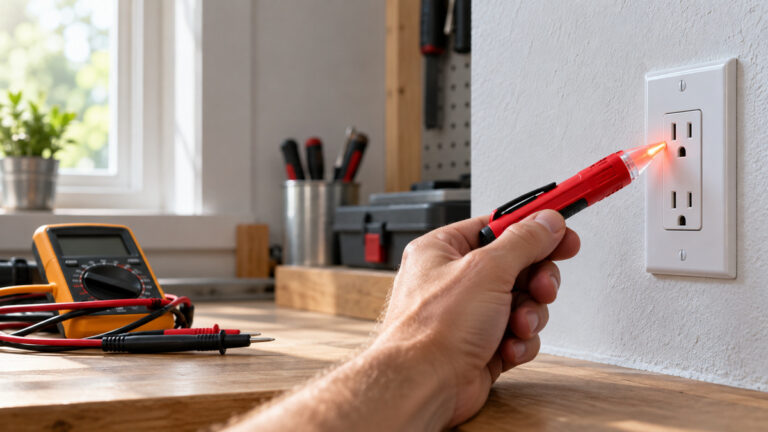
Use a contactless pen only as a first screen, not as proof of dead. Start with fresh batteries and read the manual. For a voltage tester workflow, test the pen on a known live outlet. Then hold the tip near the wire, cord, outlet slot, switch terminal area, or breaker wire without touching copper. Note light and sound. Then retest the known live outlet. If the pen stayed dark, still confirm with a direct-contact tester before touching anything.
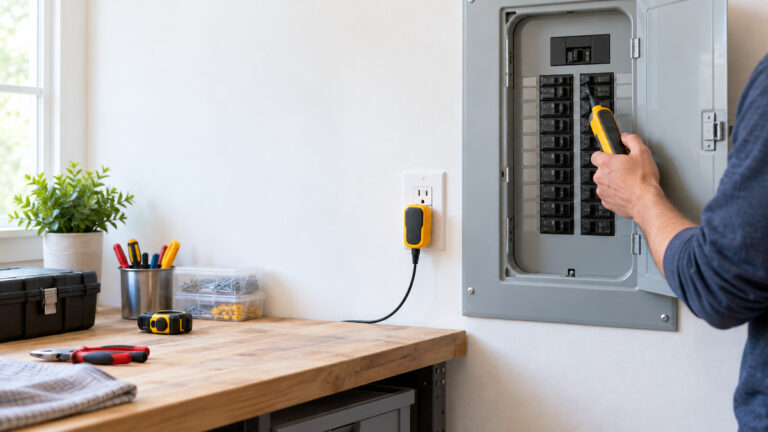
Keep fingers behind the tip. Do not touch probes to live parts with this tool. Do not open panels. Panel or service work belongs to a licensed electrician. False positives happen near bundled wires, dimmers, or electronic ballasts. A beep alone does not tell you which conductor is live. Move the tip slowly, change sensitivity if the model allows, and compare wires one at a time. Learn proper technique from how to use a non contact voltage tester on wires and the concepts in non contact voltage tester vs multimeter. If you see damage, heat marks, buzzing, or melted insulation, stop and call a professional.
A fluke contactless voltage tester is often chosen for simple mains screening because the operation is tip-glow plus beep with self-test. That simple style is good when you want fewer buttons. It is not good when you need low-voltage pickup or a light.
Planning example: matching range to the job
This example is our planning estimate for choosing sensitivity, not a measurement claim. Suppose you plan three checks in one weekend.
Define the assumed circuits once: (1) standard outlet at 120 V AC, (2) lighting switch leg at 120 V AC in a two-wire box, (3) doorbell transformer secondary at 16 V AC. These numbers are assumed for planning only.
Step 1: list pen low ends from listings. Fluke 90 V, Klein 50 V, Neoteck 12 V, yowexa high 12 V and low 48 V, Proster low setting 12 V, MXCOIRTP high 12 V, AstroAI high 12 V.
Step 2: compare each assumed circuit to each low end. Outlet 120 V minus 90 V equals 30 V margin for Fluke. Calculation: 120 − 90 = 30. Outlet 120 V minus 50 V equals 70 V margin for Klein. Calculation: 120 − 50 = 70. Doorbell 16 V minus 12 V equals 4 V margin for 12 V pens. Calculation: 16 − 12 = 4.
Step 3: check coverage. Re-verify: 120 is greater than 90, 50, 48, 12, and 70, so all pens cover the outlet on paper. Re-verify: 16 is greater than 12 but less than 48, 50, 70, and 90, so only 12 V high-sensitivity modes cover the doorbell assumption.
Step 4: decide. For outlet plus switch leg only, a 50 V or 90 V pen gives simpler use with fewer stray alerts. For outlet plus 16 V doorbell wire, select a pen with 12 V high-sensitivity mode and use low sensitivity for mains. Final check: 4 V margin is small, so hold the tip close, test a known live source first, and confirm with a contact meter.
Three buying scenarios
Renter checking lamps, cords, and outlets
Choose the Klein NCVT1P or Fluke 1AC II style. You get simple alarms and pocket carry. You avoid extra buttons. Pair it with a voltage tester pen guide if you later want direct-contact confirmation. Do not remove outlet covers or open the breaker box.
Homeowner tracing a dead outlet or switch
Choose yowexa YW-322, Proster PST224, or AstroAI VTS1000H. Adjustable sensitivity helps separate bundled conductors. Signal lights, bar, or percentage show stronger versus weaker fields. Test live-dead-live each time. If the breaker panel must be opened, stop and hire an electrician.
DIYer who also checks low-voltage wiring
Choose Neoteck, yowexa high mode, Proster high mode, or AstroAI high mode with 12 V AC low end. Remember these pens state AC voltage only. They are not listed for 12 V DC car circuits. For DC needs see best 12 volt dc non contact tester and best non contact 12v dc tester. When in doubt, check the product listing and manual.
Five common mistakes
1. Trusting silence as proof of dead
No alarm alone does not confirm absence of voltage. Dead batteries, wrong sensitivity, thick insulation, or distance can hide voltage. Always do live-dead-live and confirm with a contact tester.
2. Using the wrong sensitivity
High sensitivity near many wires causes extra beeps. Low sensitivity can miss low voltage. Select range before detection where the manual requires it. Compare live and neutral at close range one wire at a time.
3. Ignoring the CAT rating
A pen without a stated CAT rating is not proven for mains locations. The listing does not state a CAT rating for Proster and MXCOIRTP. Do not use them on panels or service gear. Match CAT to the circuit and follow local rules.
4. Testing in the wrong place
Holding the tip too far from the conductor weakens the field. Testing through metal cover plates blocks sensing. Place the tip near the terminal block, socket hole, or bare insulated wire entry as the manual directs.
5. Using an AC pen for DC or hybrid systems
These picks state AC detection. Do not use them to clear car DC wiring, airbag circuits, or hybrid and EV high voltage. Disconnect and handle batteries safely and ask a professional for those systems. For related options see best multimeter with non contact voltage detection.
FAQ
Does a contactless voltage tester prove a circuit is dead?
No. It screens for AC fields without contact. A dark tip can still mean weak batteries, wrong sensitivity, shielding, or distance. Test on a known live source before and after, then confirm dead with a direct-contact tester. If unsure, call an electrician.
What is the difference between a non contact voltage tester and a multimeter?
A non contact pen senses an AC field near insulation and beeps or lights. It does not show exact volts. A multimeter with leads measures volts, continuity, and current with contact. Many users own both. This comparison explains use cases: non contact voltage tester vs multimeter.
Which sensing range do I need for home outlets?
Standard outlets are covered on paper by pens with 50 V or 90 V low ends — check the listing for the exact range. A low-voltage AC mode is only needed for doorbell, thermostat, or control wiring. Choose single range for simplicity or dual range if you also trace breaks or separate live and neutral.
Why does my tester beep on both wires?
Stray coupling between close wires can trigger alarms on dead conductors. This is often called a false positive. Slow down, increase distance, switch to lower sensitivity if allowed, and compare one wire at a time. See best non contact voltage tester false positive.
Can the best voltage tester find a wire break?
Some dual-sensitivity pens list breakpoint find as a function, such as yowexa and AstroAI. You trace along the cord until the alarm stops. Results vary with insulation, depth, and interference. Check the product listing for that function and follow the manual.
Do I need true RMS or counts for a voltage tester pen?
No. True RMS and counts apply to multimeters that display exact voltage. A pen only indicates presence with light and sound. If you need numbers, use a multimeter or a contact voltage meter tester.
Are pen testers safe for breaker panels?
Only a licensed electrician should work inside panels or on service equipment. Even with a CAT III or CAT IV pen, keep covers on and use the pen only as directed from outside. If the listing does not state a CAT rating, do not use that pen for mains at all.
What should I check on the listing before buying?
Check AC range, sensitivity modes, alarm type, battery type and auto-off, weight and size, flashlight, CAT rating, and included components. Confirm whether batteries are included. Follow the maker manual for limits and calibration.
Bottom line
Choose simple if you check standard outlets and cords: pick a 50 V to 1000 V or 90 V to 1000 V pen with clear light plus beep and stated CAT rating. Choose adjustable if you trace wires or check 12 V AC control circuits: pick a 12 V high-sensitivity pen with low-sensitivity mode, signal-strength lights or screen, and stated CAT III or CAT IV where needed. Decision rule: buy the lowest low-end you truly need, with the highest CAT rating stated for your location — and if the listing does not state a CAT rating, do not use it on household mains.
Sources
- Measurement category: supports CAT II, CAT IV definitions and impulse withstand range