Fluke 1550C Insulation Tester: Uses, Safety and Stated Specs
As an Amazon Associate we earn from qualifying purchases.
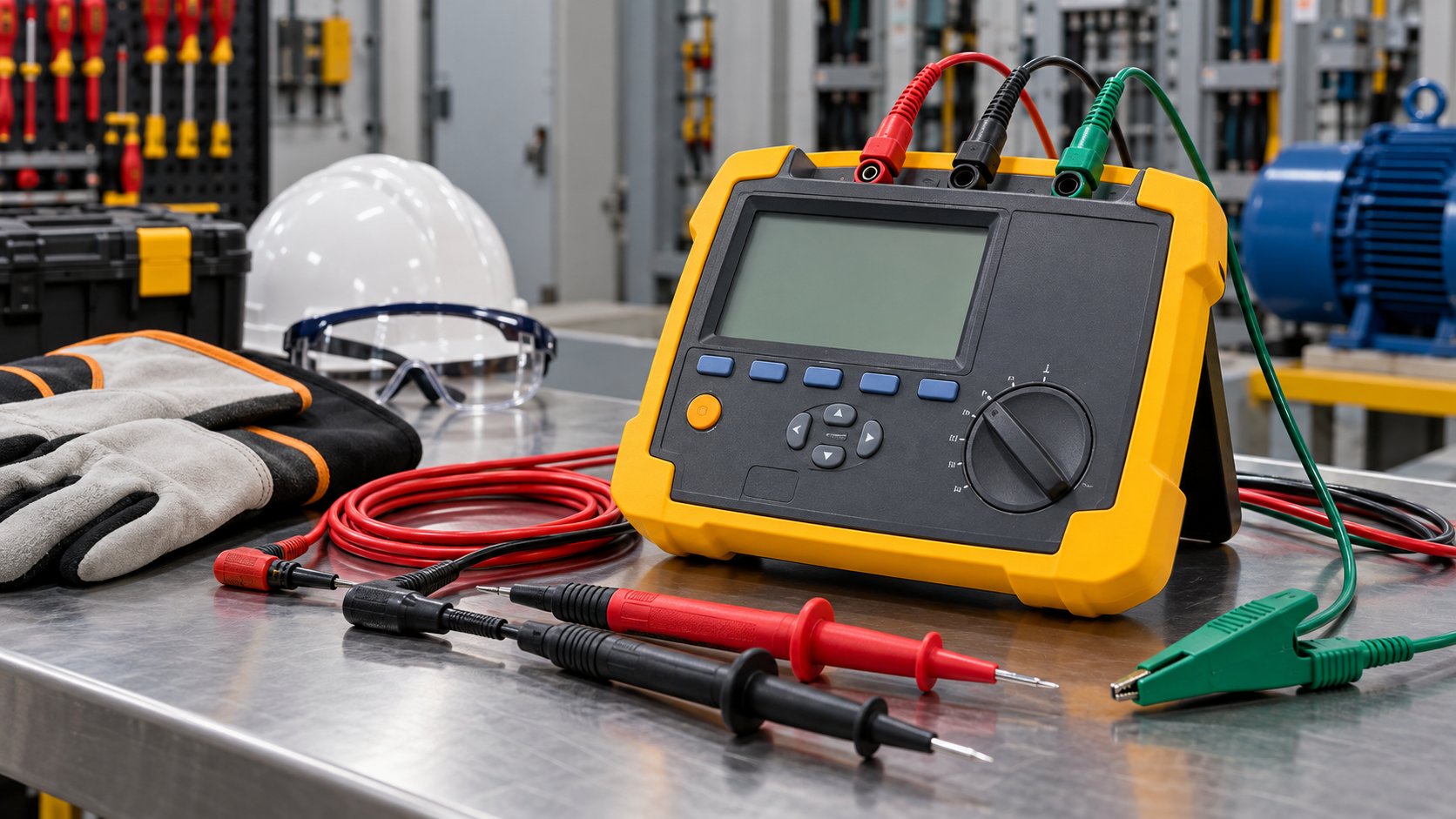
The Fluke 1550C is a high-voltage insulation tester, sometimes called a megohmmeter. It applies a DC test voltage to a circuit or piece of equipment and measures the resistance of the insulation between conductors. Its test voltages go up to 5000 V on this model. Fluke’s users manual says that work on a circuit must start with all power removed and the circuit capacitance discharged, so read the safety section below before you connect anything.
Quick answer
- What it does: applies a DC test voltage and measures insulation resistance, with polarization index and dielectric absorption ratio tests.
- Test voltages: preset 250 V, 500 V, 1000 V, 2500 V and 5000 V on the 1550C. The 10 000 V preset is listed for the 1555 only.
- Safety: remove all power and discharge circuit capacitance before testing. The manual does not state a CAT rating in the text we opened.
- Not for: live circuits, and any job where the 5000 V maximum is not enough.
What the 1550C measures
Insulation testing answers a simple question: how well does the material between two conductors block current? A higher insulation resistance means less leakage current at the test voltage. The 1550C reports insulation resistance on a digital display and a bar graph, and it stores results with a user-defined ID tag.
The manual lists these functions: insulation resistance measurement, polarization index (PI), dielectric absorption ratio (DAR or DAR [CN]), a ramp test that raises the voltage at 100 V per second, a timed test from 0 to 99 minutes, and breakdown voltage indication. Polarization index and dielectric absorption ratio are both measured over the course of a test, and the manual lists them as tests you can run alone or in combination.
Resistance is measured from 200 kΩ up to 2 TΩ. The manual says the tester is not specified below 200 kΩ, and that a shorted pair of leads produces an unspecified reading above zero. That is normal for this input circuit and does not change readings inside the specified range.
Test voltages and the 1550C’s limit
The manual lists preset test voltages of 250 V, 500 V, 1000 V, 2500 V, 5000 V, and 10 000 V on the 1555 only. The programmable range runs from 250 V to 10 000 V in 50 V and 100 V steps, but the manual is explicit that the 1550C’s maximum is 5000 V. A programmed value above 5000 V is not available on the 1550C.
The actual test voltage can be up to 10 % higher than the value you select, according to the manual. That matters when you work near the top of a motor or cable rating, because the applied voltage may exceed the nominal value you set. Choose the test voltage that the equipment manufacturer or your test procedure requires, and confirm it on the display before you start.
Safety before you connect
High-voltage testing can kill. The manual’s warning is direct: to prevent electric shock, fire or personal injury, remove all power from the circuit under test and discharge the circuit capacitance before you test it. Work on energized equipment, switchgear and service equipment belongs to trained, qualified personnel who follow their site’s procedures.
- Remove power and lock out the equipment. Follow the site’s lockout procedure, not just the switch on the wall.
- Discharge the circuit capacitance. The manual requires this before any test on a circuit.
- Connect the common test lead before the live test lead. Remove the live test lead before the common test lead when you finish.
- Confirm there is no hazardous voltage. The manual asks you to check, before and after the test, that the tester does not show a hazardous voltage. If the tester beeps continuously and a hazardous voltage is shown, remove power and disconnect the test leads.
- Know what ends a test. The manual lists the conditions that terminate an insulation test, including a depleted battery, so watch the display and the battery indicator during a test.
- Discharge after the test. Follow your site procedure and the manual’s guidance for discharging the circuit once the test is complete.
The manual’s live-circuit warning covers voltages from 30 V to 1100 V AC or DC, with a stated accuracy of ±15 % plus ±2 V. Do not rely on that warning alone. It is a check, not a substitute for proving the circuit is dead.
Power, battery and charging
The 1550C uses a 12 V lead-acid rechargeable battery rated 2.6 Ah. The manual says a full charge can take up to 12 hours, and that charging at very high or very low temperatures should be avoided. It also advises charging the battery if the tester is not used for a long period. The manual gives a typical number of tests per charge: 4100 at 250 V, 3600 at 500 V, 3200 at 1 kV, 2500 at 2.5 kV, 1000 at 5 kV and 500 at 10 kV. These figures come from the manual’s battery section and depend on the test conditions.
The tester shuts off after 30 minutes of inactivity, according to the manual. It has an infrared port for downloading test data, and the manual lists PC software as supplied.
Specifications Fluke states
The table below uses only figures that appear in the documents listed at the end of this article. Where a figure is not in those documents, the cell says so.
| Item | Fluke states for the 1550C |
|---|---|
| Preset test voltages | 250 V, 500 V, 1000 V, 2500 V, 5000 V |
| Programmable range | 250 V to 10 000 V in 50 V and 100 V steps, but the 1550C maximum is 5000 V |
| Resistance measurement | 200 kΩ to 2 TΩ |
| Accuracy basis | 1 year after calibration, 0 °C to 35 °C |
| Accuracy outside that range | Add 0.25 % per °C, per the manual |
| Timer | 0 to 99 minutes |
| Power | 12 V lead-acid rechargeable battery, 2.6 Ah |
| Dimensions | 170 mm x 242 mm x 330 mm (6.7 in x 9.5 in x 13.0 in) |
| Weight | 3.6 kg (7.94 lb) |
| Security | Kensington lock |
| Safety rating (CAT) | Not stated in the users manual. The manual refers to a printed Safety Information document. A technical data copy states CAT IV 600 V and CAT III 1000 V; see the note below. |
A note on conflicting figures. The technical data copy we opened, hosted by Instrumart, describes both the 1555 and the 1550C as testing up to 10 kV. The users manual says the 1550C maximum is 5000 V. Where the two disagree, this article follows the users manual, because that is the document for the product itself. The technical data copy does not carry a revision date in the text we read, so we cite it only to show the disagreement.
Checks before you buy
- Confirm the highest test voltage you need. The 1550C stops at 5000 V. If your equipment needs 10 kV, the manual points to the 1555.
- Confirm the safety rating for your work. The users manual does not give a CAT rating in the text we opened. Read the printed Safety Information document that ships with the tester before you buy, and match its rating to the circuit you will test.
- Plan the battery. A full charge takes up to 12 hours, and the test count depends on the voltage you choose.
- Check the leads and accessories. The manual lists replacement test leads and clamps. Use leads that suit the voltage and the connection points on your equipment.
- Consider the weight. At 3.6 kg, it is a bench or cart instrument rather than a pocket tool.
Mistakes to avoid
- Testing a circuit with power still on. The manual’s first warning is to remove all power.
- Skipping the discharge. The manual requires discharge before testing, and the step should not be left out.
- Reading a value below 200 kΩ as precise. The manual says the tester is not specified below that point.
- Setting a voltage above what the equipment can take. Confirm the required test voltage from the equipment manufacturer or your procedure.
How we chose
This guide covers one model, the Fluke 1550C, because the keyword names it directly. We opened three Fluke documents and read them as text. The first is the Fluke 1550C/1555 Users Manual, Rev. 2, 4/24, in a copy hosted by Chevrier Instruments. The second is the Fluke 1550C/1555 Quick Reference Guide, part number 3592822, Rev. 2, 8/19, in a copy hosted by RS Online. The third is the Fluke 1555 and 1550C technical data sheet, in a copy hosted by Instrumart. The first two are full Fluke documents with part numbers and revision dates. The third is cited only where it disagrees with the manual. We did not use retailer listings for any figure.
What we could not verify
- The users manual we opened does not state a CAT rating for the 1550C. The printed Safety Information document, which we did not have, carries the safety specifications.
- The technical data copy’s CAT III 1000 V and CAT IV 600 V statements could not be matched to a revision date in the text we read.
- The sources do not give a fixed test-voltage accuracy for each preset in one table. The manual gives an accuracy table that depends on the insulation resistance band.
- The sources do not give the battery life in years or the number of charge cycles.
Frequently asked questions
What is the highest test voltage on the Fluke 1550C?
The manual sets the 1550C maximum at 5000 V. The 10 000 V preset applies to the 1555.
Can the 1550C be used on a live circuit?
No. The manual requires all power to be removed and the circuit capacitance discharged before testing.
What does polarization index tell me?
The manual describes PI as a ratio taken over time that shows how the insulation changes during a test. It is most useful when it is run for a set time.
What resistance range does the tester measure?
The manual states 200 kΩ to 2 TΩ. Readings below 200 kΩ are not specified.
How long does the battery take to charge?
The manual says up to 12 hours for a full charge.
Does the 1550C store results?
Yes. The manual describes storage for test results with a user-defined ID tag, and an infrared port for downloading the data.
Bottom line
The Fluke 1550C is a battery-powered insulation tester with preset test voltages up to 5000 V and a resistance range from 200 kΩ to 2 TΩ. Its safety depends on removing power, discharging the circuit and following the lockout and test steps in the manual. Confirm the rating for your work in the printed Safety Information document before you buy, and leave any work on energized equipment to trained personnel.
Related guides
- Best Multimeters for Electricians compares meters for trade work and the ratings to check.
- Best Clamp Meter for HVAC covers current measurement on energized equipment.
- Best Non Contact Voltage Tester covers a quick check before you touch a wire.
Sources
- Fluke Corporation, “1550C/1555 Insulation Tester Users Manual”, April 2010, Rev. 2, 4/24. Copy hosted by Chevrier Instruments: https://chevrierinstruments.com/wp-content/uploads/2025/02/UM-Fluke-1550c_1555.pdf, opened 27 October 2026. Third-party copy of a Fluke document.
- Fluke Corporation, “1550C/1555 Insulation Tester Quick Reference Guide”, PN 3592822, Rev. 2, 8/19. Copy hosted by RS Online: https://docs.rs-online.com/7c24/A700000015028561.pdf, opened 27 October 2026. Third-party copy of a Fluke document.
- Fluke Corporation, “Fluke 1555 and 1550C Insulation Resistance Testers, Technical Data”, undated copy. Hosted by Instrumart: https://core.instrumart.com/assets/Fluke-1555-1550CDatasheet.pdf, opened 27 October 2026. Third-party copy of a Fluke document; cited only for the figures that disagree with the manual.