Rohde & Schwarz Oscilloscopes: Ratings, Uses and Checks
Rohde & Schwarz Oscilloscopes: Ratings, Uses and Checks
As an Amazon Associate we earn from qualifying purchases.
If you typed oscilloscope rohde schwarz, you are looking at the oscilloscope line made by Rohde & Schwarz, often shortened to R&S. An oscilloscope draws a voltage signal against time, so you can see waveforms, timing, and noise that a multimeter reading cannot show. This article covers what the manufacturer publishes for the RTB2000 and RTB 2 series, the input and safety figures it states, how to approach the instrument with care, and what to check before buying.
Quick answer
- A Rohde & Schwarz oscilloscope shows how a signal changes over time. The RTB2000 is listed with two or four channels, and its bandwidth depends on the option ordered.
- The RTB2000 data sheet states a 1 MΩ input impedance and a maximum input of 300 V (RMS), with derating above 250 kHz.
- The data sheet names IEC 61010-1 and related safety standards, but the text we opened does not state a measurement category (CAT) rating.
- Before you buy, confirm the channel count, bandwidth option, and probes, and check the data sheet for the exact model you plan to use.
What an oscilloscope does
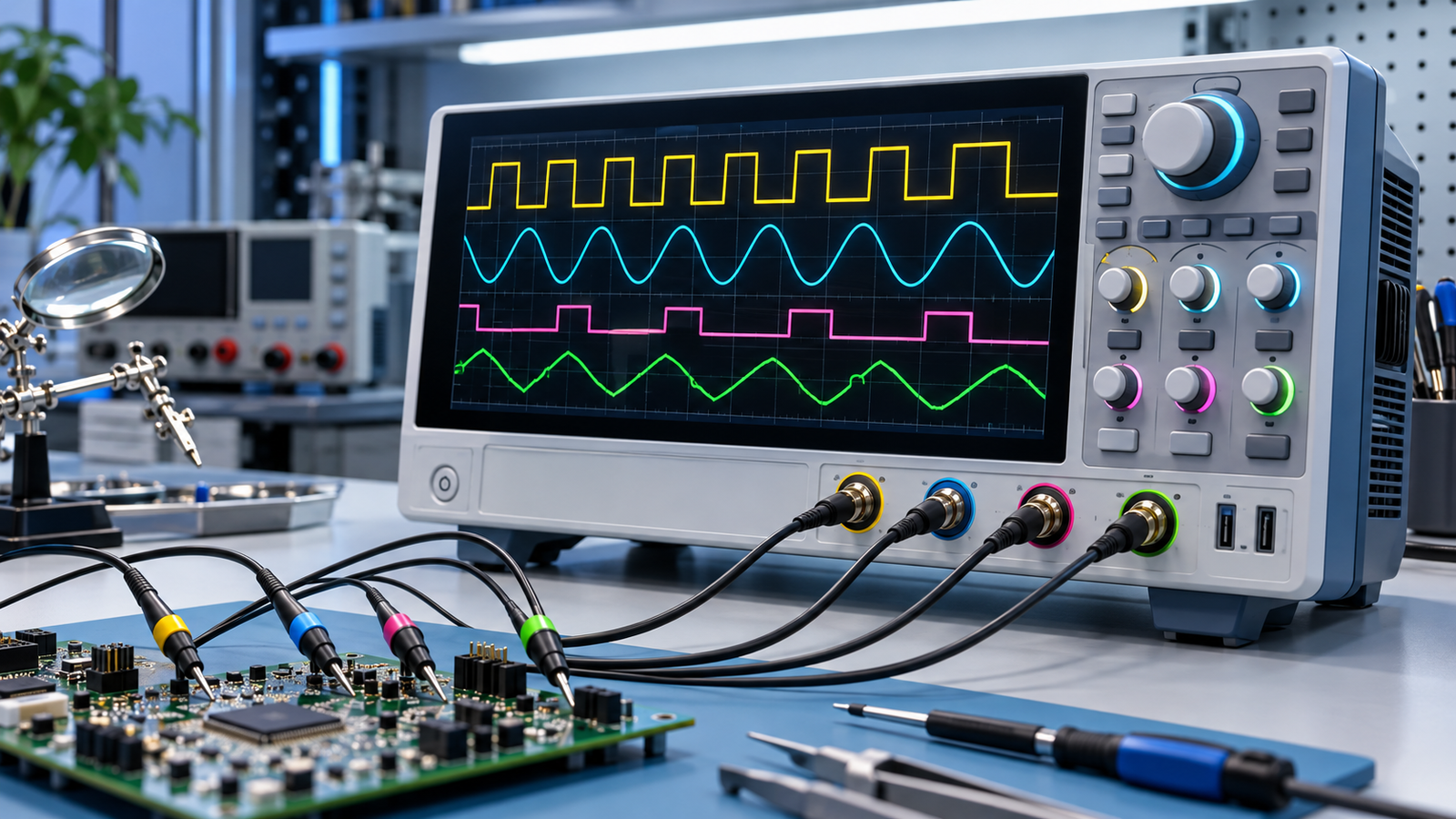
A multimeter gives you one number at a time. An oscilloscope draws the signal on a screen, so you can see its shape, frequency, and timing, and catch brief events. The R&S RTB2000 brochure page describes the instrument as a digital oscilloscope, and the data sheet describes its acquisition, trigger, and channel systems in detail. For many people the first questions are how many channels it has, how fast it samples, and how much bandwidth it offers.
Oscilloscopes are used across electronics design, repair, education, and production testing. The RTB2000 brochure page and the RTB 2 fact sheet both list education as a use. Whether a given scope fits your work depends on the signal you need to see, and that depends on the specifications below.
Models the sources cover
The R&S RTB2000 data sheet, version 17.00 dated July 2023, lists two base units: the R&S RTB2002 with 2 channels and the R&S RTB2004 with 4 channels. Analog bandwidth depends on the option fitted. The brochure page describes the RTB2000 family as covering 70 MHz to 300 MHz.
The R&S RTB 2 series fact sheet is a separate, newer line. It lists key bandwidths of 70, 100, 200 and 300 MHz, two or four analog channels, and up to 16 digital channels with an MSO probe. It also lists a sample rate of 2.5 Gsample/s interleaved and 1.25 Gsample/s with all channels in use, and a memory depth of 10 Msample on each channel. Because this is a different series, do not assume its figures apply to the RTB2000.
Input ratings from the RTB2000 data sheet
Input ratings are where most safety mistakes start, so read them before you connect anything. The table below uses the data sheet’s wording.
| Item | Figure stated in the RTB2000 data sheet |
|---|---|
| Base units | R&S RTB2002, 2 channels; R&S RTB2004, 4 channels |
| Input impedance | 1 MΩ ±2% with 9 pF ±2 pF (measured) |
| Input sensitivity range | 1 mV/div to 5 V/div |
| Maximum input voltage | 300 V (RMS), max. 400 V (Vp) |
| Derating | Derates at 20 dB/decade to 5 V (RMS) above 250 kHz |
| Power supply | 100 V to 240 V at 50 Hz to 400 Hz, max. 60 W |
| Standards named | IEC 61010-1, EN 61010-1, CAN/CSA-C22.2 No. 61010-1-04, UL 61010-1 |
The derating line matters for fast signals. Above 250 kHz, the data sheet reduces the allowed input voltage, so a 300 V (RMS) figure does not apply across the whole frequency range.
The sensitivity range runs from 1 mV/div to 5 V/div, so the setting you choose decides how large the trace appears on the screen and how much of the input range it uses. The data sheet lists DC, AC, and GND input coupling. DC coupling passes the whole signal, AC coupling blocks the DC component, and GND connects the input to the reference so you can set the zero line. Choosing the wrong coupling can hide a signal or make it look larger than it is, so check the coupling setting before you read a waveform.
What the sources do not say about CAT ratings
The data sheet names the safety standards that the instrument is built to, and it lists the input voltage limit above. The text we opened does not state a measurement category, such as CAT II, CAT III, or CAT IV, for the RTB2000 or the RTB 2 series. A maximum input voltage is not the same as a measurement category rating, and this article does not treat it as one.
This matters for mains work. Because the sources do not give a CAT rating, do not use a scope on household or building mains on the basis of this article. Check the safety section of the user manual and the labels for your exact model, and get advice from a licensed electrician or the manufacturer before you measure any mains circuit.
How to approach the instrument safely
Use the manufacturer’s documents as the controlling rules for your model. The steps below are general practice and are not quoted from the sources:
- Read the data sheet and the getting started manual for your exact model before connecting anything.
- Confirm the maximum input voltage, and the derating above 250 kHz, before you connect a signal.
- Use probes and leads rated for the voltage you will measure. The base unit includes a 300 MHz passive probe per channel, according to the data sheet, but that probe is not a mains-rated accessory.
- Do not connect the scope to a signal above its stated input limits, and do not rely on the scope’s display alone for a safety decision.
- Stop and seek advice if you are unsure whether a point is safe to probe.
What to check before buying
- Channel count. The RTB2002 has 2 channels and the RTB2004 has 4 channels.
- Bandwidth option. The data sheet lists bandwidth by option, so confirm the option for the signals you need to see.
- Digital channels. The RTB 2 series lists up to 16 digital channels with an MSO probe. Check whether the model you are considering offers them.
- Input limits. Check the maximum input voltage, the derating, and the input impedance against your signals and probes.
- Display sharing. The brochure page says the RTB2000 has an RJ-45 Ethernet jack and a built-in web server as standard, which lets you show the screen on a computer over a network.
- Power supply. The data sheet lists 100 V to 240 V at 50 Hz to 400 Hz, with a maximum of 60 W.
Mistakes to avoid
- Reading the 300 V (RMS) figure as a rating for every frequency. The data sheet derates the input above 250 kHz.
- Assuming the RTB 2 series figures apply to the RTB2000. The fact sheet covers a different series.
- Treating the scope’s input rating as a mains safety rating. The sources do not give a CAT rating for these models.
- Ignoring the bandwidth option. The data sheet lists bandwidth by option, not one figure for every unit.
- Using a multimeter-style habit on a scope input. Check the input impedance of 1 MΩ with 9 pF before you connect a high-impedance source.
How we chose
This is a model explainer, not a ranking. It covers the Rohde & Schwarz oscilloscope line as shown by the RTB2000 and RTB 2 series, and it relies only on the three documents listed under Sources, all opened on 2026-10-27. The sections were chosen from what those documents state: channels, bandwidth, input limits, standards, and power. The article does not rank the RTB2000 against other scopes and does not include prices, customer feedback, or retailer listings.
What we could not verify
- The sources do not state a measurement category (CAT) rating for the RTB2000 or the RTB 2 series.
- The text we opened does not give the bandwidth for each option in a clear table, so this article does not list one figure per option.
- The sources do not show a price, a lead time, or a warranty term, and this article does not state them.
- The sources do not say which Rohde & Schwarz scope suits a particular task, such as automotive ignition work or power electronics. This article does not make that call.
FAQ
Does a Rohde & Schwarz oscilloscope measure mains voltage?
The sources do not give a measurement category rating for these models, so this article cannot say they are rated for mains work. Check the safety section of the manual for your exact model, and get advice from a licensed electrician before you measure mains.
What is the RTB2000 input impedance?
The data sheet lists 1 MΩ ±2% with 9 pF ±2 pF, measured. This is the figure to match against your probes and your signal source.
What is the difference between the RTB2000 and the RTB 2 series?
The RTB2000 data sheet lists 2 and 4 channel base units with bandwidth by option. The RTB 2 fact sheet lists bandwidths of 70, 100, 200 and 300 MHz, sample rates up to 2.5 Gsample/s interleaved, and digital channels with an MSO probe. They are separate series, so check each model’s own data sheet.
Why does the input voltage drop at high frequency?
The data sheet says the input derates at 20 dB/decade to 5 V (RMS) above 250 kHz. That means the allowed voltage falls as frequency rises above that point.
Does the scope need a power supply rating check?
Yes. Confirm that your supply falls within the 100 V to 240 V range and the 50 Hz to 400 Hz frequency range listed in the data sheet, and that the instrument’s 60 W maximum fits your setup.
What input coupling modes does it offer?
The data sheet lists DC, AC, and GND coupling. DC passes the full signal, AC blocks the DC level so you can see small changes riding on it, and GND shows the reference line.
Can I view the screen on another computer?
The RTB2000 brochure page says the scope has an RJ-45 Ethernet jack and a built-in web server as standard, so the screen can be shown on a PC over a local network.
Bottom line
A Rohde & Schwarz oscilloscope shows signals over time, and its RTB2000 data sheet gives clear figures for channels, input impedance, and input voltage. The sources do not give a CAT rating, so keep the scope away from mains work unless the manual for your exact model says otherwise and a licensed electrician agrees. For probes and leads that match your work, see the multimeter test leads guide. For the difference between a meter and a scope in everyday use, read the true RMS multimeter guide, and for auto-ranging meters, the auto-ranging multimeter guide.
Sources
- Rohde & Schwarz, R&S RTB2000 Oscilloscope Data Sheet, version 17.00 (July 2023). https://scdn.rohde-schwarz.com/ur/pws/dl_downloads/pdm/cl_brochures_and_datasheets/specifications/3607_4270_22/RTB2000_dat-sw_en_3607-4270-22_v1700.pdf (opened 2026-10-27)
- Rohde & Schwarz, R&S RTB2000 oscilloscope brochure and datasheet page. https://www.rohde-schwarz.com/us/brochure-datasheet/rtb2000/ (opened 2026-10-27)
- Rohde & Schwarz, R&S RTB 2 Series Oscilloscope fact sheet, 3673.1247.32. https://scdn.rohde-schwarz.com/ur/pws/dl_downloads/pdm/cl_brochures_and_datasheets/fact_sheet/3673_1247_32/RTB-2_sh_en_3673-1247-32_v0100.pdf (opened 2026-10-27)