How to Test an RV Battery Bank With a Multimeter
As an Amazon Associate we earn from qualifying purchases.
How to test an RV battery bank with a multimeter comes down to resting the batteries, reading each one at its own terminals, comparing each reading with a chart for its chemistry, and then checking that the batteries agree. This guide covers that low-voltage DC work on a 12 V house bank. It does not cover shore power, the converter’s AC input, or any outlet, panel or service wiring.
Quick answer
- Turn off all loads and disconnect the charger, then let the bank rest for at least four hours.
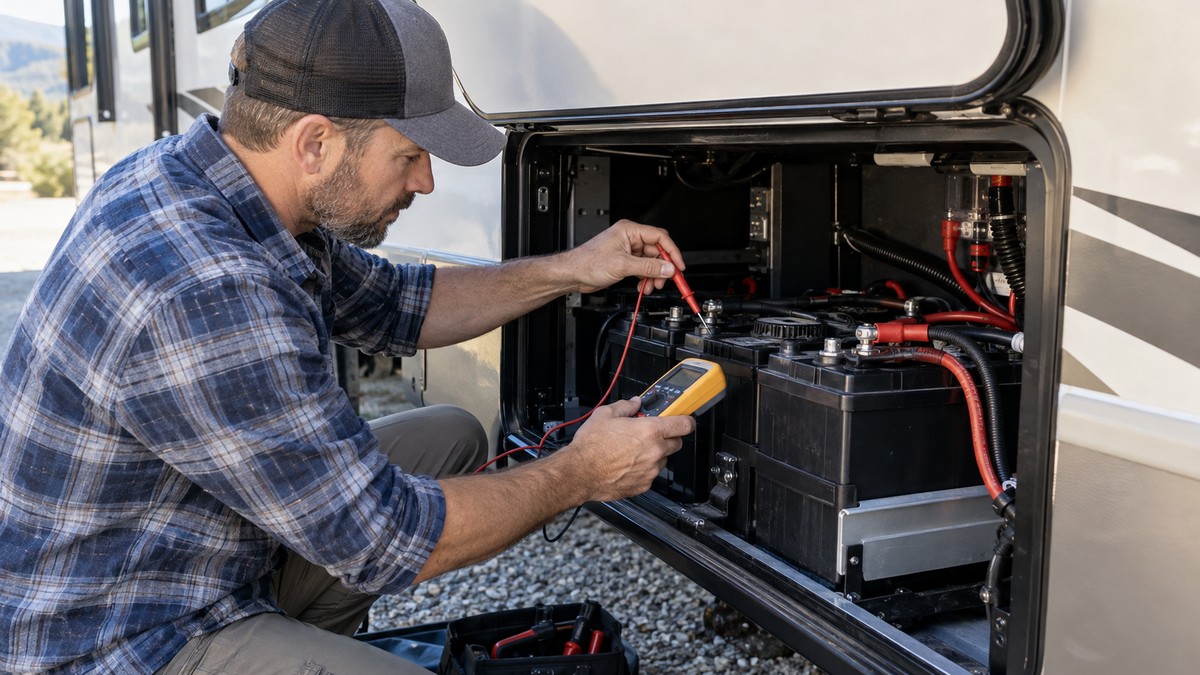
- Read each battery separately in DC volts, black lead on negative and red lead on positive.
- Compare each reading with the chart for its chemistry. A flooded 12 V battery reads about 12.6 V when full.
- Charge the bank, then check that the batteries read the same. A noticeable gap points to an imbalance.
Electrical safety first
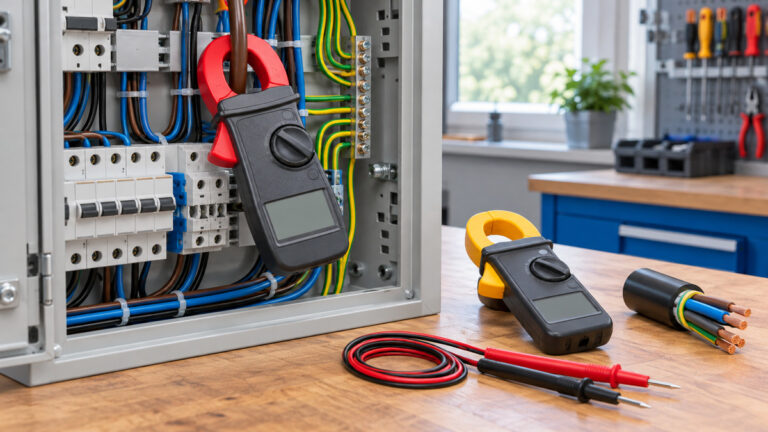
Work on mains circuits can kill. Before you measure anything, check that the meter’s CAT rating suits the circuit you are testing, and read the rating from the listing or the manufacturer’s manual. Panel and service work belongs to a licensed electrician.
Fluke’s multimeter safety guide explains that shock occurs when the human body becomes part of an electrical circuit. The same guide says CAT ratings are usually printed near the input jacks, and it advises choosing a meter rated for the highest category you could potentially use it in. The sources we opened do not state a CAT level that battery-bank work requires, so read the rating printed on your own meter.
Battery hazards are a separate concern. Fluke warns that lead-acid batteries can emit explosive gas and contain acid. DIYRV adds that a battery cable shorted with a tool can arc and cause an explosion, so it advises eye protection and rubber gloves. Victron’s wiring guide states that battery terminals are not insulated, and it advises insulated tools and no metal jewellery near the bank.
Preparation
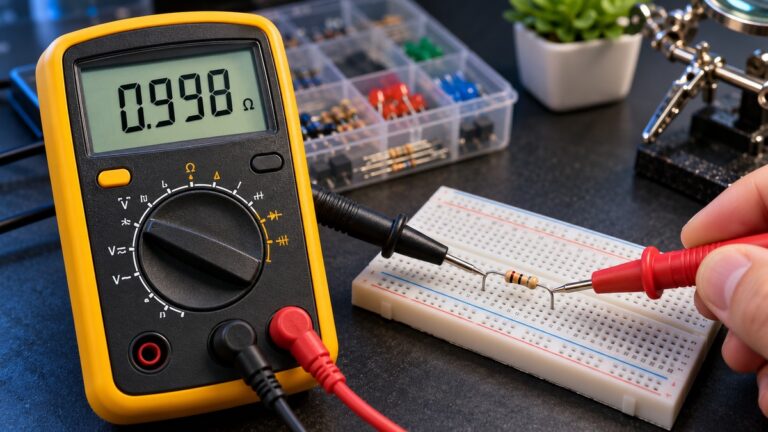
You need a digital multimeter that reads DC volts. Fluke’s DC voltage guide says to set the dial to DC voltage and, if unsure, start with the higher range. It also says to plug the black lead into COM and the red lead into the V/Ω jack. Renogy’s RV battery guide uses the 20 V DC range for a 12 V battery. The sources we opened do not recommend a meter model, and this guide names none.
Before you start, note whether each battery is flooded lead-acid, AGM, or lithium, because the chart you use depends on it. Battery University notes that AGM batteries produce a slightly higher voltage than the flooded equivalent. Keep a simple log of the date, the time, the battery’s position in the bank, and each reading, so that you can spot a battery that drifts over several visits.
Step 1: Charge the bank fully and let it rest
Charge the bank to full first. DIYRV advises charging each battery as completely as you can, with an overnight charge usually sufficient. It then says to leave the battery unattached for a couple of days before checking the open-circuit voltage.
The rest period matters because a battery that has just been charged or discharged gives a distorted voltage. Battery University says the battery needs to rest in the open-circuit state for at least four hours, and that battery manufacturers recommend 24 hours for lead-acid batteries. Fluke adds that you should turn off all accessories before a resting measurement. Turn off the refrigerator, lights, inverter and water pump, and make sure no charger is connected.
Step 2: Inspect the bank before you measure
Look at each terminal and connector before you place a probe. Fluke advises checking the terminals for corrosion or looseness first, because a poor connection can mislead the reading.
If the bank uses flooded batteries with removable caps, check the electrolyte level. DIYRV says that if the level is low, refill the cell with distilled water so the water covers the plates, and that you can see the level through the plastic opening in the battery. Trojan’s flooded-battery guide says to fully charge the batteries before adding water, and to use distilled or deionized water.
Step 3: Read each battery on its own
Set the meter to DC volts. Fluke says to put the black lead on the negative terminal and the red lead on the positive terminal. Modern meters detect polarity, so a reversed connection shows a minus sign on the display rather than causing harm.
Test each battery separately. DIYRV states that each battery must be tested individually and separate from the battery network, because one battery can be bad while the others work well, and you cannot tell which one from a reading of the whole bank. That may mean disconnecting cables. DIYRV advises a shop if the wiring layout is unclear, since a mistake reconnecting battery cables is a potentially deadly issue.
Step 4: Compare each reading with a chart for its chemistry
For a 12 V flooded lead-acid battery, Fluke gives about 12.6 V when fully charged, about 12.4 V for roughly 75 percent, about 12.2 V for roughly 50 percent, and below 12.0 V as likely discharged or weak. Renogy gives 12.6 to 12.8 V for a healthy, fully charged battery that is not charging or powering anything. Trojan’s flooded-battery table lists 12.73 V at 100 percent, with a specific gravity of 1.277.
These figures do not match exactly. Fluke and Renogy start their full range at 12.6 V, while Trojan’s full point is 12.73 V. The sources do not say which figure fits every battery, so the battery’s own datasheet should take precedence over a general chart, as Trojan’s table and Battery University both imply.
A 12 V lithium iron phosphate (LiFePO4) battery uses a different chart. LiTime’s lithium chart lists 13.33 V or higher as 100 percent, 13.15 to 13.2 V as 50 percent, and 13 to 13.15 V as 25 percent. Fluke’s chart does not cover lithium, so do not use a lead-acid chart for a lithium bank.
| Battery type | Full (100 percent) | About 50 percent | Source |
|---|---|---|---|
| 12 V flooded lead-acid | 12.6 V (Fluke); 12.73 V (Trojan) | 12.2 V (Fluke) | Fluke, Trojan |
| 12 V AGM lead-acid | 12.7 V and above (Renogy) | Not stated in the sources we opened | Renogy |
| 12 V LiFePO4 | 13.33 V and above | 13.15 to 13.2 V | LiTime |
Step 5: Check that the batteries agree
A bank can read well overall and still hide one weak battery. Victron’s guide describes a balance check on a charged bank. Charge the bank, measure towards the end of the bulk stage while the charger is still delivering full current, measure one battery, measure the other, and compare. A noticeable difference means the bank is unbalanced.
Victron explains why this matters. Batteries farther along a parallel bank pass current through more interconnecting leads, so they carry unequal current. Victron states that the bottom battery is worked harder, discharged harder and charged harder, and that it will fail prematurely. The guide also says that cable and connection resistance matters in a bank.
One owner’s report shows what an imbalance can look like. The owner of five 12 V 100 Ah batteries in parallel measured them at rest with the battery switch off. The three batteries nearest the positive bus read 13.3 V, and the two nearest the negative bus read 13.6 V. A Victron moderator suggested charging and discharging each battery individually to isolate the weak one. This is one owner’s report, not a published specification. The sources we opened do not give a number for how far apart two batteries may read before the bank is unbalanced.
Step 6: Check voltage drop under load (optional)
Voltage drop shows resistance in a connection that carries current. Fluke’s starter-circuit method sets the meter to DC volts, places one probe on the battery positive post and the other on the starter stud, cranks for four to five seconds, and records the peak with MIN/MAX or auto-hold. Fluke gives an acceptable total drop of about 0.2 to 0.5 V for a starter circuit, and says anything higher suggests corrosion, loose terminals, or damaged cables.
That method and its figures are written for a vehicle starter circuit. The sources we opened do not describe the same test on an RV house bank, and they do not give a voltage-drop limit for house-bank cables. Use the method only to find a connection that reads high under load, not as a pass or fail limit for the house bank.
Charging check
DIYRV’s motorhome guide says the reading should be about 12 V with the engine off, and that it should rise to about 13.8 V when the engine starts, which means the charging system is working. Fluke gives a wider range for a running car alternator: 13.7 to 14.7 V. The sources we opened do not cover the AC side of an RV, including shore power, the converter input, or any 120 V outlet. That wiring belongs to a licensed electrician.
Reading the results
A battery that reads at or near the full figure for its chemistry after a proper rest is in a normal state of charge. A battery that reads well below the fully charged figure after a full charge and rest has a problem. DIYRV says such a battery has one of two problems: it was left discharged too long, or it has a bad cell. Renogy adds that a voltage that drops sharply without any load suggests a dead cell.
A resting reading shows state of charge, not capacity. DIYRV advises replacing a battery that is not operating properly, and if the batteries still go dead after the checks, taking them to an auto parts or battery store for a load test. The sources we opened do not describe a multimeter load test.
Common mistakes
- Reading right after charging. Battery University says the voltage method needs a rest, so a reading taken straight off the charger does not show state of charge.
- Reading with a load or charger connected. Fluke’s resting-measurement instruction covers this case.
- Using a lead-acid chart for lithium. LiTime’s lithium figures are much higher than the lead-acid figures above.
- Reading only the bank total. A single weak battery can hide inside a bank that looks fine, so each battery needs its own reading.
- Ignoring corroded or loose terminals. Fluke says to inspect terminals before testing.
- Adding water before a full charge. Trojan’s guide says to fully charge the batteries first.
Frequently asked questions
How long should the batteries rest before I read them?
Battery University says at least four hours, and 24 hours for lead-acid batteries, as recommended by manufacturers. DIYRV describes a check after a couple of days unattached.
What reading means a flooded 12 V battery is full?
The sources differ. Fluke gives about 12.6 V, Renogy gives 12.6 to 12.8 V, and Trojan gives 12.73 V at 100 percent. Use the battery’s own datasheet if you have one.
Do lithium batteries read differently?
Yes. LiTime’s chart lists 13.33 V or higher as full for a 12 V LiFePO4 battery, which is above the lead-acid figures. Lithium voltage stays nearly flat over much of the range, so a voltage reading gives a less precise state of charge.
Can I test the bank while the RV is plugged in?
A resting reading needs the charger disconnected and no load on the bank. Battery University says the voltage method requires no load attached. Shore power is outside this guide.
Can a multimeter replace a load test?
The sources we opened do not say so. DIYRV points to an auto parts or battery store with a load tester for that check.
How we chose
The sources were grouped by type. The first group is maker documentation: Fluke’s multimeter guides, Trojan’s flooded-battery guide, Renogy’s RV battery guide, LiTime’s lithium chart, and Victron’s wiring guide. The second is a technical reference, Battery University’s state-of-charge article. The third is RV owner guidance, DIYRV. One Victron community thread is used only as an owner’s report, and it is labelled that way.
Each source was opened with curl on 2026-10-21, and only pages that returned a readable body were kept. Quoted sentences were checked against the fetched text, and any that did not match were paraphrased. Pages that returned HTTP 403 or did not respond were not used, and search results were not used as evidence.
What we could not verify
The sources we opened do not cover the following points, and this guide does not claim them.
- A numerical limit for the voltage gap between two batteries in a bank. Victron describes a noticeable difference only.
- A multimeter load-test procedure. The sources describe a load test done with a dedicated tester.
- A voltage-drop limit for RV house-bank cables. Fluke’s 0.2 to 0.5 V figure is for a vehicle starter circuit.
- The chart for a specific battery model. The battery’s own datasheet should be used.
- A CAT rating needed for battery-bank DC work.
- An AGM voltage figure below full charge.
Sources
- Fluke, How to Measure Battery Voltage with a Multimeter: https://www.fluke.com/en-us/learn/blog/digital-multimeters/how-to-test-a-battery-with-a-multimeter
- Fluke, How to Measure DC Voltage with a Digital Multimeter: https://www.fluke.com/en-us/learn/blog/digital-multimeters/how-to-measure-dc-voltage-with-a-digital-multimeter
- Fluke, How to Check Starter Circuit Voltage Drop with a Multimeter: https://www.fluke.com/en-us/learn/blog/digital-multimeters/how-to-check-starter-circuit-voltage-drop-with-a-multimeter
- Fluke, Guide to digital multimeter safety: https://www.fluke.com/en-us/learn/blog/safety/multimeter-guide
- DIY RV, How to Perform Open Voltage Testing on Your RV House Batteries: https://www.doityourselfrv.com/?p=13593
- Battery University, BU-903 How to Measure State-of-charge: https://batteryuniversity.com/article/bu-903-how-to-measure-state-of-charge
- Trojan Battery, Flooded Battery Quick Start Guide (copy hosted at ressupply.com): https://ressupply.com/documents/trojan_battery/Flooded_Battery_Quick_Start_Guide.pdf
- Renogy, How to Tell if RV Battery Is Bad: https://au.renogy.com/blogs/off-grid-power/how-to-tell-if-rv-battery-is-bad
- LiTime, Lithium Battery Voltage Chart: https://www.litime.com/blogs/blogs/lithium-battery-voltage-chart
- Victron Energy, The Wiring Unlimited book, battery bank wiring: https://www.victronenergy.com/media/pg/The_Wiring_Unlimited_book/en/battery-bank-wiring.html
- Victron community thread on a five-battery parallel bank (owner report): https://communityarchive.victronenergy.com/questions/245925/multiplus-ii-charged-only-2-out-of-5x-battle-born%EF%B9%96childToView=247739.html
For a meter suited to vehicle work, see our roundup of digital voltage meters for cars. For the voltage drop method in more depth, see our guide to voltage drop testers.