Best Analog Multimeter
As an Amazon Associate we earn from qualifying purchases. Details
The best analog multimeter is the one whose ranges, category rating and dial suit the work you do, and the listings answer only part of that question. This guide compares six pointer meters by what their Amazon.com listings state. Read the category rating first, then the ranges, then the features. Where a listing is silent or contradicts itself, we say so, so you know what to confirm in the manual before you buy.
Quick answer
- Choose the Hioki 3030-10 if you want one analog meter whose listing states Category III certification up to 600V.
- Choose the Gardner Bender GMT-318 for a pocket-size meter with a stated CAT II 500V rating, and confirm its fuse rating in the manual.
- Choose the Tekpower TP8260L for a backlit dial and a transistor check, but settle its category rating before you use it on circuits above 600V.
- Choose the Aicevoos AS-7199A only if its 2500V listing matters to you, and find its category rating before you connect it to anything live.
What the needle tells you
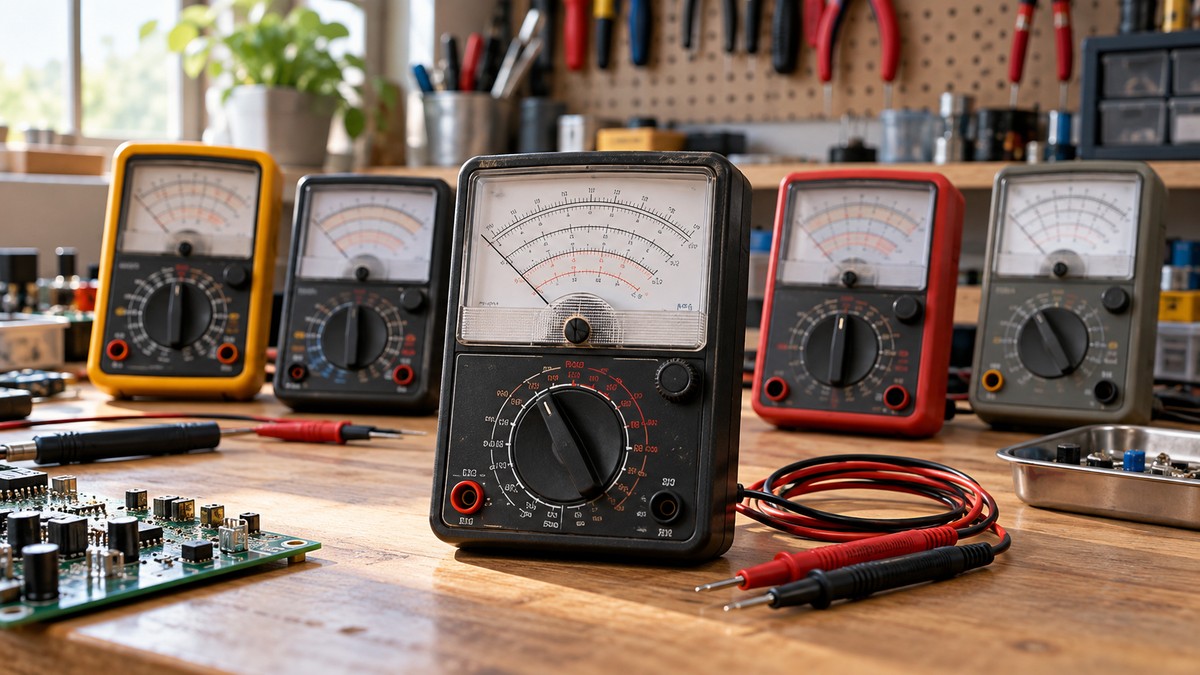
An analog multimeter shows a reading as the position of a pointer on a printed scale, and most of the listings in this roundup work that way. The LibreTexts ohmmeter exercise describes the behavior directly: when the probes touch, the needle deflects full scale, and when the probes come apart, the needle returns to its resting position.
Two practical points follow from that behavior. First, the ohm scale runs backward. The same exercise says the resistance scale on an analog multimeter is reverse-printed, so zero ohms sits at the right-hand end and infinite resistance at the left. Second, the meter needs zeroing before resistance readings. Touch the test probes together, then move the adjustment until the needle points to zero at the right-hand end of the scale.
Range selection is the next difference. The Hioki description says the meter is manual-ranging, which means the operator chooses the range for the property being measured. The Gardner Bender listing also says manual range selection. The Tekpower description does not say how its ranges are selected, so read its manual before you start.
The Hioki listing describes its reading method too. It says the average-sensing meter gives accurate readings on linear loads, such as standard induction motors and incandescent lights, where the current or voltage has an undistorted waveform. The listing does not say how the meter behaves on a distorted waveform, so a load of that kind is a question for the manual.
Electrical safety comes first
Analog meters are often used on live equipment, so the rating on the case matters as much as the dial. OSHA says its electrical standards are designed to protect employees from dangers such as electric shock, electrocution, fires and explosions. Its work-practice rule, 29 CFR 1910.333, requires safety-related practices to prevent electric shock or other injuries when work is performed near or on equipment or circuits that are or may be energized. The same rule says live parts shall be de-energized before a worker works on or near them, unless the employer can show that de-energizing adds hazards or is not feasible.
The measurement category sorts the places you measure. Electronics Reference says CAT I measurements present the lowest risk, and each category above CAT I presents greater risk than the lower categories. It describes CAT II as circuits connected to a low voltage supply, typically a household wall outlet, and CAT III as building installation, including circuit breakers, distribution boards, wiring and switches.
Three rules follow from the category sources. A meter should never be used for a higher category measurement than its rating, according to Electronics Reference. The test leads carry their own category and voltage ratings, so the weakest part sets the limit for the whole setup. And voltage ratings compare directly only within one category. Tester.co.uk gives the example that a CAT II 1000V tester gives more protection than a CAT II 600V tester, but less than a CAT III 600V tester.
The table below lists what each listing states about category and fuses. The Hioki, GMT-318 and Tekpower listings give a category rating in their text. The other three give none in the text we read.
| Listing | Category rating stated | Fuse or safety text stated |
|---|---|---|
| Hioki 3030-10 | CAT III up to 600V, under IEC 61010 (bullets) | A 0.5 A fuse rated 250V is installed (description) |
| Gardner Bender GMT-318 | CATII 500V (agency approvals) | F500mA, 250V in the specifications; 250 mA in the comparison table |
| Tekpower TP8260L | CAT II 600V (bullets) | 250 mA/250 V and 10 A/250 V fuses (description) |
| Sanwa YX-360TRF | None stated | None stated |
| NJTY S471 | None stated | Three fuse tubes, two spares installed (bullets) |
| Aicevoos AS-7199A | None stated | None stated in the bullets |
The Aicevoos figure needs care. Its title gives a 2500V limit, but the text names no category. A voltage number without a category cannot be compared on safety, and the Tester.co.uk example shows why.
The ranges, compared
The next table lists the top of each stated range. A dash means the listing text we read does not give it.
| Listing | Top DC voltage | Top AC voltage | Top DC current | Top resistance |
|---|---|---|---|---|
| Gardner Bender GMT-318 | 500 V | 500 V | 250 mA | 50 kΩ |
| Hioki 3030-10 | 600 V | 600 V | 300 mA | 3 kΩ |
| Tekpower TP8260L | 1000 V | 1000 V | 10 A | 20 MΩ |
| Aicevoos AS-7199A | 2500 V (title) | 2500 V (title) | 10 A (title) | Rx 100K (title) |
| NJTY S471 | — | — | — | — |
| Sanwa YX-360TRF | — | — | — | — |
The table supports two small calculations, both our planning estimates. A 120 V AC reading on the Tekpower’s 250 V AC range would sit at 120 / 250 = 0.48, or 48 percent of that scale. On its 1000 V range, the same reading would sit at 120 / 1000 = 0.12, or 12 percent. The listings do not say how the scale is printed, so these figures show where the pointer would fall on each range, not how easy it is to read. The second calculation compares top DC voltage ranges: the Tekpower’s 1000 V is 1000 / 600 = 1.67 times the Hioki’s 600 V.
The two tables together show a split. The Aicevoos and Tekpower listings state the highest voltage limits in this set, yet the Aicevoos gives no category. The Hioki and GMT-318 stop at 600 V and 500 V, and both state a category. The Sanwa and NJTY listings state no range at all in the text we read.
Reading the scale without overloading it
The LibreTexts ammeter exercise gives a sequence for a manually ranged meter. It says to begin on the highest range for the quantity, then move the selector to lower ranges until the strongest indication appears on the display without over-ranging the meter. The Hioki and GMT-318 listings both describe manual range selection, so the sequence applies to them directly. The Tekpower description does not say, so check its manual before you follow the same steps.
The same exercise calls a left motion of an analog needle a “backwards” indication, and it says to reverse the test probe connections and try again. The exercise applies this step to current measurement, so use it for that job and read the manual for anything else.
How to choose an analog multimeter
Start with the category, then the range, then the fuse. The category is the rating that says where a meter may be used. A listing without one needs the manual before you connect the meter to mains circuits.
Next, compare the top ranges with the voltages and currents you expect to measure. The table above gives each listing’s stated tops, and nothing in the listings suggests that a higher top is better in every case. Check the fuse rating as well. Two of the listings that state a fuse give more than one figure, so the manual should settle which one applies.
Form matters for daily use. The GMT-318 is a pocket meter, and its listing gives a body of 109 mm by 70 mm by 33 mm and a weight of 140 g with the battery. The Hioki weighs 280 g and comes with a carrying case. The Tekpower measures 6 1/2 by 3 1/2 by 1 1/2 inches and weighs 14.3 ounces, and its case is described as strong and protective.
Check the battery type before you buy. The GMT-318 uses one 1.5 V AA cell, the Hioki uses two AA cells, and the Tekpower uses two AA cells and is described as lasting 10 hours of continuous use. The Aicevoos comes with two 1.5 V batteries in the box.
Finally, decide whether you need a function the others lack. The NJTY lists hFE, capacitance and dB measurement. The Tekpower lists continuity, decibel values and a diode test. The Aicevoos lists remote control detection and a transistor check. The GMT-318 listing says it tests continuity in its manufacturer text, but its comparison table shows no audible continuity entry for that model.
1. Hioki 3030-10 HiTester Manual-Ranging, Average-Sensing Analog Multimeter, 600V, 3 Kilohms, 300 (Manual-ranging meter with a stated CAT III 600V rating)
Pros
- The listing states certification for Category III installations up to 600V under IEC 61010
- The listing describes an average-sensing reading for linear loads with an undistorted waveform
- The box includes a carrying case, a 9060 test lead set and two installed 1.5V batteries
Cons
- The temperature function needs a thermistor probe that the listing says is sold separately
- The stated maximum current is 300 milliamps and the maximum resistance is 3 kilohms
Best for: An electrician or technician who needs one analog meter with a stated category rating
Skip if: Your load has a distorted waveform, or you need a range above 600 volts
View on Amazon (affiliate link)
2. Gardner Bender GMT-318 Analog Multimeter, 6 Function, 14 Range, AC / DC Volt, 500V (Pocket-size meter with a stated CAT II 500V rating)
Pros
- The listing states CATII 500V under agency approvals and gives a body of 109 mm by 70 mm by 33 mm
- The listing describes a 15-position rotary dial with manual range selection
- The manufacturer text calls it a pocket sized analog tester for voltage, current, resistance and batteries
Cons
- The listing gives two fuse ratings, 250 mA in the comparison table and F500mA, 250V in the specifications
- The manufacturer text says it tests continuity, while the comparison table shows no audible continuity entry
Best for: A household user who needs a small meter for outlets, household batteries and low-voltage circuits
Skip if: You need one confirmed fuse rating or a category above CAT II
View on Amazon (affiliate link)
3. Tekpower TP8260L Analog Multimeter with Back Light, and Transistor Checking Dock (Backlit 20-range meter with a transistor dock)
Pros
- The bullets name a backlight for dim work areas and a transistor checker for PNP and NPN types
- The description lists five DC voltage ranges, from 2.5 V up to 1000 V
- The description lists two fuses, 250 mA/250 V and 10 A/250 V, and the bullets give a one-year warranty
Cons
- The bullets give CAT II 600V, but the description lists a 1000 V DC range, and the listing does not reconcile the two
- The description gives ±4.0% for AC voltage and DC current, looser than its ±3.0% for DC voltage
Best for: A home or hobby user who wants a backlit dial and a transistor check in one meter
Skip if: You need a category rating that clearly covers 1000 V work
View on Amazon (affiliate link)
4. NJTY S471 Analog Multimeter, DC/AC Voltage, DC Current and Resistance (Needle meter with hFE, capacitance and dB functions)
Pros
- The bullets list eight measurement functions, including hFE gain, capacitance, dB and load voltage and current
- The bullets describe an audible continuity beep
- The bullets say three fuse tubes are included, with two spares already installed
Cons
- The bullets state no voltage or current range and no category rating
- The bullets describe a capacitor test for battery performance but give no capacitance range
Best for: A hobbyist who wants transistor gain and audio dB readings on a pointer meter
Skip if: You need stated ranges or a category rating before you buy
View on Amazon (affiliate link)
5. Analog Multimeter AS-7199A, Pointer Multimeter, AC DC Volt 2500V, DC Current 10A, Rx 100K, Batt (Pointer meter listed to 2500V without a category)
Pros
- The title and bullets state AC and DC voltage up to 2500 V
- The bullets list 11 functions, including remote control detection and a transistor check
- The bullets describe a stand, magnets for metal surfaces and hanging holes, and two 1.5V batteries in the box
Cons
- The listing gives no measurement category for the 2500 V range
- The bullets name no fuse rating
Best for: A bench user who wants a pointer meter with a high-voltage listing and magnets for metal surfaces
Skip if: You work on mains circuits and need a stated category before you connect
View on Amazon (affiliate link)
6. Sanwa YX-360TRF Linear Analog Multimeter Tester YX360TRF NEW (Linear analog meter with little stated in its listing)
Pros
- The listing names the Sanwa brand and the YX-360TRF model in its title
- The bullets describe it as a linear analog multimeter tester, the type this roundup covers
Cons
- The bullets give no measuring ranges, fuse rating or category rating
- The text we read includes no specification table, so the ranges must come from the manual
Best for: A bench user who wants a named analog brand and will read the manual before use
Skip if: You need ranges or a category rating stated in the listing before you buy
View on Amazon (affiliate link)
Mistakes to avoid
- Measuring resistance on a powered circuit. The LibreTexts exercise says never to measure the resistance of an electrically live object or circuit, and it uses a battery as its example of a source to avoid.
- Skipping the zero adjustment. The same exercise tells you to touch the probes together and set the needle to zero before a resistance reading.
- Using a meter above its category. Electronics Reference says a meter should never be used for a higher category measurement than its rating.
- Trusting a voltage figure without its category. Tester.co.uk shows that voltage ratings compare directly only within the same category.
- Moving probes between jacks without checking the manual. The LibreTexts ammeter exercise says many inexpensive analog meters use the same jacks for voltage, resistance and current, so the manual is the reference for each function.
Who should buy which meter
An electrician who needs a stated category rating on one analog meter is the clearest case for the Hioki, because its listing gives the category, a carrying case and an average-sensing method for linear loads. A household user who wants a small meter for outlets, batteries and low-voltage circuits fits the GMT-318 better, since its manufacturer text lists those uses and its listing states CATII 500V.
A hobbyist who works with transistors has two options in this set. The NJTY lists hFE and capacitance functions, and the Tekpower lists a transistor dock for PNP and NPN types. Choose by the function you need, then confirm the ranges in the manual, because neither listing gives a full range table.
Any high-voltage use is a separate decision. The Aicevoos listing states 2500V, but a meter for that work needs a category rating that the listing does not give. Until the manual states one, keep the Aicevoos away from mains work. For meters of other types, the multi meters roundup is the place to compare beyond the pointer style.
How we chose
We searched Amazon.com for “analog multimeter” in a browser on 21 October 2026 and read the results on the first page. We kept listings whose titles or bullets describe a pointer or analog meter. We left out digital multimeters, clamp meters and an oscilloscope combination that the results included. We opened seven analog listing pages and kept six, one from each of six brands. We left out the MT-2207-C because its bullets state no measurement range, fuse rating or category rating.
We read the listing text only: the title, bullets, product description and any specification section that appeared in the text. We did not use prices, ratings or review counts to choose or rank the picks, and the order of the picks follows the category and range information in each listing.
What we could not verify
- Whether any listed meter meets the category it states in practice. The sources we opened cover the category rules, not these products.
- The accuracy of any reading. Only the GMT-318 comparison table (±4%) and the Tekpower description (±3.0% DC voltage, ±4.0% AC voltage and DC current) state an accuracy figure. The other four listings state none in the text we read.
- The ranges of the Sanwa and NJTY meters. Their listing text gives no measurement ranges, so we cannot compare them on range.
- Which fuse rating applies to the GMT-318. Its comparison table gives 250 mA, and its specifications give F500mA, 250V. The manual has to settle it.
- Whether the Tekpower meets CAT II 600V or the 1000V DC range in its description. The listing gives both, and it does not reconcile them.
- The category rating of the Aicevoos 2500V range, which the listing does not state.
- Needle behavior, scale legibility and parallax in use. None of the listings describes these in measurable terms, and the sources we opened do not cover them for these models.
- Battery life for the GMT-318, Hioki and Aicevoos, which no listing states. The Tekpower is the only one with a stated figure, 10 hours of continuous use.
FAQ
Should I buy an analog multimeter instead of a digital one?
Buy an analog meter when a moving pointer suits the job. The listings we read do not rank analog against digital. The Hioki listing describes an average-sensing meter that reads accurately on linear loads with an undistorted waveform, so check your load before you rely on a needle. For the digital alternative, see the hand-held digital multimeter roundup.
What CAT rating do I need on an analog multimeter?
Match the rating to the place you measure. Electronics Reference describes CAT II as circuits connected to a household wall outlet, and CAT III as building installation such as breaker panels and wiring. A meter should never be used for a higher category than its rating, and the leads need their own ratings that match the work.
Can I measure resistance on a powered circuit with an analog meter?
No. The LibreTexts exercise says never to measure the resistance of an electrically live object or circuit with the ohms function. OSHA’s work-practice rule also says live parts shall be de-energized before a worker works on or near them, unless the employer can show that this adds hazards or is not feasible.
How do I zero the ohm scale before a reading?
Touch the test probes together, then move the zero adjustment until the needle points to zero at the right-hand end of the scale. The LibreTexts exercise describes the adjustment as a small knob or wheel on the meter, and it describes the same step before resistance readings.
Why do the jacks matter on an analog meter?
Many inexpensive analog meters use the same jacks for voltage, resistance and current, so the red lead can sit in the wrong jack for the function you chose. The LibreTexts exercise says to consult the owner’s manual for the right jack. Read the fuse rating in the manual too, since the Hioki, GMT-318 and Tekpower listings each state one.
Is a 2500V analog meter safe for high-voltage work?
Not from the listing alone. The Aicevoos title states AC and DC voltage up to 2500V, but its text names no measurement category. Tester.co.uk notes that voltage ratings compare directly only within the same category, so a voltage figure without a category tells you little on its own. Do not use the meter on high-voltage circuits until the manual states a category that covers the work.
Bottom line
Choose the Hioki 3030-10 if a stated CAT III 600V rating matters most. Choose the Gardner Bender GMT-318 for a pocket meter with a stated CAT II 500V rating. Choose the Tekpower TP8260L for a backlit dial and a transistor check, after you settle its category. If a listing gives no category rating, do not connect the meter to mains circuits until the manual states one.
Sources
- OSHA, Electrical: OSHA’s statement that its electrical standards protect workers from shock, electrocution, fires and explosions
- OSHA, 29 CFR 1910.333 Selection and use of work practices: safety-related work practices, de-energizing live parts, and discharging capacitors
- Electronics Reference, Measurement Categories (CAT I to CAT IV): what each category covers and the rule against using a meter above its rating
- Tester.co.uk, What Are CAT Ratings?: voltage ratings compare directly only within the same category
- LibreTexts, Kuphaldt: Ohmmeter Usage: analog needle behavior, the reverse-printed ohm scale, zeroing, and the live-circuit warning
- LibreTexts, Kuphaldt: How to Use an Ammeter to Measure Current: analog meters that share jacks for voltage, resistance and current