Best Multimeter for Automotive Work: 8 Listings Compared
As an Amazon Associate we earn from qualifying purchases. Details
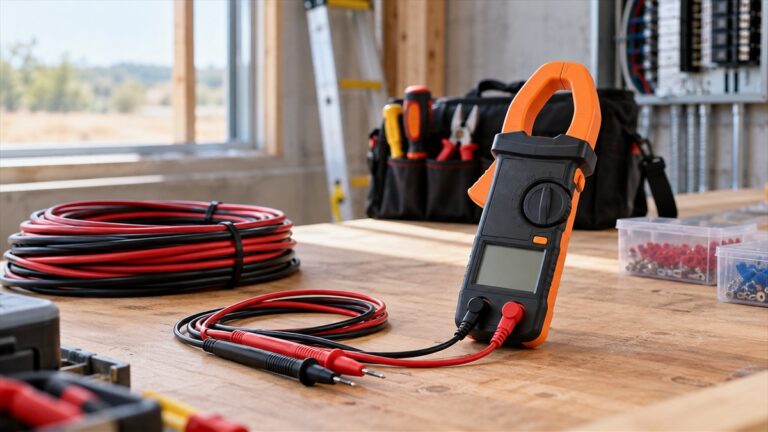
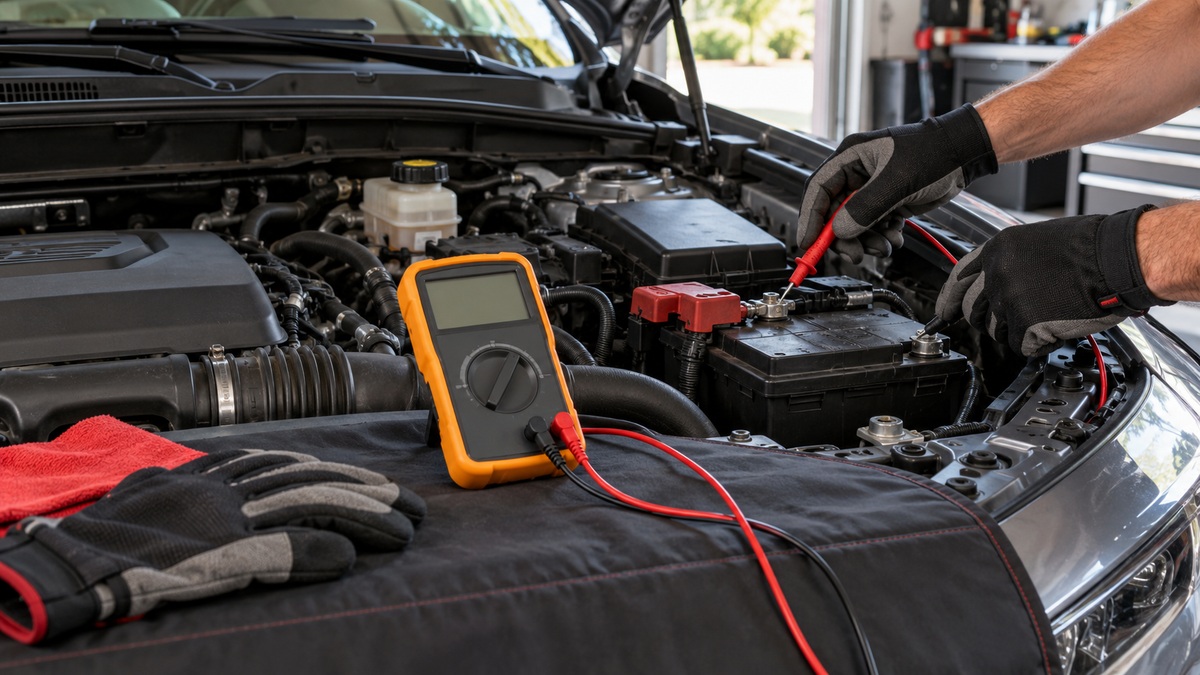
The best multimeter for automotive checks is a digital meter that reads DC volts on a range covering 12 V and 24 V, and that also states resistance and continuity functions. Of the 12 listing records in our research file, 8 are meters or testers that suit car electrical checks, and this guide compares those 8. Each card shows what its listing states about DC range, resistance, continuity and safety rating. Where a title and its bullets disagree, we follow the bullets and say so. No prices, ratings or sales figures appear here.
Quick answer
- Pick a digital multimeter when the job needs DC volts plus resistance and continuity. Five of the eight picks state all three in their bullets.
- Check the DC range before you buy. Only the 5-inch Generic meter gives its DC ranges in a specification table. Two records give no numeric DC range at all, and the others state their range in the bullets.
- A 12 V voltmeter or a digital test light covers a quick voltage check. The 12 V voltmeter and two of the three test lights state no resistance function.
- Car electrical work should be done by a qualified person. The warnings quoted in the safety section are a starting point, not a full procedure.
What an automotive multimeter has to measure
Most records in this set name DC volts first, then resistance and continuity, and each record lists those as separate functions. The Purdue Extension project sheet, a 4-H document, describes voltage this way: “Voltage potential can be measured and is the difference between two points, for example between the positive and negative ends of a battery, or between a hot wire and neutral/ground wire.” The same sheet says the measuring principles “are the same regardless if the voltage is DC (Direct Current) battery or AC (Alternating Current) house wiring.”
The Fluke 88 V Automotive Multimeter manual is a second reference. It is from a different brand, and none of the eight listings in this guide is that product. In its section on AC and DC voltage it states: “The Meter’s voltage ranges are 600.0 mV, 6.000 V, 60.00 V, 600.0 V, and 1000 V.” A 12 V or 24 V reading sits below the 60.00 V range in that list. We cite the manual for the shape of a range list only, not for the rating of any listed product.
The same manual describes a setting that “Changes the default ranging from manual to auto for the V ac and V dc functions.” Two listings name auto ranging in their bullets, and a third names it in its title. The listings do not say how their own auto ranging works, so the stated range figure is the thing to check.
Read the listing fields in this order
Work through the fields in this order for every record. Where a field is missing, say so rather than filling it in.
- Function. Check whether the record names DC volts, resistance and continuity, or only a voltage display.
- DC range. Take the figure from the bullets or the specification table. If the title gives a different figure, use the bullets and note the difference.
- Accuracy. Check whether the figure is a percentage alone or a percentage plus a digit term. A percentage alone leaves the error on small readings unstated.
- Safety rating. Record the category and voltage as the listing states them. This guide does not define the categories.
- Power and parts. Note whether the unit runs on batteries, on the vehicle or on a cord, and whether leads, a case or a stand come with it.
DC volts, resistance and continuity in the listings
The table shows what each record states in its bullets or specification table. It does not show performance, and it adds no figure from outside the record.
| Pick | Type as listed | DC volts as listed | Resistance as listed | Continuity as listed |
|---|---|---|---|---|
| Lscsdf meter | Multimeter | No numeric range | Stated | Stated |
| SGDRN voltmeter | Panel voltmeter | 12V DC systems, no range | Not stated | Not stated |
| ATOBLIN 1 to 72 V test light | Digital test light | 1 V to 72 V DC display | Not stated | Stated |
| FS899S meter | Multimeter | 60 mV to 600 V DC, ±1.2 to 1.5% | 600 Ω to 60 MΩ | Stated (auto mode) |
| ATOBLIN probe tester | Digital test light with modes | Clip supply 5 V to 60 V; probe 1 V to 75 V | Stated (mode) | Stated |
| AutoViteX kit meter | Multimeter in a kit | Up to 1000 V DC | Up to 200 MΩ | Audible continuity |
| ATOBLIN 4 to 75 V test light | Digital test light | 4 V to 75 V DC | Not stated | Title only |
| 5-inch Generic meter | Multimeter | 6 V, 60 V and 600 V DC ranges | 600 Ω, 6 kΩ and 60 kΩ ranges | Stated |
Five records state both resistance and continuity: the Lscsdf meter, the FS899S meter, the ATOBLIN probe tester, the AutoViteX kit meter and the 5-inch Generic meter. The ATOBLIN 1 to 72 V test light states continuity but no resistance. The ATOBLIN 4 to 75 V test light names continuity only in its title. The SGDRN voltmeter names 12V DC systems and no other figure.
Two records give DC figures in a form that needs care. The ATOBLIN probe tester lists a clip supply range and a probe test range as separate figures. The FS899S meter gives a percentage with no digit term. The next section works through that figure.
The 60 V arithmetic (our planning estimate)
The 5-inch Generic meter states its DC accuracy as ±(0.5%+3) on its 60 V DC range, with a 0.01 V resolution. The FS899S meter states ±1.2 to 1.5% with no digit term. These are two different rules. The arithmetic below is our planning estimate built from the stated figures, not a reading from either meter. We read the +3 term as three steps of the 0.01 V resolution. That reading is our assumption, because the listing does not define the term.
Generic error limit = reading × 0.5% + 3 × 0.01 V:
- 12.00 V: 12.00 × 0.005 = 0.06, plus 0.03, equals 0.09 V.
- 24.00 V: 24.00 × 0.005 = 0.12, plus 0.03, equals 0.15 V.
- 48.00 V: 48.00 × 0.005 = 0.24, plus 0.03, equals 0.27 V.
FS899S error limit = reading × 1.2% to 1.5%:
- 12.00 V: 12.00 × 0.012 = 0.144, about 0.14 V; 12.00 × 0.015 = 0.18 V.
- 24.00 V: 24.00 × 0.012 = 0.288, about 0.29 V; 24.00 × 0.015 = 0.36 V.
On these figures the Generic limit is smaller at both voltages: 0.09 V against 0.14 V to 0.18 V at 12 V, and 0.15 V against 0.29 V to 0.36 V at 24 V. The FS899S listing does not say how its percentage applies to each range, so treat the comparison as a comparison of listing figures only.
The 5-inch Generic meter’s 60 V range also leaves room at the top. A 48 V reading sits 12 V below the range limit (60 minus 48 equals 12). The Lscsdf and SGDRN records state no numeric accuracy, so neither can be placed on this comparison.
Safety for car electrical work
Car electrical work carries shock and fire risk. The OSHA electrical overview says: “OSHA’s electrical standards are designed to protect employees exposed to dangers such as electric shock, electrocution, fires, and explosions.” That page is written for workplaces, so we cite it only for the general hazard point.
The OSHA text on work practices adds that “A qualified person shall use test equipment to test the circuit elements and electrical parts of equipment to which employees will be exposed and shall verify that the circuit elements and equipment parts are deenergized.” It also says that “Live parts to which an employee may be exposed shall be deenergized before the employee works on or near them”. That rule is written for workplaces, and this guide does not turn it into steps for a vehicle.
The Purdue sheet makes two points that apply here: “Working with live electrical circuits can be very hazardous without proper tools and safeguards.” and “Move cautiously while probing circuits.”
The Fluke manual gives two warnings. It says: “Use caution when working with voltages above 30 V ac, 42 V ac peak, or 60 V dc.” It adds: “These voltages pose a shock hazard.” The 12 V and 24 V systems in this guide sit below 60 V DC. That warning sets a threshold for caution, and it does not say that a lower voltage is safe. The manual’s instruction for in-circuit tests is short: “For in-circuit tests, turn circuit power off.”
This guide therefore gives no steps for live circuits or battery charging, and it leaves car electrical work to a qualified person.
Which type fits which job
Multimeters. Four picks are multimeters or a kit built around one: the Lscsdf meter, the FS899S meter, the 5-inch Generic meter and the AutoViteX kit. All four state DC volts, resistance and continuity in their bullets, so they cover the widest set of checks in this guide.
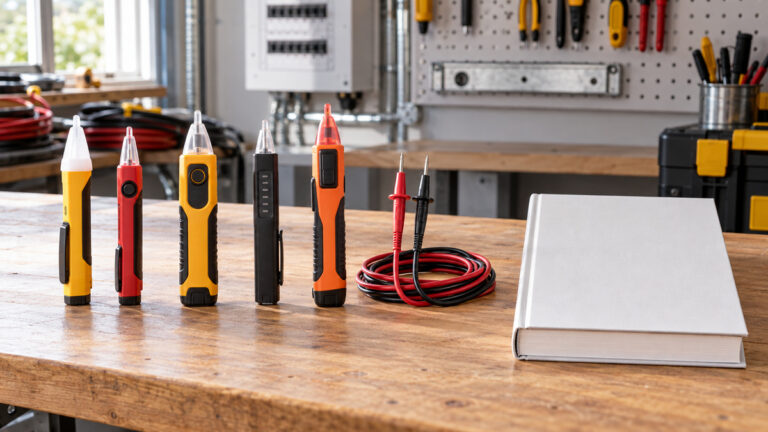
Digital test lights. Three picks show a voltage on a digital display: the ATOBLIN 1 to 72 V unit, the ATOBLIN 4 to 75 V unit and the ATOBLIN probe tester. They suit a quick voltage check with polarity lights. Only the probe tester lists resistance and frequency modes.
A voltmeter. The SGDRN voltmeter mounts with the included adhesive tape and shows battery voltage. It is the simplest pick in the set, and its bullets name no resistance or continuity function.
For a broader list of voltage checkers for cars, see our auto voltage tester picks for car electrical checks. For circuit testers that cover cars, outlets and breakers, see our circuit tester guide.
The picks and who each one fits
Each card gives the record’s own statements, the points it helps with, the points it limits and a skip note. The cards follow the order of the table above. That order is not a ranking.
1. USB Rechargeable Digital Multimeter 6000 Counts Large Color Screen & Backlight FS899L Smart Auto (6000-count multimeter with color screen and backlight)
Specs from the listing (checked ):
- Measurement Type: Multimeter
- Unit Count: 6000 Count
- Model: Lscsdf
Pros
- Bullets list AC and DC voltage, resistance and continuity in one meter.
- A 4.8 inch color screen and backlight are stated for dim places.
- Bullets say it recharges from an ordinary micro data cable, which is included.
Cons
- Bullets give no numeric DC voltage range.
- The title names True RMS and auto ranging, but the bullets state neither.
Best for: Buyers who want one multimeter with a color display for car and home checks.
Skip if: Skip it if you need a stated DC range or a stated accuracy, because the record gives neither.
View on Amazon (affiliate link)
2. DC 12V Car Digital Voltmeter, LED Display Auto Voltage Gauge (White) (12 V DC car voltmeter with adhesive mount)
Specs from the listing (checked ):
- Item Dimensions: 2 x 1.1 x 0.3 inches
- Included Components: 1 Digital Voltmeter, 1 Double-Sided Adhesive
- Item Highlight: Waterproof Vehicle Power Energy Voltage Monitor, Portable Design, Electrical Panel Meter, Universal for Car Motorcycle Boat
Pros
- Bullets say it is compatible with most 12V DC systems, including cars and trucks.
- A backlit LED display is stated for reading at night or in low light.
- The included double-sided tape is listed for quick mounting.
Cons
- It names voltage only, with no resistance or continuity function in the bullets.
- The bullets give no numeric range beyond 12V DC systems.
Best for: Buyers who want a fixed readout of vehicle battery voltage.
Skip if: Skip it for resistance or continuity checks, because the record names voltage only.
View on Amazon (affiliate link)
3. Automotive Test Light Probe Kit, 3-36V DC Power Circuit Probe Tester with Voltmeter, Auto (Digital test light, 1 V to 72 V DC display, in a kit)
Specs from the listing (checked ):
- Power Source: Corded Electric
- Included Components: test light probe kit
- Item Weight: 558 g
Pros
- Bullets state a digital display that reads from 1 V to 72 V DC.
- Red and green indicator lights are stated for polarity.
- The kit includes a carrying case, 14 flexible leads and a long power cable with battery clamps.
Cons
- The title's 3-36V DC figure is the tester's own power range, according to the bullets.
- The bullets name continuity checks but no resistance function.
Best for: Buyers who want a voltage display and polarity lights in a kit with a carrying case.
Skip if: Skip it for resistance checks, because the bullets name voltage and continuity checks only.
View on Amazon (affiliate link)
4. FS899S Smart Digital Multimeter, Automatic True RMS 6000 Counts, USB Rechargeable Voltmeter (True RMS 6000-count multimeter with auto mode and voice output)
Specs from the listing (checked ):
- Specification Met: Iec 61010-1, Cat III 1000v, Cat IV 600v
- Power Source: Battery Powered
- Manufacturer: Susilks
Pros
- Bullets state DC voltage from 60 mV to 600 V with ±1.2-1.5% accuracy.
- The specification table and the bullets both give CAT III 1000 V and CAT IV 600 V.
- Bullets say auto mode measures AC and DC voltage, resistance and continuity without dial switching.
Cons
- Its accuracy is stated as a percentage only, with no digit term.
- The brand field reads Generic, and the manufacturer field reads Susilks.
Best for: Buyers who want an auto-ranging meter that covers DC volts, resistance and continuity in one case.
Skip if: Skip it if you need a DC accuracy figure with a digit term, because the record gives a percentage only.
View on Amazon (affiliate link)
5. Power Circuit Probe Tester, 5-60V DC LCD Digital Automotive Test Light, Auto Voltage Tester (Battery-powered probe tester with LCD, voltage, resistance and frequency modes)
Specs from the listing (checked ):
- Power Source: Battery Powered
- Compatible Devices: Vehicles with 5-60V DC electrical system
- Included Components: test light
Pros
- Bullets list voltage, resistance and frequency modes in one tester.
- Bullets say it runs from the vehicle battery, with no extra battery needed.
- Bullets list a clip supply of 5 V to 60 V DC and a probe test range of 1 V to 75 V DC.
Cons
- The title gives 5-60V DC, which the bullets list as the clip supply figure.
- The specification table names a test light as the only included component.
Best for: Buyers who want a battery-powered tester with voltage, resistance and frequency modes.
Skip if: Skip it if you need a DC voltage reading above 75 V, because the bullets give no higher range.
View on Amazon (affiliate link)
6. Pro Electrical Test Kit Includes Digital Multimeter with Continuity Non-Contact Voltage Tester (Kit with a multimeter, non-contact pen and outlet tester)
Specs from the listing (checked ):
- Specification Met: Cat III 1000v, Cat IV 600v, Ip54
- Included Components: Manual-Ranging Multimeter
- Item Weight: 10.56 ounces
Pros
- Bullets list DC voltage up to 1000 V and resistance up to 200 MΩ.
- Audible continuity and a 1.5 V battery test are stated for the meter.
- A storage bag is included, according to the bullets.
Cons
- The 20 A range is unfused and limited to 10 seconds of continuous measurement, according to the bullets.
- The outlet tester is listed for 110 V to 125 V AC circuits, and the bullets do not mention vehicles.
Best for: Buyers who want one bag with a multimeter, a non-contact pen and an outlet tester.
Skip if: Skip it if you need a current range you can hold for long periods, because the 20 A range has a 10-second limit.
View on Amazon (affiliate link)
7. Automotive Test Light 4-75V DC LCD Digital Voltage Tester with Buzzer Sound, Auto Circuit Tester (LCD voltage test light, 4 V to 75 V DC, with buzzer and flashlight)
Specs from the listing (checked ):
- Power Source: Corded Electric
- Included Components: test light
- Item Weight: 0.23 kg
Pros
- Bullets state a 4 V to 75 V DC range and a flashlight for dark spaces.
- Red and green lights are stated to show positive and negative polarity.
- Bullets say the screen shows OL when the test voltage exceeds 75 V.
Cons
- The title names continuity, but the bullets do not state a continuity function.
- The bullets give no resistance function.
Best for: Buyers who want a voltage check with a buzzer, polarity lights and a flashlight.
Skip if: Skip it for any reading above 75 V, because the bullets name 75 V as the upper limit.
View on Amazon (affiliate link)
8. Rechargeable Digital Multimeter 6000 Counts True RMS Smart Tester with 5-Inch Screen, Auto-Range (Rechargeable 6000-count multimeter with 5-inch screen and 20-piece lead kit)
Specs from the listing (checked ):
- DC/AC 60V: Accuracy: ±(0.5%+3); Resolution: 0.01V
- DC/AC 600V: Accuracy: ±(0.5%+3); Resolution: 0.1V
- Specification Met: Ul, Ce, Iec 61010-1
Pros
- The specification table gives a 60 V DC range at 0.01 V resolution with ±(0.5%+3) accuracy.
- Bullets state a continuity alert, auto-ranging and a built-in flashlight.
- Bullets say USB-C charging supports up to 8 hours of continuous operation.
Cons
- The bullets name the FS899L, but the model field reads USB-C Rechargeable Digital Multimeter.
- The title gives 6000 counts, and the bullets do not state that figure.
Best for: Buyers who want a numeric DC range table to check against a 12 V or 24 V target.
Skip if: Skip it if you need a CAT rating in the specification table, because that table lists UL, CE and IEC 61010-1 only.
View on Amazon (affiliate link)
Mistakes to avoid
- Reading a test light as a meter. The ATOBLIN 1 to 72 V and 4 to 75 V test lights state no resistance function, so a resistance check needs a multimeter or the probe tester.
- Trusting a title figure. The ATOBLIN 1 to 72 V title gives 3-36V DC, and its bullets say that is the power range for the tester. The probe tester title gives 5-60V DC, which its bullets list as the clip supply.
- Running the 20 A range for long periods. The AutoViteX bullets say the 20 A range is unfused and limited to 10 seconds of continuous measurement, with 15 minutes of cooldown.
- Assuming a category rating covers every range. Each record states its rating in its own form, and the pages we opened do not explain what the categories mean.
- Taking an outlet tester into the car. The AutoViteX outlet tester is described for standard 110 V to 125 V AC circuits, and its bullets do not mention vehicles.
- Choosing by title alone. Four titles name something the bullets do not describe: True RMS on the Lscsdf meter, continuity on the ATOBLIN 4 to 75 V test light, 6000 counts on the 5-inch Generic meter, and the automotive use on the AutoViteX kit. Read the bullets first.
How we chose
The research file holds 12 listing records, checked on 2026-10-20. Each record has a title, a brand, bullet points and a specification table. Three rules decided which records stayed:
- Keep a digital multimeter, or an automotive voltmeter or a digital test light whose bullets or specification table give a numeric voltage display.
- Drop capacitor testers, USB chargers with a voltmeter, test-lead kits with no meter, and plain or probe-only test lights with no display.
- Where a title and its bullets disagree, use the bullets and say which one we used.
Four records were dropped: the capacitance meter, the two USB chargers with a voltmeter, and the 114-piece test-lead kit. That leaves 12 minus 4 equals 8 picks.
The three ATOBLIN units are test lights rather than multimeters. Each one shows a voltage on a digital display, so each stays in the list with that label. The SGDRN voltmeter stays because it is an automotive voltmeter for 12V DC systems.
Each card repeats only what its record states. We did not add prices, ratings, sales figures or figures from outside the record, apart from the arithmetic and the manual reference shown above. The picks are not ranked.
What we could not verify
The pages we opened and the listing records do not settle the points below. Each one is a reason to check the current listing or the manufacturer’s manual before you buy.
- Prices, stock, ratings and sales figures. The research file holds none, and this guide states none.
- Accuracy in practice. The accuracy figures are the listings’ own claims, and the pages we opened do not check them.
- The FS899S percentage. The record gives ±1.2 to 1.5% without a digit term and does not say how that applies to each range.
- The Lscsdf and SGDRN DC ranges. Neither record gives a numeric range, so their fit for 12 V and 24 V checks cannot be confirmed from the data.
- The model history. Three records name the FS899L, and the data does not show whether those units are the same product.
- The FS899S brand. Its brand field reads Generic and its manufacturer field reads Susilks.
- The AutoViteX safety line. The specification table lists CAT III 1000V, CAT IV 600V and IP54. The bullets give the CAT III and CAT IV ratings to the non-contact pen and a CAT II rating to the multimeter.
- The AutoViteX automotive claim. The title says automotive, but the bullets name electricians, HVAC pros and DIY users.
- The 6000-count figure on the 5-inch Generic meter. Only the title carries that count, so the bullets leave it unconfirmed.
- Continuity on the ATOBLIN 4 to 75 V test light. The title names continuity, but the bullets do not state a continuity function.
- Power source on the ATOBLIN 1 to 72 V test light. The specification table reads corded electric, while the bullets describe a power cable with battery clamps.
- What the CAT categories mean. This guide repeats the ratings the listings state, but it does not define the categories, and the pages we opened do not cover them.
- Car-specific readings. None of the pages we opened gives a typical 12 V or 24 V reading for a car, so this guide gives none, and it gives no charging figure.
- Warranty, battery life and durability claims. These are the listings’ own statements, and this guide does not check them.
FAQ
Is a multimeter better than a test light for car work?
It depends on the check. The Purdue sheet describes voltage as “is the difference between two points,” which a meter reads as a number on a stated range. The digital test lights here show voltage on a display with polarity lights, and their bullets state fewer functions than the multimeters do. If the job also calls for resistance or continuity, choose a record whose bullets state those functions.
Do I need resistance and continuity on a car multimeter?
Not for every check. The pages we opened do not say which car checks need which function, so this guide does not rank them. What the listings show is that five of the eight picks state resistance and continuity in their bullets, so a buyer who needs both has several choices in this set.
What DC range should an automotive multimeter have?
It should include the voltage you check, with room above it. The Fluke 88 V manual lists ranges that include 60.00 V and 600.0 V, so a 60 V range covers 12 V and 24 V with room to spare. In this set, the 5-inch Generic meter states 6 V, 60 V and 600 V DC ranges, and the FS899S meter states 60 mV to 600 V. Read the figure from the record itself.
Can a 12 V voltmeter replace a multimeter?
Only for a voltage check. The SGDRN record names 12V DC systems and no resistance or continuity function, so it answers the voltage question and little else. A voltage-only unit suits a fixed battery reading, but it cannot do the resistance or continuity checks that the multimeter records describe.
Who should do car electrical work?
A qualified person should. OSHA’s work-practices text says a qualified person shall use test equipment and verify that parts are deenergized, and that rule is written for workplaces. This guide gives no steps for live circuits, so any wiring, fuse or live-terminal job belongs with that person.
Bottom line
Buy a digital multimeter whose bullets state DC volts, resistance and continuity, and check that its stated DC range covers 12 V and 24 V with room to spare. For a single voltage read on a 12 V system, the SGDRN voltmeter is enough. For wiring, fuses or live terminals, hand the job to a qualified person.
Sources
- Electrical (OSHA overview): OSHA’s general statement on electric shock and fire hazards in workplaces.
- 29 CFR 1910.333, Selection and use of work practices (OSHA): qualified person and deenergized-parts wording, written for workplaces.
- Voltage Meter Basics (Purdue University Cooperative Extension, 4-H project sheet, PDF): voltage as a difference between two points, and caution while probing circuits.
- Model 88 V Automotive Multimeter Users Manual (Fluke Corporation, PDF): voltage range list, the 30 V AC and 60 V DC caution, and the in-circuit power-off instruction. A different brand, not a listed product.