Megger PI Test: Which Insulation Tester Can Do It
As an Amazon Associate we earn from qualifying purchases. Details
A megger PI test checks insulation by comparing two resistance readings taken at different times, and only some insulation testers can take both. This guide compares three insulation testers from their listings: a Megger MIT310-EN, a RuoShui 60F and a ToolSentryX M500. It helps you decide which tester fits a polarization index check, which one suits a fixed-voltage check, and which listings leave out details you need. Where a listing contradicts itself, this guide says so. Insulation testing uses high voltage, so read the maker’s manual before you connect any lead.
Quick answer
Choose the RuoShui 60F if you need a polarization index reading. Its listing names PI and DAR, describes a timed measurement and states a CAT III 600V rating. Choose the Megger MIT310-EN if you want a known brand with three test voltages, 250, 500 and 1000 V, and a calibration certificate. Confirm its timed readings before you buy. Choose the ToolSentryX M500 only for a fixed 500 V resistance check. Its listing does not mention PI. If you searched for a pi megger, the same rules apply. Do not use a tester whose listing states no CAT rating on household mains.
What the megger PI test measures
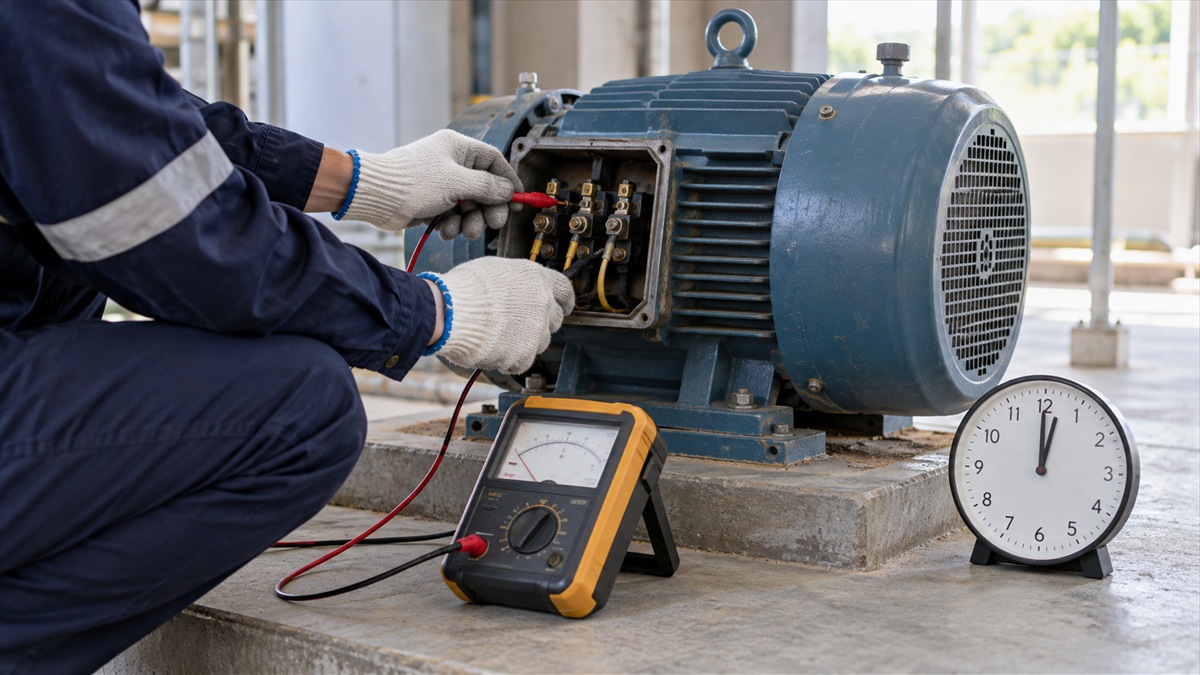
The PI test is a ratio. The RuoShui listing defines it as the resistance reading at 10 minutes divided by the reading at 1 minute, with the test voltage applied for each period. A related DAR check uses 15 seconds and 60 seconds instead. Both ratios show how insulation resistance changes over time. A single reading cannot show that change.
A megohmmeter measures the resistance of insulators. The same source says its high DC voltages are typically from 500 V to 5 kV. The three listings here test at voltages from 50 V up to 2500 V, so they sit below that typical range. The PI result is a ratio, not a pass or fail score. None of the three listings gives an acceptance value for the ratio, so check the standard your equipment follows. For the wider equipment category, see insulation resistance test equipment.
What to check before you buy a PI-capable tester
Timed readings
A PI check needs readings at 1 minute and at 10 minutes. The RuoShui listing describes a timing function: you set the measurement time, and the instrument stops when that time comes. The Megger and ToolSentryX listings do not describe timed readings. The listing does not say whether either one can capture both points, so confirm this on the product page before you buy.
Test voltage
The MIT310-EN lists 250, 500 and 1000 V. The RuoShui lists 50, 100, 250, 500, 1000, 1500, 2000 and 2500 V. The M500 is fixed at a stable 500 V. Choose the voltage your standard or your equipment manual requires, and pick a tester that offers it. If the 1000 V step is the one you need, compare the 1000 V megger options before you choose.
Resistance range
The M500 measures up to 1000 MΩ. The MIT310-EN style field reads 1000 megaohms resistance. The RuoShui title says 100 Ω, but its bullet says insulation resistance measurement as high as 100 GΩ. These two statements conflict, so rely on neither until you confirm the figure on the product page. The M500 gives one fixed voltage, so its listing offers no voltage choice to check against a resistance range.
Safety rating
A CAT rating tells you which circuits the tester is built for. Measurement category II covers measurements on circuits directly connected to the low-voltage installation. The RuoShui listing states CAT III 600V, pollution degree II, and compliance with IEC 61010-1 and IEC 61557. The MIT310-EN lists IEC 61326 and IEC 61010-1, and it has a live circuit warning, but the listing does not state a CAT rating. The M500 listing does not state a CAT rating either.
How to choose
Choose a PI-capable tester if your work calls for a 1-minute and 10-minute reading. Choose a tester whose listed voltage matches your equipment standard. Choose a tester whose listed CAT rating suits the circuit. If a listing states no CAT rating, do not use that tester on household mains.
Two of the three listings do not mention PI at all. That does not decide their quality. It does mean you must confirm the timing function before you buy for a PI check.
When a PI reading is more than you need
If your job asks for one resistance reading at one voltage, a PI-capable tester adds a timing function you will not use for that job. The M500 covers a fixed 500 V check. The MIT310-EN covers three listed voltages and does not claim timed readings. Choose the RuoShui only when the PI or DAR ratio is part of the job.
Warranty and calibration
The MIT310-EN listing states a three-year warranty and mentions a calibration certificate. It does not state a calibration interval. The RuoShui and M500 listings do not state a warranty in their details. Ask the seller for both documents before you buy if either one matters to your work.
Picks in detail
RuoShui 60F: best for PI and DAR readings
The listing describes insulation resistance PI (polarization index) measurement and a DAR (absorption ratio) measurement. Its timing function sets the measurement time and stops automatically. The listing offers test voltages from 50 V to 2500 V and says it has automatic voltage release. Its power field reads corded electric, and the listing does not say whether it also runs on batteries. It is the only one of the three listings that names a DAR measurement. Its title and bullets disagree on resistance range, as described above. Choose it if PI is the reason you are buying. Skip it if you need a clearly stated resistance range before you buy.
Megger MIT310-EN: best for voltage choice and brand
This is a digital and analog insulation tester from Megger, with a listed test voltage of 250, 500 and 1000 V. The listing says it has a live circuit warning and is weatherproof to IP54, with a three-year warranty. Its specifications list IEC 61326 and IEC 61010-1, and the item weighs 2.2 pounds. The listing mentions a calibration certificate. It does not state a CAT rating or a PI function. Choose it if you want a recognized brand and three listed test voltages. Skip it if you need a PI reading the listing does not describe.
ToolSentryX M500: best fixed 500 V check
The listing says it measures insulation resistance up to 1000 MΩ at a stable 500V output. It is battery powered and includes a soft carrying pouch. Its title calls it digital, but its bullet describes an analog scale divided into Good, Caution, and Bad zones. The listing does not give the numbers behind those zones, so do not read them as pass or fail limits. The listing describes the tester as suited to compressors, motor windings, transformers, panels and control circuits. Choose it for a fixed 500 V resistance check. Skip it if you need a listed CAT rating or a timed PI reading.
1. 60F Insulation Resistance Tester, Megommeter 100 Ω, Testing Voltage for250V, 500V or 1000V (Best for PI and DAR)
Specs from the listing (checked 2026-10-16):
- Brand: RuoShui
- Measurement Type: Ohmmeter
- Power Source: Corded Electric
Pros
- Lists PI and DAR measurements
- States CAT III 600V and pollution degree II in the bullets
Cons
- Title and bullet give different resistance ranges
- Listing does not say whether it also runs on batteries
Best for: Readers who need a polarization index reading
Skip if: You need a clearly stated resistance range before you buy
View on Amazon (affiliate link)
2. Megger MIT310-EN Digital/Analog Insulation Tester, 250/500/1000 V Test Voltage (Best for voltage choice)
Specs from the listing (checked 2026-10-11):
- Brand: Megger
- Specification Met: IEC 61326, Iec61010-1
- Item Weight: 2.2 pounds
Pros
- Three listed test voltages
- Brand named in the listing
Cons
- Listing does not state a CAT rating
- Listing does not describe a PI or timed reading
Best for: Readers who want a known brand with three test voltages
Skip if: You need a PI reading the listing does not describe
View on Amazon (affiliate link)
3. M500 Megohmmeter Insulation Tester, 500V Digital Megger Meter Measures Up to 1000 MΩ, Portable HVAC (Best fixed 500 V check)
Specs from the listing (checked 2026-10-11):
- Model: M500
- Compatible Devices: Electrical devices and systems
- Power Source: Battery Powered
Pros
- Fixed 500V output stated in the listing
- Resistance up to 1000 MΩ stated
Cons
- Title says digital, bullet says analog scale
- Listing gives no numbers for the Good, Caution and Bad zones
Best for: Readers who need a fixed 500 V resistance check
Skip if: You need a listed CAT rating or a timed PI reading
View on Amazon (affiliate link)
Side-by-side comparison
The table compares only what each listing states. A blank cell means the listing does not say.
| Listing | Test voltages | Resistance range | CAT rating | PI or timed reading | Power source |
|---|---|---|---|---|---|
| RuoShui 60F | 50 V to 2500 V in listed steps | 100 GΩ in a bullet, 100 Ω in the title | CAT III 600V | PI, DAR and timing function | Corded electric |
| Megger MIT310-EN | 250, 500 and 1000 V | 1000 megaohms in the style field | Not stated | Not described | Battery powered |
| ToolSentryX M500 | Fixed 500 V | Up to 1000 MΩ | Not stated | Not described | Battery powered |
Checklist before you buy
- Timed readings: confirm the tester can record a reading at 1 minute and at 10 minutes.
- Test voltage: confirm the voltage your standard or manual requires is offered.
- CAT rating: confirm a rating that suits the circuit is stated in the listing.
- Resistance figure: confirm the range on the product page, especially for the RuoShui.
- Power source: confirm whether the tester runs on batteries or mains before you plan the job.
- Documents: ask for the calibration certificate and warranty terms if either one matters to you.
The PI is 800 divided by 200, which equals 4. Check the division: 200 times 4 equals 800, so the result holds. A PI of 4 is a ratio, not a score. None of the three listings gives an acceptance value for it, so compare the result against the standard for your equipment.
Worked example: test voltage steps
The MIT310-EN offers 250 V, 500 V and 1000 V, so its top step is 1000 V divided by 250 V, which equals 4 times its lowest step. The RuoShui lists steps up to 2500 V, so its top step is 2500 V divided by 1000 V, which equals 2.5 times the 1000 V step. Use the step your standard names, and check that the tester offers it.
Mistakes to avoid
Assuming every insulation tester does PI. Two of the three listings never mention PI or timed readings. Check the listing for a timing function before you buy for this test.
Mixing up 100 Ω and 100 GΩ. The RuoShui title and bullet give two different resistance figures. Confirm the figure before you rely on it.
Reading the M500 zones as limits. The listing gives a Good, Caution and Bad scale without numbers. Look up the limit in your standard.
Skipping the CAT rating. The listing does not state a CAT rating for two of the three testers. Under the listing rule, a tester without a stated rating does not belong on household mains.
Connecting leads without the manual. OSHA’s rule says listed or labeled equipment shall be installed and used in accordance with any instructions included in the listing or labeling. Follow the maker’s manual for leads and voltage, and ask a licensed electrician to do panel or high-voltage work. For a plain overview of the controls, see how to use a megger tester.
Ignoring the power source. The RuoShui field reads corded electric. The MIT310-EN and M500 listings say battery powered. Check the power source before you plan where and how you will use the tester.
FAQ
What is a megger PI test?
It is a ratio of two insulation resistance readings. The RuoShui listing defines it as the reading at 10 minutes divided by the reading at 1 minute, with the test voltage applied for each period. It shows how the resistance changes over time.
Is a PI test the same as a DAR test?
No. The RuoShui listing lists both. DAR uses 15 seconds and 60 seconds, while PI uses 1 minute and 10 minutes.
Can a multimeter run a PI test?
A multimeter measures voltage, resistance and current. The three listings here describe dedicated insulation testers with set test voltages. Check your multimeter’s manual before you use it for an insulation test, and do not assume it can take timed readings at these voltages.
Which test voltage should I pick?
Follow the voltage your standard or equipment manual requires. The RuoShui lists several steps up to 2500 V. The M500 is fixed at 500 V.
Why do the RuoShui listing figures disagree?
Its title says 100 Ω, while a bullet says insulation resistance measurement as high as 100 GΩ. The listing does not explain the difference, so confirm the range before you buy.
Does the Megger need calibration?
The MIT310-EN listing mentions a calibration certificate, but it does not state a calibration interval. Check the manual or the seller’s documents for the interval.
Is an insulation tester safe for household mains?
Only if its listing states a CAT rating that suits the circuit. The RuoShui listing states CAT III 600V. The MIT310-EN and M500 listings do not state a CAT rating, so do not use them on household mains until the rating is confirmed.
Bottom line
Choose the RuoShui 60F if you need a PI or DAR reading and a stated CAT rating. Choose the Megger MIT310-EN if you want a recognized brand with three listed test voltages, and confirm its timing function first. Choose the M500 only for a fixed 500 V resistance check. Whatever you buy, follow the maker’s manual, and ask a licensed electrician for panel or high-voltage work.
Sources
- Megohmmeter: a megohmmeter measures the resistance of insulators, with high DC voltages typically from 500 V to 5 kV
- Measurement category: category II is for measurements performed on circuits directly connected to the low-voltage installation
- 29 CFR 1910.303: listed or labeled equipment shall be installed and used in accordance with any instructions included in the listing or labeling