Best DVOM Meter: Digital Multimeters Compared by Specs
As an Amazon Associate we earn from qualifying purchases. Details
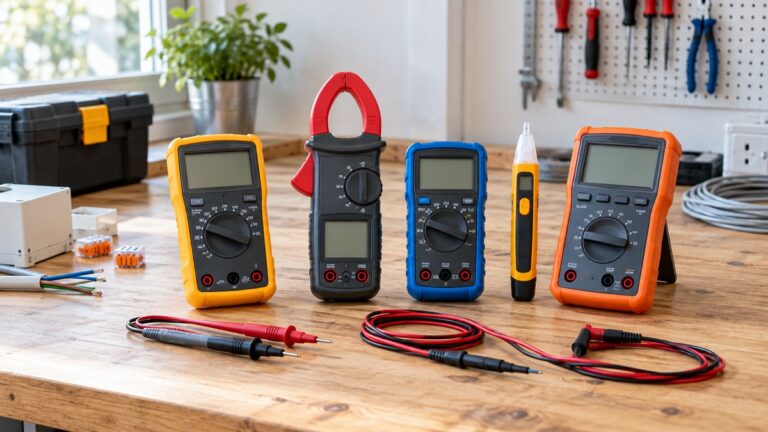
What is the best DVOM meter for your work? A DVOM, or digital volt-ohm meter, is a digital multimeter. It measures voltage, resistance and current, and some models add temperature or capacitance. The right choice depends on the functions you need, how the meter ranges, the CAT rating stated for it, and whether you need true RMS. This guide sets out those criteria first, then the five multimeter-type models below, each judged only by what its own listing says. Read the specs against your job before you buy.
Quick answer
Choose a DVOM with a stated CAT rating if your readings may be on mains circuits, and confirm that the rating suits the point you measure. Choose an auto-ranging model with true RMS if you want the meter to pick the range and you measure distorted waveforms. Choose a manual-range model if you prefer to set the range yourself and need only basic readings. Choose a meter with a backlit display and data hold if you often work in dim spaces. Check the manual before any mains use, and stop at any panel or service job.
What matters for a DVOM
A digital multimeter gives numeric readings and is more precise than an analog meter with a moving pointer. That precision is the main reason DVOMs became the common bench and field tool. A multimeter can measure voltage, resistance and current, and some models add temperature or capacitance, so the function list is the first thing to check.
Five criteria decide most choices in this category:
- Ranging. Some listings name manual range selection, and others name auto-ranging. Manual range means you set the range on the dial. Auto-ranging means the meter selects it. Read the listing’s range field before you buy.
- CAT rating. Measurement category II covers circuits directly connected to the low-voltage installation, and category IV covers measurements at the source. The category must suit the point you measure, and the rating must be stated for the meter, not only for its leads.
- True RMS. A true RMS converter gives a more correct value than an averaging meter. Averaging meters use a correction factor that is valid only when the input is sinusoidal, so distortion or offsets cause errors. If your circuits may be distorted, look for true RMS in the listing.
- Count and display. A count figure tells you the resolution of the reading. Backlight and display size affect how easily you read the number in dim or cramped spaces.
- Fuses and protection. Fuses have specific current and voltage ratings, breaking capacity and response times. Overload protection is a stated feature in several listings, so note the fuse rating and replace it only with the rating the manual gives.
How to choose
Start with the functions you use most. If voltage and resistance are your main readings, a standard DVOM is enough. If current is your main reading on live conductors, a clamp is the better tool, and you should compare clamp models instead. For work on mains or distribution circuits, the CAT rating comes before the feature list. A meter without a stated rating is not one to use on household mains.
Next, decide how much you want the meter to do. An auto-ranging meter removes a setting step, which suits a user who wants fewer decisions at the probe. A manual-range meter gives you direct control and often costs less time to learn, though the listing may not say so. Finally, check the extras that matter for your space: a backlight, data hold, a stand, or a carrying case.
Where each model fits
The five models below show the range of this category. Each write-up relies on that listing’s own specs, so check the listing before you buy. Use the picks as a shortlist, not as a ranking.
1. AstroAI Digital Multimeter Tester 2000 Counts with DC AC Voltmeter and Ohm Volt Amp Meter; Measures (Compact manual-range multimeter)
Specs from the listing (checked 2026-10-11):
- Model: AM33D
- Range Selection: Manual
- Digital Display: 2000 Counts. The unit symbols will automatically appear according to the measured functions
- Fuse Protection: mA: F250 mA/250 V Fuse;10 A: F10 A/250 V Fuse
- Environmental Conditions: CAT II 600 V; CAT Ill 300 V
Pros
- Range Selection is listed as Manual, so the rotary switch sets the range
- The digital display is listed as 2000 Counts, with unit symbols that appear for each function
- Fuse Protection lists F250 mA/250 V and F10 A/250 V fuses
Cons
- Range Selection is Manual, so you choose the range yourself on each reading
- Sample speed is listed as 3 times per second in the specs and 2 times per second in a bullet, so the listing is inconsistent
- The power line names 2 x 1.5 V AAA batteries, while the included components name a 9V battery
Best for: Basic voltage, resistance and DC current checks where a compact manual-range meter is enough.
Skip if: You want auto-ranging, or a clamp for reading current on live conductors.
View on Amazon (affiliate link)
2. ANENG Digital Multimeter with Case,DC AC Voltmeter,Ohm Volt Amp Meter (Multifunction with battery test)
Specs from the listing (checked 2026-10-11):
- Model: SZ301
- Max Count: 2000 Count
- MultiFunction Test: Diode;On-OFF Detection;Data Retention;Live Detection;NCV Sensing;Reverse Display;Auto Shut-down;Smart Anti-burn;
- Battery Test: 12V/9V/7.5V Battery
Pros
- Max Count is listed as 2000 Count
- A battery test for 12V/9V/7.5V batteries is listed
- NCV sensing and live detection appear in its MultiFunction Test field
Cons
- Its display is listed as an LED screen, with no backlight named in the specs
- Its included components field reads only a slash, so the accessories are not named
- No CAT rating appears in its specs, so check the manual before any mains use
Best for: Battery checks and general bench measurements, where NCV and live detection add value.
Skip if: You need a stated CAT rating or a backlit display for dim spaces.
View on Amazon (affiliate link)
3. Digital Multimeter Voltmeter Battery Voltage Multi Tester Continuity Ohm Volt Amp DC AC Current (Large backlit display with stand)
Specs from the listing (checked 2026-10-11):
- Model: XL830L
- Measurement Type: Multimeter
- Style: modern
- Included Components: multimter
Pros
- The bullets list a 2.7-inch large backlit LCD display with Data Hold
- A fold-out stand lets the meter stand on a bench, as the bullets state
- The listing states a 2-year quality guarantee and includes a 9V battery
Cons
- Its included components field reads multimter, a misspelling, so confirm the kit contents before buying
- Its specs give no current range, so check the manual before any current measurement
- No CAT rating appears in its specs, so check the manual before mains work
Best for: Shop or home use where a large backlit display and a stand help readability.
Skip if: You need a stated CAT rating or detailed current ranges in the listing.
View on Amazon (affiliate link)
4. 2026 Upgraded FS899L Digital Multimeter, 6000 Counts True RMS Auto-Ranging AC/DC Voltage Tester (True RMS with CAT III and CAT IV)
Specs from the listing (checked 2026-10-11):
- Specification Met: Cat.iii 1000v, Cat.iv 600v
- Measurement Type: Multimeter
- Style: modern
- Part Number: FS899L-1
Pros
- The specs list CAT III 1000V and CAT IV 600V
- True RMS is stated with a 6000-count resolution
- A 4.8-inch color screen, a built-in flashlight and Data Hold are listed
Cons
- Its included components name only an instruction manual, so leads and a case are not stated
- Charging is listed as USB-C with a 2-hour charge, so plan the charge before a field day
- The title says auto-ranging, so this model is not a manual-range meter
Best for: Field work where a stated CAT III and CAT IV rating matters to you, and a color screen helps.
Skip if: You want a simple meter with a manual range dial, since the title lists auto-ranging.
View on Amazon (affiliate link)
5. FNIRSI DMC-100 Clamp Meter 9999 Counts TRMS, 600A AC/DC Amp Meter (Clamp multimeter with recording)
Specs from the listing (checked 2026-10-11):
- Model: FNIRSI-DMC-100
- Measurement Type: Ammeter, Multimeter, Ohmmeter, Voltmeter
- Item Highlight: Graph Recording, 2″ TFT, Rechargeable Multimeter, AC/DC Current Clamp, Voltage, Resistance, Capacitance & NCV for HVAC & Auto
- Included Components: Clamp Meter*1, Multimeter Pen*2, Temperture Probe*1, Type-C Charging Cable*1
Pros
- Voltage, resistance, capacitance, frequency and temperature are listed alongside current
- Real-time curve recording stores 8 sets of real-time data plus 30 sets of historical records
- A 1500mAh lithium battery with Type-C charging is stated
Cons
- The clamp jaws measure current only, and voltage must use the test leads
- Its Style field reads AC Current while the title says AC/DC, so confirm DC current in the manual before relying on it
- No CAT rating for the meter appears in its specs, so check the manual before mains work
Best for: Recorded readings across voltage, resistance and current in one handheld unit.
Skip if: You want voltage and resistance only, with a stated CAT rating on the listing.
View on Amazon (affiliate link)
Common mistakes
- Buying for the function list alone. A long list does not mean every function is strong. Check the ranges and accuracy figures in the listing.
- Assuming a CAT rating for the whole kit. A rating on the leads does not make the meter rated. Look for the meter’s own rating in the specs or manual.
- Ignoring the range setting. On a manual-range meter, a wrong range can give a misleading reading. Check the dial or display before you read.
- Using an averaging meter on distorted circuits. A true RMS reading is the more correct choice in that case.
- Replacing a blown fuse with a different rating. Use the fuse rating the manual gives. A protective device that does not match is a hazard.
- Treating a clamp multimeter as a clamp-only tool. Clamp multimeters add functions, and the jaws still read current only.
Worked example: picking for a mixed workload
Job one is battery checks, job two is continuity on wiring, and job three is current on a running motor. Suppose each job takes 2 readings per visit, and the shop makes 5 visits a week. The total is 2 plus 2 plus 2 equals 6 readings per visit set, and 6 times 5 equals 30 readings a week. Check the arithmetic: 30 divided by 5 equals 6, so each visit set holds six readings. Two of the three jobs are voltage or resistance work, so a DVOM covers most of the week. The third job needs a clamp, which a DVOM does not replace.
FAQ
What does DVOM stand for?
DVOM stands for digital volt-ohm meter. In practice it is another name for a digital multimeter, which measures voltage, resistance, and current. For a broader guide to voltage meters, see What Does a Voltage Meter Do.
Is a DVOM the same as a clamp meter?
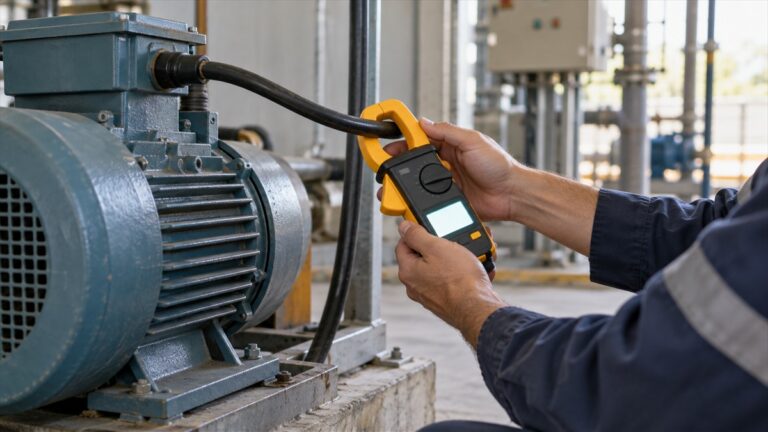
Not always. A DVOM measures voltage and resistance and usually current through its own connection. A clamp meter reads current by opening its jaws around a conductor without breaking the circuit. Some models combine both roles, so check the function list.
Do I need true RMS in a DVOM?
It matters when the waveform may be distorted. True RMS is the more correct method in that case. If your work is mostly on clean sinusoidal circuits, the difference may be small, but the listing should still name the method.
Is auto-ranging better than manual ranging?
Neither is better in every case. Auto-ranging removes a setting step, and manual ranging gives you direct control. Choose by how you work, and check the range field in the listing.
Do I need a CAT rating on a DVOM?
If you measure on mains or distribution circuits, yes. The category must suit the point you measure. Look for a stated rating on the meter, and confirm it in the manual before any mains work. For a related overview, see Best Digital Volt Meter.
Can a DVOM measure a car battery?
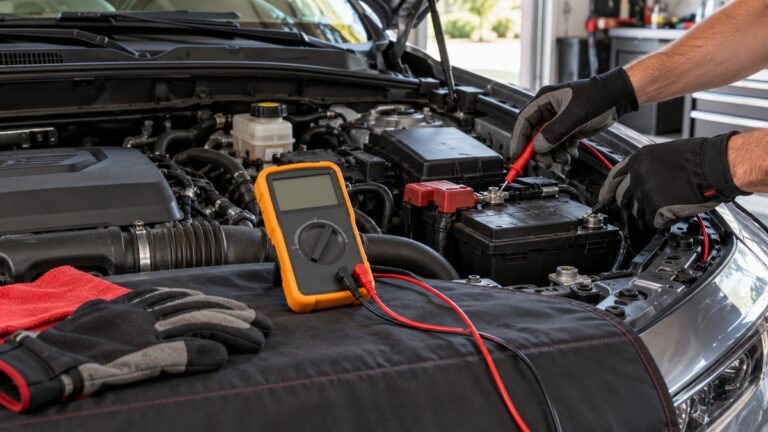
Many listings name battery checks, and some name automotive use. Follow the manual’s instructions and handle batteries safely. Never work on airbag or high-voltage hybrid or EV systems. For a car-focused guide, see Best Digital Voltage Meter for Car.
Which should I buy first?
Start with the readings you take most often. If voltage and resistance dominate, a DVOM is the first purchase. Add a clamp later if current on live conductors becomes a regular task. For a clamp comparison, see Esr Meter vs Multimeter.
Bottom line
A DVOM is a practical first tool for voltage, resistance and everyday current checks. Choose one with a stated CAT rating if you work on mains. Choose auto-ranging for fewer settings and manual ranging for direct control. Confirm the fuse rating, the display and the function list in the listing before you buy, and follow the manual on every reading.
Sources
- Multimeter, Wikipedia: what a multimeter measures and its intrinsic safety features
- Measurement category, Wikipedia: CAT II and CAT IV definitions and impulse voltages
- True RMS converter, Wikipedia: averaging meters and distorted waveforms
- Electrical resistance and conductance, Wikipedia: resistance and the ohm
- Circuit breaker, Wikipedia: overcurrent protection that can be reset
- OSHA electrical safety: most frequent causes of electrical injuries and ways to reduce risk