Best 110v Outlet Tester: How to Choose from Five Listings
As an Amazon Associate we earn from qualifying purchases. Details
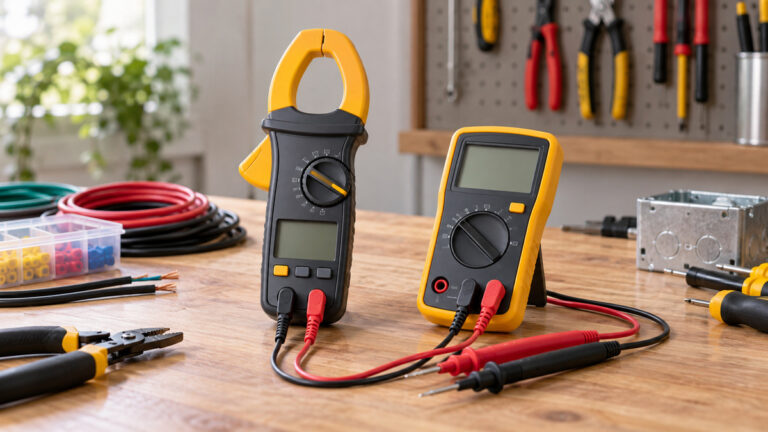
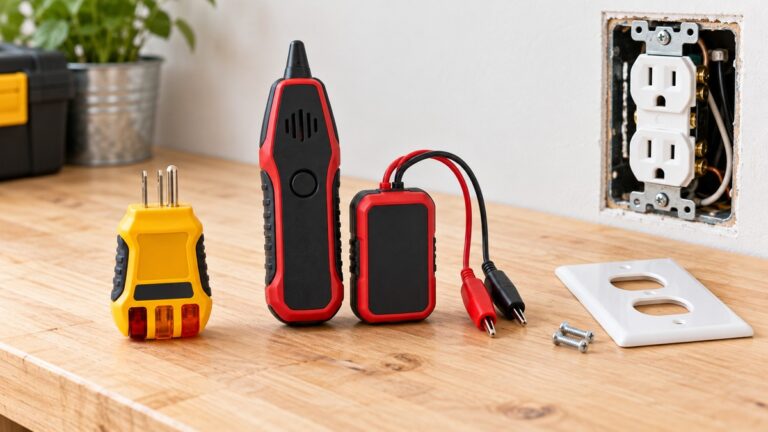
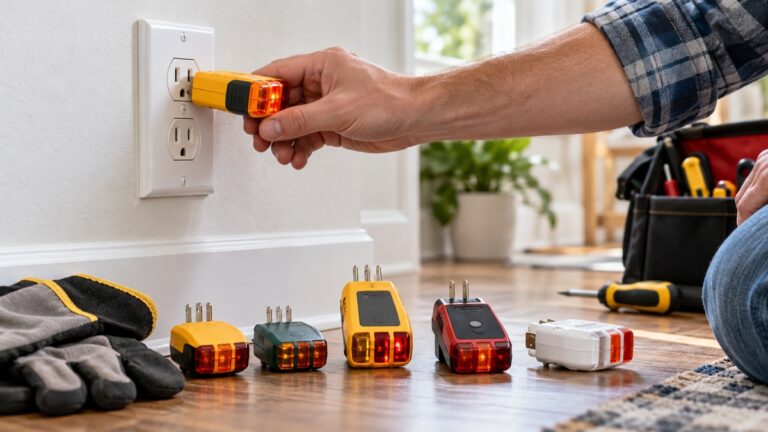
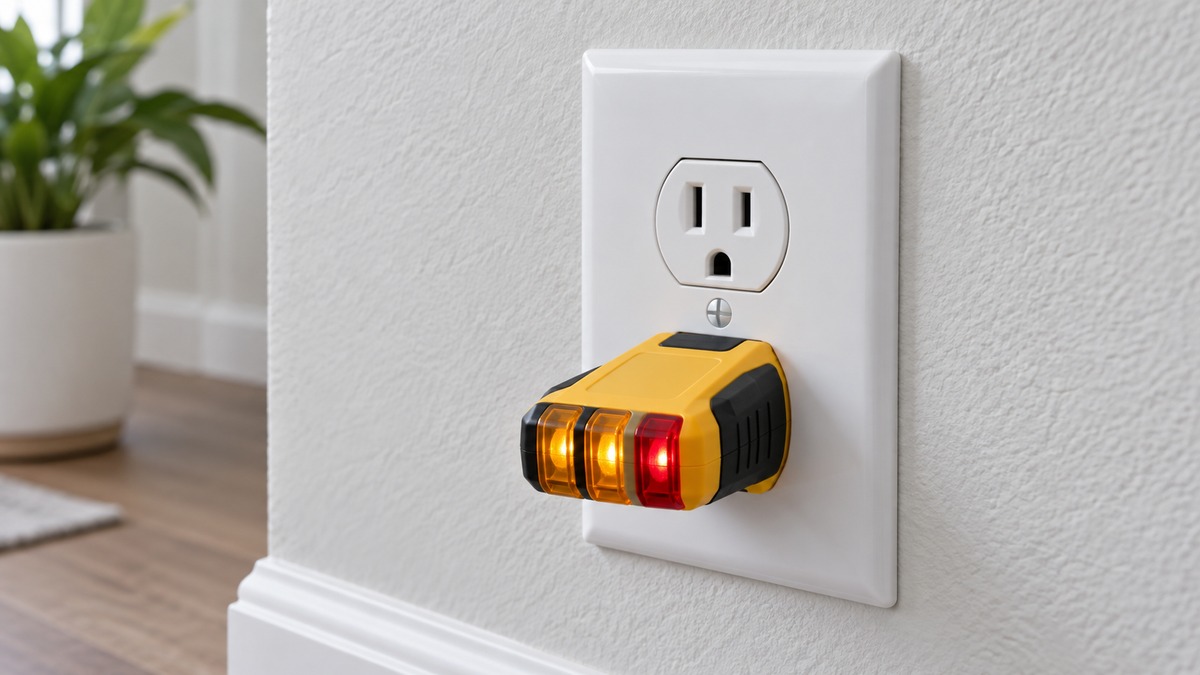
A 110v outlet tester is a small plug-in or handheld tool that checks whether a receptacle has power, whether its wiring is correct and whether its GFCI protection works. The listings in this group differ more than their titles suggest. Some are plug-in style checkers, some are breaker finders with a transmitter and a receiver, and one is a multimeter kit. Compare the voltage range each listing states before you compare anything else, because the stated ranges are not the same. Mains wiring can kill. Check the meter’s CAT rating against the circuit, follow the tool’s manual, and leave panel or service work to a licensed electrician. This guide shows how to pick the right type of 110v tester for outlet checks and breaker tracing, and it sticks to what each listing says.
Quick answer
Pick by the job first. If you only need to confirm that a receptacle has power, that its wiring is correct and that a GFCI works, a plug-in style tester or a kit with a GFCI tester covers it. If you need to find which breaker feeds an outlet or light, choose a breaker finder with a transmitter and a receiver. If you also need resistance, continuity or a voltage reading with a number, a multimeter kit is the right category, but confirm its ranges first. For any choice, confirm that the voltage range matches the circuit you test. Do not use a tool on mains wiring until its listing or manual gives a CAT rating that suits the circuit.
What matters for a 110v outlet tester
This search is about a standard wall receptacle, not a panel, a motor or a sealed device. That changes what to check. These six points matter most, and each one changes which tester fits.
The stated voltage range
Read the range as a claim to confirm. One listing gives a 90-135V display range, the most direct figure in this group. Another gives a 90-150 V range in one bullet and 90-120V AC circuits in a second bullet. When two figures appear for the same tool, rely on neither until the manual confirms the working range. Several listings state no voltage range at all, so check the listing before you assume it covers your circuit. For a plug-in style check of the same kind of receptacle, see 3-prong outlet tester options.
How faults are reported
Testers report wiring conditions in different ways. Some use three lights and a chart. Others show a condition name on an LCD. A named fault is quicker to act on, but only if you know what it means. Look for the faults the listing names, such as open ground, open neutral, reversed polarity and a missing live. Where a listing does not name its faults, treat its lights as presence signals only. For a closer look at one fault, see open ground checks.
GFCI testing
A GFCI tester is a separate function from a three-light check. A residual-current device, also called a ground fault circuit interrupter or GFCI, interrupts a circuit when the current in its line and neutral conductors is unequal. That imbalance points to current leaking to ground or to an unintended path. Several listings in this group describe a GFCI test function. Treat it as a check on a device’s status, not as a repair or a stand-in for the device. For the polarity side of the same check, see outlet polarity checks.
Non-contact voltage detection
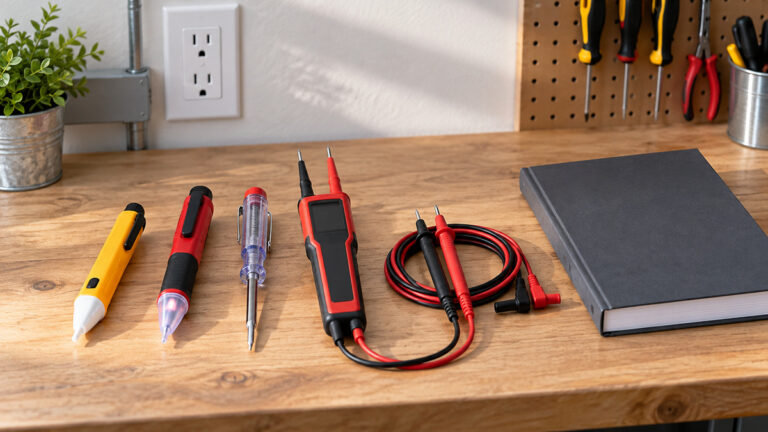
Non-contact voltage detection finds voltage on insulated conductors without touching metal. A test light is simpler than a multimeter, and it often suffices to check whether a conductor is live. Read a non-contact pen as a presence signal, not a measurement. Treat any LED or warning tone as a yes-or-no indication until the manual says otherwise.
Safety rating and certification marks
Check the CAT rating before any mains use. Measurement category II is for measurements performed on circuits directly connected to the low-voltage installation, and an outlet check involves that kind of circuit. The listings in this group state safety text in different places. One specification field reads Cat II 300v. A safety line in another listing mentions CAT II 135V but is cut off in the listing copy. Several listings show no CAT rating at all. A UL or ETL mark is a certification, and it is not the same thing as a CAT rating. Do not treat one as the other.
Adapters and accessories
Adapters decide where you can test. A light socket adapter lets you test a lamp circuit from the fixture. A three-prong to two-prong adapter helps with older two-slot receptacles. An alligator clip lead lets you grip a bare wire without holding it by hand. Count the accessories in each listing and check that the count matches the title. One listing in this group names a three-piece set but lists only an adapter as its included component, so the count is a real check, not a formality.
How to choose
Choose by job first, then check the numbers. Choose a plug-in style check if you only need presence, polarity and GFCI status at one receptacle. Choose a breaker finder if the problem is locating which breaker controls an outlet or light. Plug the transmitter into the circuit and scan with the receiver, as the listings describe. Choose a multimeter kit only if you also need resistance, continuity or a measured voltage, and only after you confirm its CAT rating.
Choose a 110v tester by its stated range. Where the listing gives a voltage range, that range has to cover the circuit you test. A tool that meets only two of the three needs (voltage range, CAT rating and accessories) is a weak match.
Before you buy, write down three things: the voltage you expect on the circuit, the CAT rating your work needs and the adapters your receptacles require. Compare each listing against that list, and skip any listing that misses one of them.
Breakers, fuses and what a finder can show
A circuit breaker protects a circuit from current in excess of what the equipment can safely carry. Unlike a fuse, a breaker can be reset, manually or automatically, to resume normal operation. A breaker finder answers a narrower question: which breaker feeds a given receptacle or light. It does not tell you whether that breaker or the wiring behind it is in good condition. Those questions belong to the manual and to the steps it describes, not to a guess.
Fuses behave differently. A fuse is a sacrificial device. Once it has operated, it is an open circuit and must be replaced. Replacement fuses carry specific current and voltage ratings, so match the rating the label or manual gives, and never fit a larger one to stop a nuisance blow. If a finder points you to a fuse rather than a breaker, the replacement rule is the one that matters.
Batteries and upkeep
Battery power is part of the job. The listings in this group use different cells, from a 9V and AAA set to 1.5v cells, so check the battery type before you buy spares. A low-battery alert and an automatic shut-off help prevent battery drain, which is worth looking for on any battery-powered tester. Store the tester with its batteries in the state the manual recommends, and keep the case closed so the indicators and leads stay protected.
Inspect the leads and the housing before each use. A cracked housing, a frayed lead or a loose adapter is a reason to stop and replace the part, not to keep working with it. Keep the adapters with the tester, so the right one is ready when a receptacle needs it.
Products that fit this
Each card below gives the product’s stated fields, its main pros and cons, and who should skip it. Check those fields against your circuit before you buy.
1. Klein Tools 80025 Outlet Tester Kit, 2-Piece (Quick GFCI and presence check)
Specs from the listing (checked 2026-10-11):
- Model: 80025
- Included Components: GFCI Outlet Tester (Cat. No. RT210)
- Measurement Type: Voltmeter
- Item Highlight: GFCI Tester and Non-Contact Voltage Tester Pen, Perfect for Home Inspection
Pros
- Pairs a GFCI tester (RT210) with a non-contact voltage pen (NCVT1P) in one kit
- Green LED shows operating status, while a red LED and warning tone signal detected voltage
- The non-contact pen detects voltage in cables, circuit breakers, lighting fixtures and switches
Cons
- No voltage range appears in the listing text, so check the manual before using it on a circuit
- The specs label the measurement type as Voltmeter, but the bullets describe detection and LED indicators rather than a numeric reading
- No CAT rating appears in the listing, so it is not for mains work until the manual states one
Best for: Checking a single receptacle for presence and GFCI status, with the pen as a quick presence test.
Skip if: You need a numeric reading or a stated CAT rating for the circuit you are working on.
View on Amazon (affiliate link)
2. Circuit Breaker Finder Kit with GFCI Outlet Tester for 90-135V AC Circuits,includes Light Socket (Stated 90-135V display range)
Specs from the listing (checked 2026-10-11):
- Model: FTCT 01
- Specification Met: ETL
- Power Source: Battery Powered
- Included Components: 1 circuit breaker finder kit,3 batteries,1 user manual,1 accessory kit
Pros
- The LCD shows real-time voltage across a stated 90-135V range, plus signal strength for tracing
- The kit includes a light socket adapter, a 3-prong to 2-prong adapter and an alligator clip lead
- The specs list ETL as the specification met, and the set ships with 3 batteries
Cons
- The part number ST06 with accessory does not match the model FTCT 01 in the same listing, so confirm the unit before you buy
- Battery power with a 9V and two AAA cells means keeping a spare set on hand for field use
- The safety line naming CAT II 135V is cut off in the listing copy, so confirm the CAT rating in the full listing or manual
Best for: Users who want a visible voltage readout across a 90-135V range and adapters in the box.
Skip if: You need a model and part number that match, or a CAT rating you can read in full before mains work.
View on Amazon (affiliate link)
3. Circuit Breaker Finder Kit, Electrical Circuit Tracer with Digital Multimeter, GFCI Outlet Tester (Multimeter plus breaker tracer)
Specs from the listing (checked 2026-10-13):
- Style: Industry
- Part Number: V100X
- Included Components: adapter
- Power Source: Battery Powered
Pros
- Adds a digital multimeter that the listing says supports up to 600V detection, with AC and DC voltage, resistance and continuity
- Combines a breaker finder, a GFCI outlet tester and a multimeter in a single portable carrying case
- The GFCI test is described as flagging open ground, open neutral, open hot and reversed polarity
Cons
- Included Components reads only adapter while the title says 3-Piece, so the accessory count is unclear
- One bullet cites max 300V detection for the upgraded model and another cites 600V for the multimeter; these are separate functions, so neither is an overall rating
- No CAT rating appears in the listing text, and the multimeter's safety rating has to come from its manual
Best for: Buyers who want a multimeter and an outlet tester in one kit and will check the manual for ratings.
Skip if: You want one clear voltage range, a stated CAT rating or a fully listed accessory set.
View on Amazon (affiliate link)
4. Circuit Breaker Finder Kit – 1-Second Breaker ID, 7 Wiring Faults Diagnosis, Live Voltage & Hz (Named wiring faults on an LCD)
Specs from the listing (checked 2026-10-13):
- Specification Met: Ul Listed
- Measurement Type: Voltage
- Included Components: Circuit Breaker Finder Transmitter, Receiver, 1.5v Battery*4,
- Maximum Alternating Current: 100 milliamps
Pros
- The LCD names each wiring condition across 7 states, so you do not need to decode indicator lights
- The transmitter display shows live voltage and circuit frequency in Hz alongside the wiring condition
- The specs list UL Listed as the specification met, and the kit includes light socket, 3-to-2 prong and alligator clip adapters
Cons
- No input voltage range appears in the listing, and the 100 milliamp maximum alternating current in the specs is a current figure that does not describe outlet voltage
- Number of Items reads 5 while the included list names a transmitter, a receiver and batteries, so confirm the piece count on arrival
- UL Listed is a certification mark, not a CAT rating, so no CAT rating appears for mains use
Best for: Tracing which breaker controls an outlet or light, then reading the wiring state from the LCD.
Skip if: You need a multi-function meter, a stated voltage range or a CAT rating before mains testing.
View on Amazon (affiliate link)
5. Vansdon Circuit Breaker Finder with LCD, GFCI Outlet Tester,Circuit Tracer (Stated Cat II 300v with adapters)
Specs from the listing (checked 2026-10-13):
- Specification Met: Cat II 300v
- Model: BF-2000
- Warranty Description: 2 Years Manufactuer
- Compatible Devices: Electrical circuits,Wiring,Standard electrical outlets and fixtures
Pros
- The specification field reads Cat II 300v, a rating you can compare with the circuit before use
- The GFCI trip test function is listed alongside a receiver with non-contact voltage testing
- The set includes a 3-to-2 prong ground adapter, a light socket adapter and an alligator clip adapter, described as a 7-in-1 set
Cons
- One bullet gives a 90-150 V range and another gives 90-120V AC circuits; rely on neither number until the manual confirms one
- Item dimensions read 10 x 2 x 50 inches, which suggests a data-entry error, so confirm the size on the box
- The manufacturer field names Oudong while the brand is Vansdon, so confirm the seller and warranty before buying
Best for: Buyers who want a stated Cat II rating and the 7-in-1 accessory set the listing describes.
Skip if: You need one consistent voltage range or a brand and manufacturer that match.
View on Amazon (affiliate link)
Counting checks for six receptacles
Take a garage with six receptacles on two circuits. Make two checks for each receptacle: one for presence and wiring, and one for GFCI status where the receptacle is GFCI-protected. The total is 6 times 2 equals 12 checks. Split across two circuits, 12 divided by 2 equals 6 checks per circuit. If your tool covers presence and GFCI status in one pass, you need one pass per circuit. If it covers only presence, add a second pass or a second tool for the GFCI checks. Write down each result by receptacle, so you can compare the same receptacle after any repair.
Mistakes to avoid
- Buying on the title alone. Titles carry ranges and certification claims that the bullets and specs may not repeat, or may contradict. Read the fields.
- Treating a presence signal as a measurement. An LED or pen that signals voltage does not give you a number.
- Treating a UL or ETL mark as a CAT rating. They answer different questions.
- Assuming the model matches the part number. Two fields in one listing can disagree, so match the model on the box to the listing before you buy.
- Skipping the manual. OSHA’s rule for listed equipment says it must be installed and used in line with the instructions included with its listing or label, so the manual is part of the job.
- Running tester leads over sharp edges or through pinch points. OSHA’s rule on flexible cords says they must be protected from accidental damage, and a damaged lead can give a wrong result.
- Buying a breaker finder when you need a meter. A breaker finder locates a circuit. It does not replace a meter with a stated CAT rating.
FAQ
Is a 110v outlet tester enough to confirm GFCI protection?
A GFCI check verifies the status of that device’s protection function, as the listings describe. It does not confirm every receptacle downstream, and it does not replace the steps in the manual. Use it as one check among several, and follow the manual for the exact sequence.
Can a breaker finder tell me a panel is safe to open?
No. A breaker finder traces a circuit to its breaker using a transmitter and a receiver. It does not rate a panel as safe. Use it only as its manual describes, and stop before any step that needs a panel cover removed.
What does CAT II mean on a tester label?
Measurement category II is a classification for measurements on circuits directly connected to the low-voltage installation. It is a category, not a guarantee of safety. Match it to the circuit, and read the manual for the limits that apply.
Is a test light the same as a multimeter?
No. A test light checks whether a conductor is live, and it is simpler than a multimeter. A multimeter measures voltage, resistance and current, and some models add temperature or capacitance. Pick the one that answers the question you have.
Why do listings give different voltage ranges for similar tools?
Some listings put a range in the title, another in a bullet and a usage range in a third place. Treat each one as a claim to confirm. Compare the manual’s range with the circuit, and do not average two figures from one listing. If a listing says 120v in its title, see 120v outlet tester options for the same voltage check.
Can a non-contact pen show the exact voltage?
A non-contact pen detects voltage on insulated conductors and signals that it is present. Only some listings in this group show a live voltage value on a display, so check the listing before you expect a number.
What should I do if a listing has no CAT rating?
Do not use the tool on mains wiring until the manual gives a CAT rating that suits the circuit. Keep any use of it within the steps the manual describes.
Bottom line
Choose by the job, then confirm the numbers in the listing and the manual. Use a plug-in style or GFCI-capable check for one receptacle, a breaker finder when you need to trace a circuit, and a multimeter kit only when you need readings and have confirmed its CAT rating. Skip any tool whose stated range does not match your circuit, and any tool whose CAT rating you cannot confirm for mains work.
Sources
- Measurement category: CAT II covers measurements on circuits directly connected to the low-voltage installation.
- Residual-current device: a GFCI interrupts a circuit when line and neutral currents are unequal.
- Test light: non-contact test lights detect voltage on insulated conductors and are simpler than a multimeter.
- Multimeter: measures voltage, resistance and current, and some models add temperature or capacitance.
- Circuit breaker: protects a circuit from excess current and can be reset to resume normal operation.
- OSHA 29 CFR 1910.303: listed or labeled equipment is installed and used according to its listing or label instructions.
- OSHA 29 CFR 1910.305: flexible cords must be protected from accidental damage.
- OSHA electrical safety: the most frequent causes of electrical injuries, and ways to reduce the risk.