MULBRANTEX DC Hi-Pot Tester Review
As an Amazon Associate we earn from qualifying purchases. Details
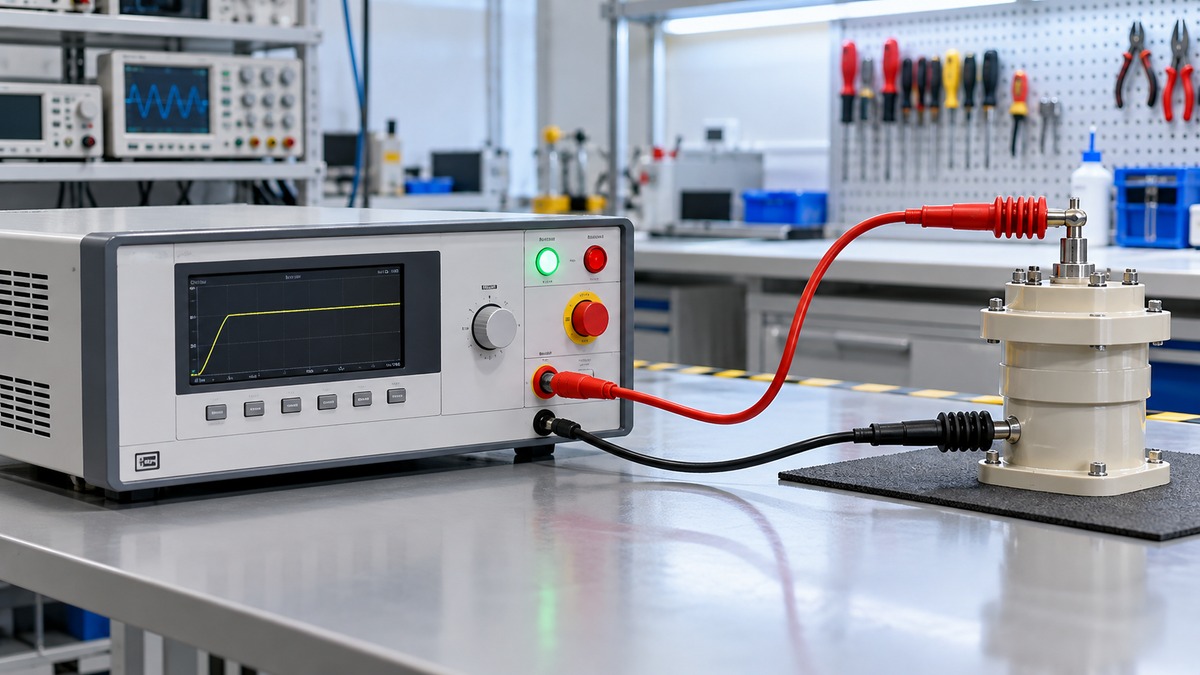
If you are looking for a tool to check components such as transistors, Zener diodes, LEDs and electrolytic capacitors, the MULBRANTEX NY38 is a DC withstand voltage tester with a listed output range of 0 to 3800 volts DC. It is battery powered, charges through a Type-C connection, and comes with alligator clips with wire, two test wires and a user manual. The listing gives its size as 3.94 inches by 1.5 inches by 1.18 inches and its weight as 4.06 ounces. It is built for component withstand and insulation voltage checks, not for general multimeter readings. This page explains what the listing covers, what it leaves out, and how to decide whether the tester fits your work.
Quick answer
The MULBRANTEX DC withstand voltage tester is a compact, battery-powered unit with a listed output range of 0 to 3800 volts DC. it is aimed at component testing: transistors, Zener diodes, LEDs, electrolytic capacitors and similar parts, plus insulation voltage checks on switches and buttons. It is not a multimeter, not a non-contact voltage detector and not a general insulation-resistance tester. The listing also leaves out several specifications that any withstand test depends on, so confirm those before you rely on the device for a task.
You can review the product information for this tester on Amazon. This review draws only on the listing data: the title, the bullet points, the specification fields and the product description. It does not report measurements or any safety validation of the device.
What a withstand voltage tester does, and what it does not
A dielectric withstand test applies a higher voltage than normal operation to see whether the insulation between points can hold it. An insulation-resistance tester measures how well insulation resists current at a set test voltage. These are separate instruments. The product information does not claim that the MULBRANTEX device replaces either one. For insulation-resistance readings, see our insulation resistance tester guide.
The product information names its main purpose as withstand voltage and insulation voltage testing of components. If your task calls for a multimeter reading, a continuity check or a non-contact voltage check, this device is not the right tool. Start by stating the test you need to perform, then check whether this device is built for it.
Who this review is for
The product information is written for electronics technicians and maintenance workers who test the withstand behavior of semiconductors and other components. It is most relevant to a person who:
- Tests component withstand voltage on a bench, as opposed to measuring circuits in normal operation.
- Needs a compact tool that can be carried between work areas. The listed item dimensions are 3.94 inches by 1.5 inches by 1.18 inches.
- Works in an environment where high-voltage test equipment is already governed by written procedures and training.
A reader who needs a general meter for everyday electrical work should look elsewhere. The product information makes the same point by describing the device as a component withstand tester, not a general meter. For a general meter, compare the multimeter guide.
Decision criteria
Five questions help you decide whether this tester fits the work.
Test purpose. the listing’s stated purpose is DC withstand and insulation voltage testing on components. Confirm that your task falls within that purpose before you consider any other feature.
Voltage range. The listing describes an output range of 0 to 3800 volts DC. does not give the output current, the accuracy, the ramp behavior, the trip or leakage threshold, or how the voltage is set and displayed. Those details matter for any withstand test, and the product information does not provide them.
Output type. The device is described as DC only. The product information does not describe AC output, so do not assume the tester can perform AC withstand tests.
Power and portability. The listing describes a battery-powered unit with a built-in lithium battery that charges through a USB Type-C connection. The battery runtime and the charging status indicators are not described in the bullets that were supplied, so the user manual is the place to check them.
Included parts. the package/listing includes the tester, alligator clips with wire, two test wires and a user manual. Knowing the box contents in advance helps you plan the setup, but the product information does not describe the clips’ ratings or the lengths of the wires.
Product specifications
The table below uses the figures that appear in the product information.
| Specification | Listed value |
|---|---|
| Brand and model | MULBRANTEX, NY38 |
| Output range (title) | 0 to 3800 V DC |
| Power source | Battery powered, rechargeable through Type-C |
| Included components | Withstand voltage tester, alligator clips with wire, two test wires, user manual |
| Item dimensions | 3.94 x 1.5 x 1.18 inches |
| Measurement type | “Voltmeter” (specification field) |
| Item highlight | Component withstand voltage tester for MOSFET, transistor, Zener diode, electrolytic capacitor, IGBT, MOV, LED and SCR |
The measurement-type field says “Voltmeter,” which does not match a withstand-voltage tester. Treat that field as a listing inconsistency to clarify with the seller before purchase, and rely on the stated purpose and the description for what the device does.
What the listing says the device is for
The bullets list the components the device is intended to test: NMOS and PMOS transistors, IGBTs, transistors, SCRs, Zener diodes, LEDs, rectifier bridges, varistors, ceramic gas discharge tubes and electrolytic capacitors. They also describe checking the insulation voltage of switches and buttons, and the insulation between parts.
The bullets make several broader claims. They say the tester can illuminate cold cathode fluorescent lamps in a display, that it is useful for judging the performance of high-power semiconductor devices, and that it can screen out components with insufficient voltage resistance. does not include test results that support them.
The listing also says the device differs from general multi-function component testers because it specializes in 0 to 3800 volts DC withstand and insulation testing. That focus is the most useful statement in the product information for a buyer who needs one specific kind of test.
Strengths in the product information
A narrow, defined purpose. the product information is clear that this is a DC withstand tester for components, not a general meter. For a technician who needs that one function, a focused tool is easier to evaluate than a multi-function instrument.
A compact size. The item dimensions are small, and The listing describes a light, portable unit. That suits a technician who moves between benches.
A listed set of components. The bullets name the component types the device is meant for, so you can check your own parts against the list before you buy.
A stated charging method. The Type-C charging connection is a listed feature, which may simplify charging if your workplace already uses that cable standard.
Purchase decision: where this product fits
0-3800V DC Hi-Pot Tester is easiest to evaluate as a fit decision, not as a universal recommendation. Its stated design can be useful when the dimensions, included parts, and intended use described above match your exact setup. It is a weaker choice when you need a capability the product information does not explicitly provide.
Buy it when
- The stated size and configuration fit the space or equipment you already have.
- The included components replace separate purchases you would otherwise need.
- The limitations described in this review do not interfere with your main use case.
Avoid it when
- A missing compatibility measurement would determine whether it works at all.
- You need proof of performance beyond the manufacturer’s stated specifications.
- A simpler product would solve the same problem without unused features.
Before ordering, verify the two or three measurements that control fit. This single check is more useful than relying on a broad “works for most” description.
Limitations and cautions
The listing leaves several points open, and several of them matter for safety and for the validity of any test.
- The output current, accuracy and trip or leakage behavior are not provided. Without them, you cannot judge the device against a test standard from the product information alone.
- The bullets describe the output as stable and precise, and as adjustable to different standards. Those are claims. does not state the adjustment steps, the resolution or any tolerance.
- The bullets are partly truncated , including the description of the battery and charging details.
- The measurement-type field reads “Voltmeter,” which conflicts with the device’s stated purpose.
- The listing describes a high-voltage output. High-voltage test equipment can cause serious injury if used incorrectly. Read the manufacturer’s user manual before you use the device, and follow your organization’s safety rules and any training requirements.
- does not include safety certifications, and this review does not treat any manufacturer-stated claim as a safety validation.
What to verify before buying
Before you buy, check the following with the seller or in the manual:
- That the device’s purpose matches your work: DC withstand or insulation testing on components, not general measurement.
- The output current, accuracy, and trip or leakage behavior, which the product information does not provide.
- The battery runtime, and how the battery indicator and charging status work, as shown in the manual.
- A corrected measurement-type field, and the seller’s return and warranty terms.
- Whether your organization’s procedures allow this type of device, and whether the user manual is available in the language your team reads.
A job-first decision check
Start with the required test standard, output voltage, current limit, trip behavior, accuracy, and calibration requirements. The listing’s 0-to-3800-volt DC range is only one part of that decision. If the procedure requires a documented leakage threshold, a particular ramp profile, traceable calibration, or an AC hipot output, do not infer those capabilities from the voltage range. Confirm them in the manual or choose an instrument whose documentation states them plainly.
Worked example: checking the listed range
The listing gives an output range of 0 to 3800 volts DC. Subtracting the low end from the high end gives a span of 3800 volts, so any setting you plan to use has to fall inside that span. The same listing gives a size of 3.94 inches by 1.5 inches by 1.18 inches, and the range does not tell you whether the unit fits your bench, so check both numbers before you plan the setup.
Frequently asked questions
Is this a general electrical troubleshooting meter? No. The listing positions it as a specialized withstand and insulation-voltage tester, not as a replacement for a multimeter or clamp meter.
Can the maximum voltage alone establish compatibility? No. The test method and safety controls matter as much as the headline voltage. Match the complete specification to the component, governing procedure, and workplace rules before use.
Conclusion
The MULBRANTEX NY38 is a compact, battery-powered DC withstand voltage tester with a listed range of 0 to 3800 volts DC, aimed at component testing. It is not a substitute for a multimeter or an insulation-resistance tester. The listing leaves out several specifications that matter for high-voltage work, and its measurement-type field conflicts with its purpose. Read the manufacturer’s manual, confirm the missing details with the seller, and do not treat any manufacturer-stated claim as a safety validation.
Sources
- – https://www.amazon.com/dp/B0G8ZLMFQH/?tag=bestmultimeter0f-20