FKM TRMS Clamp Meter Review: Ratings and Limits
As an Amazon Associate we earn from qualifying purchases. Details
Before anything else, match the FKM TRMS clamp meter’s listed CAT III 600V rating to the circuits you plan to work on. A rating below the circuit’s category or voltage is a safety problem, not a minor gap in the specification, so check it first. Then confirm that the AC current limits and the functions you need, such as voltage, resistance or temperature, all appear on the product page.
The 6000-count display and backlight help when you are reading values in poor light, but they come second to rating and range. This review works only from the figures the product page gives and does not report any bench test. Follow the meter’s manual and your local electrical rules for any work, and treat any point the page leaves out as a question to settle before you buy.
Quick answer
The FKM meter is a battery-powered TRMS clamp meter with 6,000 counts. The specs state a CAT III 600 volt rating and IEC 61010-2-032 compliance. The listing’s bullets say it measures AC current only, not DC current. It also measures AC and DC voltage, frequency, duty cycle, resistance, capacitance, diode, continuity and temperature, and includes a non-contact voltage detection function. The listing’s model label conflicts between the title and the bullets, so confirm the model on the product page. Mains electricity can kill, so work on live circuits only if you are trained and qualified to do so.
What to check in a TRMS clamp meter
Four details decide whether this meter fits. Each one can rule it in or out.
1. Rating and category. The specs state CAT III 600 volts and pollution class 2. The CAT system classifies live circuits used in measurement. The source describes CAT II as circuits directly connected to the low-voltage installation, and CAT IV as the source of the high-voltage installation. CAT III sits between them. The meter’s rating must suit the circuit you measure, and a rating of 600 volts does not cover higher voltages.
2. AC current only. The bullets say the meter measures AC current only, not DC current, and that the clamp must be placed on a single wire rather than the whole cord. The current ranges in the specs are 60 amps and 600 amps, with a lower start of 10 milliamps. Check that the function and the ranges match your measurement before you buy. For a wider comparison of AC and DC clamp meters, the AC and DC current clamp meter guide covers the options.
3. Measurement functions. The specs list AC and DC voltage, frequency, duty cycle, capacitance, resistance, diode and continuity, and temperature. The temperature range is listed as negative 40 to 1,832 degrees Fahrenheit. The listing describes auto-ranging, data hold and a relative mode. Read the accuracy line for the function you will use, because each function has its own accuracy figure.
4. Display, power and model. The display is backlit, and the listing includes an LED flashlight for dim spaces. It has a low battery indicator and auto power-off after 15 minutes. The title and bullets name different models, with the title naming FKM and the bullets naming a TS-18B. Confirm the model before you order. The true RMS digital clamp meter guide explains what the True-RMS label means for a reading.
Use these rules to choose:
- Choose this meter if you need an AC current clamp with a CAT III 600 volt rating and you will measure AC current only.
- Choose a different meter if you need DC current, because the listing says it does not measure DC current.
- Choose a different meter if you need a rating above 600 volts or a model label that the listing confirms.
1. FKM Clamp Meter,TRMS 6000 Counts,Digital Clamp Multimeter Voltage Tester (Review verdict)
Specs from the listing (checked 2026-10-13):
- Specification Met: Iec 61010-2-032, Cat Ill 600v, Pollution Class 2
- Maximum Display: 6000 counts
- AC Currente: 60A/600A [10mA~600A / 50Hz~60Hz-Range] :±(2.5%+5),10Hz~20kHz:±(0.1%+5)
- Power Source: Battery Powered
- Color: Black-18B
Pros
- CAT III 600 volt rating and IEC 61010-2-032 stated in the specs
- True-RMS measurement with 6,000 counts, per the title and specs
- Backlit display and LED flashlight, per the bullets
Cons
- Measures AC current only, according to the bullets
- model label differs between the title and the bullets
- No warranty term stated
Best for: A reader who needs an AC clamp with a stated CAT III 600 volt rating and voltage, resistance and continuity in one tool.
Skip if: Skip if you need DC current, a rating above 600 volts, or a confirmed model label.
View on Amazon (affiliate link)
The FKM TRMS clamp meter
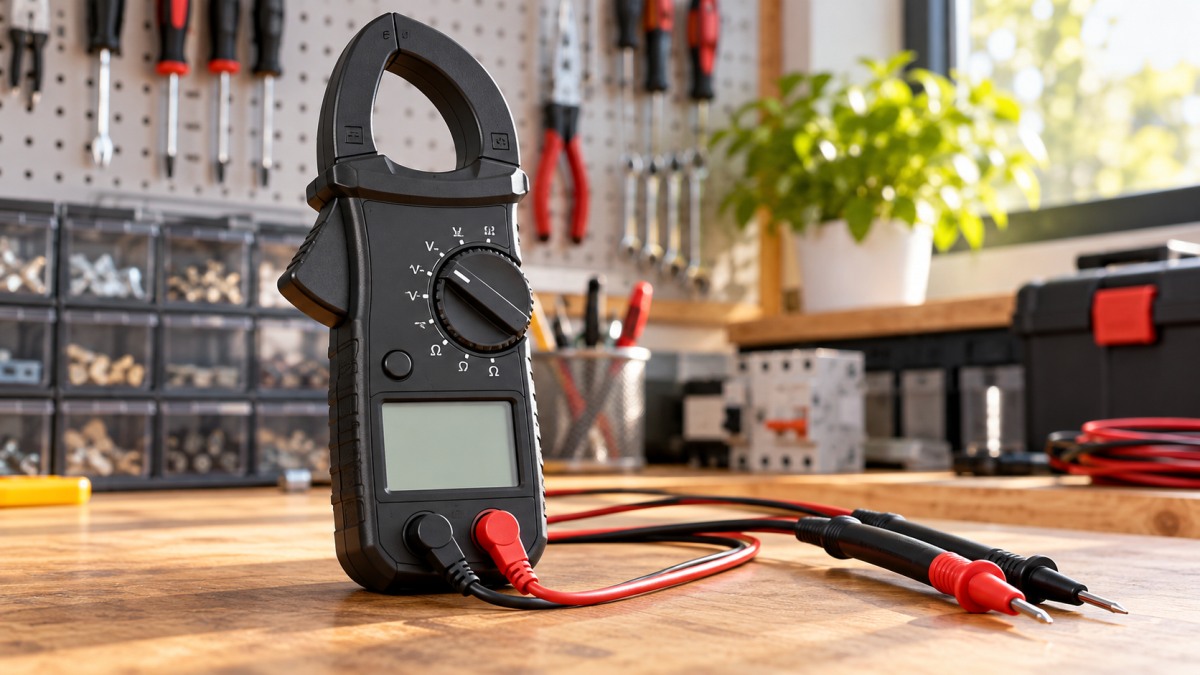
The FKM meter is a digital clamp multimeter with True-RMS measurement and 6,000 counts. The specs give the meter’s power source as battery, and list the specification met as IEC 61010-2-032, CAT III 600 volts and pollution class 2. The AC voltage range is 6, 60 and 600 volts, with a listed 600-volt top. The DC voltage range runs from 600 millivolts to 600 volts. The bullets describe a non-contact voltage detection function, a backlit screen and an LED flashlight.
The meter fits a reader who needs a clamp for AC current, with a stated CAT III rating, and who wants voltage, resistance and continuity in the same tool. The backlit display and flashlight help in a dim space.
The listing has several things to check. The bullets say it measures AC current only, while the specs list a DC voltage function. Those are different measurements, so read both before you rely on them. The model label differs between the title and the bullets. The bullets also describe the non-contact voltage function as a safety feature, which the listing describes but does not test here. The listing gives no warranty term.
Who should skip it: a reader who needs DC current measurement, a reader who needs a rating above 600 volts, and a reader who is not trained to work near live conductors.
Electrical safety first
Mains electricity can kill. Before you use any clamp meter, check the meter’s rating against the circuit you plan to measure, and check that the function you need is one the listing states. The source explains that the CAT system classifies circuits, and that a meter’s category must suit the circuit’s position in the installation.
Follow the meter’s manual for how to clamp, read and store data. The bullets say to clamp around a single wire rather than the whole cord, which the manual should confirm for the setup you have. Follow your local electrical rules, and ask a licensed electrician if the work is outside your training. This review does not describe how to measure any circuit.
Battery, display and care
The listing describes a low battery indicator and auto power-off after 15 minutes, which saves the battery when the meter is idle. The backlit screen is useful in dim spaces, and the LED flashlight helps you see the connection point. The bullets describe a durable exterior that resists scratches from accidental drops.
Keep the meter clean and dry, and check the jaw, the leads and the case for damage before each use. Replace the battery when the low battery indicator shows, as the manual describes.
Worked example: how far a 120-volt reading sits below the 600-volt rating
Compare that voltage with the meter’s listed 600-volt rating, so you can see the margin the rating leaves.
- Listed rating: 600 volts, from the specs.
- Circuit reading in this example: 120 volts.
- Margin below the rating: 600 minus 120 = 480 volts.
Check the arithmetic again. 600 minus 120 is 480.
The example shows that the rating covers a 120-volt reading with a wide margin. The rating is a limit, not a guarantee of safety, and the category must still suit the circuit. Confirm the category before you measure.
How a current clamp measures
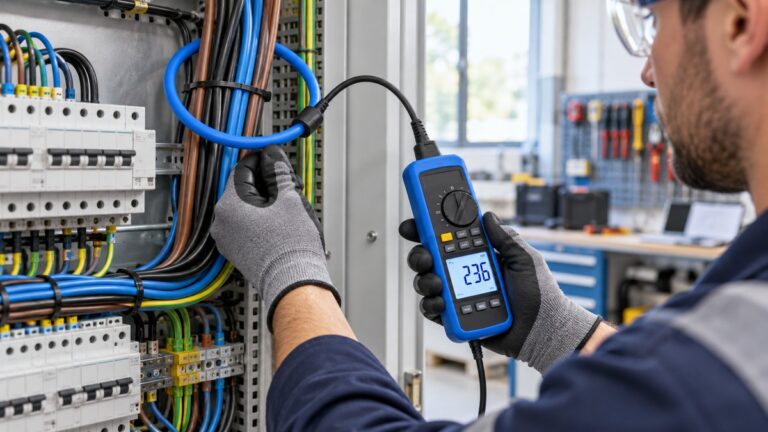
A current clamp, also called a current probe, has jaws that open around a conductor, so the current can be measured without making contact with it or disconnecting it, according to the Wikipedia overview of current clamps. The same source says clamps are typically used to read alternating current, and that some clamp meters measure 1,000 amps and more. The source describes three main types. The current transformer type works only with AC, and the Hall effect type can measure both AC and DC.
The FKM bullets say the meter measures AC current only. That matches the AC-only current transformer type described in the source, but the listing does not name the type it uses, so ask the seller or read the manual before you assume a DC reading is possible.
Why True RMS matters for a clamp reading
Many meters convert an AC signal to an equivalent DC value by averaging a rectified signal and applying a correction factor. The Wikipedia overview of true RMS converters says that factor is correct only if the signal is sinusoidal. True RMS is more correct, because it works from the square root of the average of the squared waveform, and it stays accurate for distorted waveforms, which need a more complex circuit.
The FKM title and specs say True-RMS, so the meter is designed to read distorted waveforms more accurately than an averaging meter. The listing does not give an accuracy figure for each function, so read the accuracy line on the product page before you rely on a reading.
Five common mistakes
- Assuming DC current. The bullets say the meter measures AC current only.
- Clamping the whole cord. The bullets say to clamp a single wire.
- Trusting one model label. The title and bullets name different models.
- Ignoring the rating. The rating is CAT III 600 volts.
- Skipping the manual. Follow the manual for how to clamp, read and store data.
FAQ
Does this meter measure DC current?
No. The bullets say it measures AC current only.
What rating does it have?
The specs state CAT III 600 volts and pollution class 2, with IEC 61010-2-032 compliance.
What is the display count?
The specs give 6,000 counts.
Does it have a flashlight?
Yes. The listing includes an LED flashlight.
How long does it stay on?
The listing says auto power-off after 15 minutes.
Does it come with a warranty?
The listing gives no warranty term.
Bottom line
The FKM meter suits a reader who needs an AC clamp with a stated CAT III 600 volt rating, a backlit display and voltage, resistance and continuity in one tool. It does not measure DC current, and the model label differs between the title and the bullets. Before using it, confirm the model and the rating for your circuit, read the manual, and follow your local electrical rules. Mains electricity can kill.
Sources
- Measurement category, Wikipedia: CAT II for circuits directly connected to the low-voltage installation, and CAT IV for the source of the high-voltage installation.
- Current clamp, Wikipedia: clamps measure current without contact, AC types, and the Hall effect type that measures AC and DC.
- True RMS converter, Wikipedia: averaging meters are correct only for sinusoidal signals; true RMS is more correct for distorted waveforms.