ETCR6500 Leakage Current Clamp Meter Review
As an Amazon Associate we earn from qualifying purchases. Details
If you are considering the ETCR6500 leakage current clamp meter, start by checking whether its listed range and resolution fit the leakage readings you need to take. A clamp meter is only as useful as the range it covers, and a display too coarse for your target value will not help you judge anything. Compare the accuracy figure against the level of precision your job needs before looking at the rest.
Because mains circuits carry real risk, the safety notes matter as much as the specifications. Read the meter’s manual and follow your local electrical rules before you clamp onto any conductor. This review works only from the figures the product page gives for range, accuracy, resolution, interface and battery. It does not claim any field test was run on the meter.
Quick answer
The ETCR6500 is a battery-powered AC clamp meter with a listed range of 0.00 milliamps to 300 amps, a resolution of 10 microamps, and a 4-digit LCD. The listing gives accuracy bands by range, and a USB interface for uploading stored data. It runs on a 9-volt alkaline battery. The listing does not state a CAT category, so check the rating on the product page or in the manual before you use it on any circuit. Mains electricity can kill, so work on live circuits only if you are trained and qualified to do so.
What to check in a leakage current clamp meter
Four details decide whether this meter fits. Each one can rule it in or out.
1. Range and resolution. The listing gives a range of 0.00 milliamps to 300.0 amps and a resolution of 10 microamps. A low-current range is useful for leakage work, and a high-current range covers the main load. Check that the range covers the current you expect to measure, and do not assume a range the listing does not state.
2. Accuracy by range. The listing gives accuracy bands. From 0 to 59 amps, it gives plus or minus 1.5 percent plus 5 digits. From 60 to 199 amps, it gives plus or minus 2 percent plus 5 digits. From 200 to 300 amps, it gives plus or minus 4 percent plus 5 digits. The accuracy is stated for a temperature of about 23 degrees Celsius and below 70 percent humidity. Read the band that matches your reading.
3. Electrical rating. The listing says line measurement below DC 600 volts, and it does not state a CAT category. The CAT system is a method for classifying live circuits used in measurement. The source describes CAT II as circuits directly connected to the low-voltage installation, and CAT IV as the source of the high-voltage installation. The meter’s rating must suit the circuit you measure. Do not assume a rating the listing does not give.
4. Interface and battery. The listing gives a USB interface, so you can upload stored data to a computer. It runs on a 9-volt alkaline battery, which the listing names as a 6LR61. The listing describes peak hold, data hold and data storage functions, which help you read a reading after the clamp is removed.
For other clamp styles, the best leakage current clamp guide and the AC and DC current clamp meter guide compare the options. Use these rules to choose:
- Choose this meter only if its range and accuracy match the measurement you need, and its electrical rating is confirmed for your circuit.
- Choose a different meter if you need a stated CAT category on the listing, because this listing does not state one.
- Choose a different meter if you need a rating for a higher voltage than the listing gives.
1. ETCR6500 AC Leakage Current Clamp Meter 0.00mA-300A with USB Interface (Review verdict)
Specs from the listing (checked 2026-10-11):
- Range: 0.00mA~300.0A
- Resolution: 10uA
- Accuracy (23℃±3℃, below 70%RH): 0~59A: ±1.5%±5dgt | 60A~199A: ±2%±5dgt | 200A~300A: ±4%±5dgt
- Line Voltage: Line measurement below DC 600V
- Power Supply: Alkaline dry battery 6LR61 9V
Pros
- Range of 0.00 milliamps to 300.0 amps, per the specs
- Resolution of 10 microamps, per the specs
- USB interface for uploading stored data, per the specs
Cons
- No CAT category stated in the listing
- Accuracy is stated for a narrow temperature and humidity band
- Line voltage given as below DC 600 volts, with no AC rating stated
Best for: A reader who needs a leakage current reading in the listed range and has confirmed the meter's rating for the circuit.
Skip if: Skip if you need a stated CAT category, a rating above the listed line voltage, or you are not trained to work near live conductors.
View on Amazon (affiliate link)
The ETCR6500 AC leakage current clamp meter
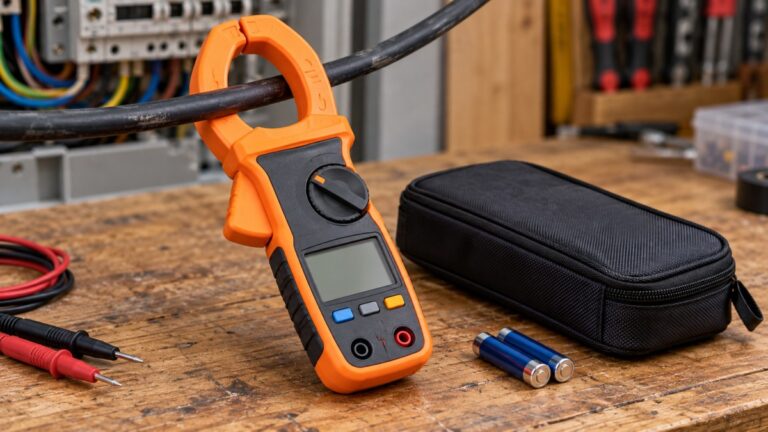
The ETCR6500 is a digital clamp meter listed for AC leakage current, AC current and online AC current. The specs give the meter size as 184 by 70 by 37 millimeters, the meter weight as 250 grams, and the color as black and red. The test mode is clamp CT with an integration method. The frequency is detected automatically at 50 or 60 hertz. The sampling rate is about two times per second.
The meter fits a reader who needs a low-current leakage reading with a USB link to a computer, and who works within the meter’s electrical rating. The peak hold and data hold functions help when the reading is hard to see in place.
The listing has several things to check. The listing does not state a CAT category, which is the key safety rating for a meter used on mains circuits. The accuracy is stated for 23 degrees Celsius, plus or minus 3 degrees, and below 70 percent humidity, so readings in other conditions may differ from the figure. The bullets describe the meter as an essential tool for electrical safety inspection, which is the maker’s description.
Who should skip it: a reader who needs a stated CAT category on the listing, a reader who will measure circuits above the listed 600-volt line rating, and a reader who is not trained to work near live conductors.
Electrical safety first
Mains electricity can kill. Before you use any clamp meter, check the meter’s rating against the circuit you plan to measure. The source explains that the CAT system classifies circuits, and that a meter’s category must suit the circuit’s position in the installation. The listing does not state a category for this meter, so do not use it on a circuit you cannot confirm.
Follow the meter’s manual for how to clamp, read and store data. Follow your local electrical rules, and if the work is outside your training, ask a licensed electrician. This review does not describe how to measure any circuit, and it does not replace the manual.
Battery and data from the listing
The listing gives a 9-volt alkaline battery. The listing does not show whether the battery comes in the box, so check the box contents. Replace the battery when the display shows it is low, as the manual describes. The USB interface uploads stored data to a computer, and the listing says the software lets you monitor and query history.
Keep the meter dry, store it in a clean place, and check the jaw and the leads for damage before each use.
Worked example: how far the reading sits above a 30-milliamp setting
The threshold is a planning value and not a figure from the listing. Compare the reading with the threshold, so you can see the margin.
- Threshold: 30 milliamps.
- Reading: 25 milliamps.
- Margin below the threshold: 30 minus 25 = 5 milliamps.
Check the arithmetic again. 30 minus 25 is 5.
The example shows a 5-milliamp margin below a threshold we chose. A reading close to the threshold calls for a closer look, because the accuracy band for the range applies to the reading. Use the meter’s manual to set the threshold for your own circuit.
What leakage current means
Leakage is the unintended flow of current out of the circuit it is meant to stay in. The Wikipedia overview of electronic leakage says that leakage of this kind can cause damage, fires, RF noise and electrocution, and that a high-voltage leak can be fatal to a person who touches it. The same source says leakage can be detected by finding that the current at one point in a circuit does not match the current at another.
The ETCR6500 is listed as an AC leakage current clamp, with a range of 0.00 milliamps to 300 amps and a resolution of 10 microamps. The listing does not explain how to place the clamp for a leakage reading, and the manual is the source for that. The fine resolution matters for small leakage currents, but it does not change the meter’s rating, which the listing does not state.
Clamping a conductor
The current clamp type the source describes, a split ring that opens around one conductor, works on AC current. The ETCR6500 listing describes clamp CT as its test mode, with an integration method. The bullets say to clamp around a single wire, not a whole cord, and that is the setup the listing describes. Follow the manual to confirm the method for the leakage reading you need, and keep the jaws closed on the conductor only.
Five common mistakes
- Assuming a CAT category. The listing does not state one, so check the rating before use.
- Ignoring the accuracy band. The accuracy changes with the range you read.
- Trusting the title’s range alone. The listed range is 0.00 milliamps to 300.0 amps.
- Using it outside its line rating. The listing says line measurement below DC 600 volts.
- Skipping the manual. Follow the manual for how to clamp and read the meter.
FAQ
Does this meter have a CAT rating?
The listing does not state a CAT category. Check the product page or the manual before using it on a circuit.
What range does it measure?
The listing gives 0.00 milliamps to 300.0 amps, with a resolution of 10 microamps.
What is the accuracy?
The listing gives plus or minus 1.5 percent plus 5 digits from 0 to 59 amps, plus or minus 2 percent from 60 to 199 amps, and plus or minus 4 percent from 200 to 300 amps.
What battery does it use?
Can I download the data?
The listing says the meter has a USB interface, and that stored data can be uploaded to a computer.
Is it safe to use on any circuit?
No meter is safe on any circuit. Check the listed electrical rating against the circuit, follow the manual, and ask a licensed electrician if the work is outside your training.
Bottom line
The ETCR6500 suits a reader who needs a leakage current reading in the listed range, has confirmed the meter’s electrical rating for the circuit, and can work safely with the manual. The listing gives accuracy bands, a USB interface and a 9-volt battery, but it does not state a CAT category. Before use, check the rating, read the manual, and follow your local electrical rules. Mains electricity can kill.
Sources
- Measurement category, Wikipedia: CAT II for circuits directly connected to the low-voltage installation, and CAT IV for the source of the high-voltage installation.
- Leakage (electronics), Wikipedia): leakage is unintended current flow out of the intended circuit and can cause damage, fires and electrocution.
- Current clamp, Wikipedia: clamps measure current without contact; the split-ring type works on AC.