As an Amazon Associate we earn from qualifying purchases.
Best cable cutters depend on the metal, the cable size, and the job, not on one universal pick. A cable cutter is a hand tool that shears copper, aluminum, and communication cable. It is not a measuring instrument. It does not check voltage, current, or continuity, so this guide does not cover meters. For copper and aluminum work, start with the capacity the listing states in the same unit as your cable. For steel wire, ACSR, or wire rope, the Klein pages opened for this article say not to use these cutters.
Quick answer
- For copper or aluminum cable within a tool’s stated range, choose a cutter whose listing gives a copper and aluminum capacity. Klein’s 63060 page states 600 MCM copper and 750 MCM aluminum.
- For small communication cable and tight spaces, a compact shear-type cutter such as Klein’s 63050 fits the job. Its listing names 4/0 aluminum, 2/0 soft copper, and 100-pair 24 AWG communication cable.
- Do not use these cutters on steel wire, ACSR, or wire rope. Klein’s pages say do not cut steel or ACSR, and the Knipex and QUAXLENT listings give the same limit.
- A cable cutter does not check whether a wire is live, so it is not a test tool for that question.
What a cable cutter does and what it does not do
A cable cutter closes two blades across a cable and shears it. The listings in this comparison describe shear-type jaws, meaning the blades cut with a sliding edge rather than crushing the conductor. Some listings also describe a beveled jaw tip that helps the two blades meet cleanly. Plan around the capacity each listing states, and do not assume a tool covers a cable size its listing does not name.
Ratchet models add a mechanism that moves the jaws in steps. The Klein 63060 listing describes a patented two-step ratchet that requires fewer strokes per cut. The Knipex listing describes one-handed operation with a ratchet principle. The listings describe ratchet action as reducing strokes and hand effort. It does not change the material limits, and the steel and ACSR warnings apply to ratchet and non-ratchet tools alike.
Cable cutters are a different category from wire-rope cutters and steel cutters. Several listings in the scanned set are wire-rope or railing tools, and one is rated for hard steel wire. Those tools are not interchangeable with copper and aluminum cutters, so they are covered only in the section on listings left out.
Reading the capacity figures
Cable capacity appears in three units across these listings, and the units do not mix. MCM is the unit Klein uses for conductor size on its 63060 page, with a separate copper figure and aluminum figure. AWG appears in the bullets for the 4/0 aluminum and 2/0 soft copper figures, and for 100-pair 24 AWG communication cable. Some listings give metric cross-section in square millimeters, and some give a cutting width in inches or centimeters.
Compare figures only within one unit and one metal. A copper figure does not compare with an aluminum figure, and a cutting width is not a conductor capacity. The Yangoutool listing shows the mismatch clearly: its title gives a 240 mm squared capacity, while its bullet gives AWG 600 MCM for the same tool. Those are different units, and the listing does not show a conversion. The sources opened for this article do not give one either, so the two figures are reported side by side here and not resolved.
When a listing gives a width, a length, and a capacity, do not assume they describe the same thing. Some listing data fields carry dimensions that do not agree with each other. This article gives no overall lengths for that reason.
Comparison table
The table includes only figures the listings or the opened manufacturer pages actually state. Where a listing does not give a figure, the cell says “not stated” rather than a guessed value.
| Model (listing) | Copper figure stated | Aluminum figure stated | Steel or ACSR limit stated | Action type |
|---|---|---|---|---|
| Klein 63050 (shear-type) | 2/0 soft copper | 4/0 aluminum | Do not cut steel or ACSR (Klein page) | Shear, one hand |
| Klein 63225, 9-inch high leverage | 2/0 soft copper | 4/0 aluminum | Not stated in listing data | Shear, high leverage |
| Klein 63060 (ratcheting) | 600 MCM | 750 MCM | Do not cut steel or ACSR (Klein page) | Two-step ratchet |
| Knipex 95 31 250 SBA | Copper stated, figure not stated | Aluminum stated, figure not stated | Not suitable for ACSR, steel wire, or wire rope | Ratchet, one hand |
| QUAXLENT 10-inch | 2/0 soft copper | 4/0 aluminum | Cannot be used to cut steel wires | High-leverage lever |
| Southwire CCPR400 | Not stated | Not stated; title gives 750 MCM | Not stated | Ratchet |
The picks and who each one fits
These six listings are the picks. Each one has a stated use, a stated limit, and a case where it is the wrong choice. The product links go to Amazon, and the listing data sets the figures.
Klein Tools 63050 Cable Cutter
The 63050 is the small shear-type cutter in this group. The bullets name the same aluminum, copper, and communication figures, and describe beveled jaw tips and through-hardened cutting surfaces, and the listing says the tool can be carried in most tool pouches. The Klein page for this model says do not cut steel or ACSR. Skip if your cable is larger than the 4/0 aluminum figure the listing states, because the 63060 is the Klein model with larger ratings.

Klein Tools 63225 9-Inch High Leverage Cutter
The 63225 uses the same stated copper and aluminum figures as the 63050, with a high-leverage design that the listing describes for better cutting capability. It has the same beveled jaw tips and the same one-hand shear action, and the listing says it is made in the USA. The listing data gives a weight of 15.52 ounces. The steel limit is not stated in the listing data, and the sources opened for this article do not cover this model. Skip if you need a documented steel limit before buying, or if your cable is above the 4/0 aluminum figure.
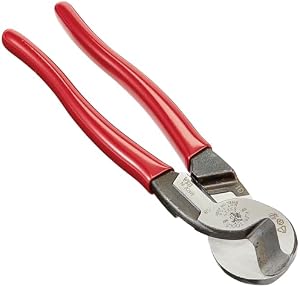
Klein Tools 63060 Ratcheting Cable Cutter
The 63060 is the largest-capacity pick here. The Klein page for this model states copper up to 600 MCM and aluminum up to 750 MCM. The listing describes a patented two-step ratchet, a quick-release lever that opens the blades in every cutting position, and a locking lever for transport. The listing data gives a weight of 1.3 pounds. The Klein page says do not use it to cut steel or ACSR. Skip if you mostly cut small communication cable, where the 63050 is the more direct match.

Knipex 95 31 250 SBA Ratchet Cable Cutter
The Knipex listing describes a ratchet cable cutter for copper and aluminum cables, single and multiple wire, with precision-ground, hardened blades. It says the cut is clean without crushing or deformation, and that one-hand operation uses the ratchet principle. The listing data gives a cutting width of 25 centimeters; this article does not treat that figure as a conductor capacity. The listing data also states a limited lifetime warranty. The listing bullets say the tool is not suitable for ACSR, steel wire, or wire rope. Skip if you need a copper or aluminum capacity figure for planning, because the listing does not state one in its bullets. The sources opened for this article do not cover this model.
QUAXLENT 10-Inch Heavy Duty Cable Cutter
The QUAXLENT listing gives 2/0 soft copper, 4/0 aluminum, 100 pairs of 24 AWG communication cable, and a range of 0 to 70 mm squared. The listing says the body is made of 55# steel and that the high-leverage handle, 5.51 inches long, gives leverage for larger cable. It also lists a second, small jaw for stripping the sheath of small wire. The bullets say the cutter cannot be used to cut steel wires and that using it on steel will damage the tool. Skip if you need a manufacturer page to confirm the capacity, since none was opened for this model.

Southwire CCPR400 Ratcheting Cable Cutter
The Southwire title gives a 750 MCM capacity. The bullets describe a ratcheting design for fewer strokes and better control, hardened steel blades, and a comfort grip. The listing data gives a weight of 1.7 pounds. The bullets do not repeat the 750 MCM figure, and they do not split copper from aluminum, so the title figure is the only capacity figure on the page. Skip if you need separate copper and aluminum figures or a steel limit, since neither is stated.
Listings left out and why
Several listings in the scanned set were not picked. Two Muzata listings are wire-rope and railing cutters. Their bullets describe cutting wire rope up to 5/32 inch, for cable railing, fencing, and bike brakes. The GRENPRO listing describes cutting hard steel wire, stainless steel rope, and aircraft cable, which is a different job from copper and aluminum. The AUPREX 24-inch long-arm listing states a cutting diameter up to 2 inches and says it is not suitable for steel wire, but it states its capacity as a diameter, not as a conductor figure, so it is not compared here.
The Yangoutool listing is left out because its title and bullet give capacities that do not match each other. The TOOLEAGUE listing is left out for a safety reason: its bullets say the PVC handle is not insulated and that it should not be used to cut live wires. The Yangoutool listing says the same about live wires.
How we chose
The selection starts from a scan file of 12 listings from 9 brands, read on 2026-10-23. The criteria were a stated copper or aluminum capacity, a stated steel or ACSR limit, and a job that matches copper and aluminum cable. Marketplace popularity was not used to select the picks. Six listings were picked and six were left out for the reasons above. The Klein pages were opened on 2026-10-27 and their figures are the figures quoted for the two Klein models.
The picks are not a ranking. They are listings whose stated figures let a reader match a cutter to a job. A reader who needs a specific capacity should pick the listing that states that figure, not the one that appears first.
What we could not verify
- Overall length for each cutter. The listing dimension fields do not agree with each other for the same tool, so this article gives no lengths.
- Copper and aluminum capacity for the Knipex model. The bullets do not state a conductor figure, and the sources opened for this article do not cover that model.
- A steel limit for the Klein 63225 and the Southwire model. The listing data is silent, and the sources opened do not cover those models.
- The conversion between the Yangoutool figures in square millimeters and AWG 600 MCM. The listing does not show one.
- Whether any cutter here is rated for live-wire work. The listings give no insulation rating for the copper and aluminum cutters, and two listings say not to use their tools on live wires.
Buying checklist
- Identify the metal first: copper, aluminum, or steel. Steel, ACSR, and wire rope rule out every cutter in the picks.
- Find the stated capacity for your metal and convert nothing. Compare only figures in the same unit.
- Check that the stated capacity covers the largest cable you need, not the typical one.
- Check the access. The 63050 and 63225 listings describe confined-space use.
- Check whether the listing addresses live wires. Two listings in this group, Yangoutool and TOOLEAGUE, say not to use their tools on live wires.
- A cable cutter does not test voltage. The listings do not describe a way to confirm a wire is dead, so use a separate tester for that check.
Mistakes to avoid
- Cutting steel or ACSR with a copper and aluminum cutter. Klein’s pages say not to, and the Knipex and QUAXLENT listings say the same.
- Comparing unlike units. The Yangoutool title and bullet give figures that do not agree, so a single number from one source is not enough.
- Treating a title figure as a full spec. The Southwire 750 MCM figure appears only in the title.
- Cutting live wires. The Yangoutool and TOOLEAGUE listings say not to.
- Buying a wire-rope cutter for copper or aluminum. The Muzata listings describe wire rope up to 5/32 inch for railing and bike brakes.
FAQ
Can a cable cutter cut steel wire?
The picks in this guide cannot. The Klein pages say not to cut steel or ACSR, and the Knipex and QUAXLENT listings give the same limit. For steel wire or wire rope, use a tool whose listing names steel as its job, such as the GRENPRO listing, which describes cutting hard steel wire. That is a different category from this comparison.
What does MCM mean on a cable cutter?
MCM is the unit Klein uses for conductor size on its 63060 page. The page gives copper and aluminum capacities in MCM. Compare MCM figures with MCM figures only. The sources opened for this article do not provide a conversion to other units, so do not convert between them.
Is a ratchet cutter better than a plain one?
Ratchet models are described as needing fewer strokes per cut, and the Knipex listing describes one-hand operation. The sources opened for this article do not compare time or effort between ratchet and plain cutters. The better choice depends on the size of cable and how much access you have.
Can I use a cable cutter on a live circuit?
No listing in this guide recommends it. The Yangoutool and TOOLEAGUE listings say not to use their tools on live wires. A cable cutter does not check the circuit’s state, so that check needs a separate tester.
Does a cable cutter measure anything?
No. A cable cutter cuts cable. It does not check voltage, current, resistance, or continuity. This page is an exception to the site’s meter focus, and it is labelled that way so readers do not expect measurement advice here.
Which tool should I check for steel cable or wire rope?
Do not use a copper and aluminum cutter. Look for a tool whose listing names steel or wire rope as the job, and confirm the stated capacity and the manufacturer’s limits before buying. The Muzata wire-rope listings and the GRENPRO listing are examples of that category, and they are not compared with the picks here.
Bottom line
Match the cutter to the metal first, then to the capacity the listing states in the same unit. If the cable is steel, ACSR, or wire rope, do not use any of these cutters. For copper and aluminum, the Klein 63060 has the largest stated ratings, and the Klein 63050 is the compact choice for smaller communication cable.
Related guides
For the electrical side of a job, read Best Multimeters for Electricians before you start, so you can check circuits with a rated meter. For the next step after cutting, see Best Wire Strippers. For fault work on a cable run, see Best Cable Fault Locator.
Sources
- Klein Tools, “Ratcheting Cable Cutter” (model 63060). https://www.kleintools.com/catalog/ratcheting-cable-cutters/ratcheting-cable-cutter. Opened 2026-10-27.
- Klein Tools, “Cable Cutter – 63050”. https://www.kleintools.com/catalog/standard-cable-cutters/cable-cutter. Opened 2026-10-27.
Affiliate disclosure: links to Amazon on this page are affiliate links. We may earn a commission on qualifying purchases at no extra cost to you.
