Best 220 Volt Tester for Outlets and Wiring: Picks and Guide
As an Amazon Associate we earn from qualifying purchases. Details
A 220 volt tester is a voltage tester you use to check whether a circuit at that level is live. The phrase covers a range of tools, from simple test lights to two-pole testers with a readout. This guide compares two voltage testers in this roundup and explains which uses each suits. It covers the range each listing states, the category it names and the form factor, plus what to confirm before you connect anything. The guide keeps to tools that show voltage presence or a set range, and it leaves resistance and current meters aside.
Quick answer
A two-pole voltage tester with a stated range that covers 220 volts is the closer fit for most checks that need a readout. The first entry offers a span from 12V to 690V AC and DC with a waterproof body. The second offers 24 to 600V AC for its twin probes, with a non-contact tip and snap-in leads for outlets. Multimeters can read voltage too, but they are a different tool, so this roundup keeps to voltage testers. Confirm the stated range and the safety category before you connect anything to a circuit.
What matters for this keyword
A range that covers the voltage
A tester should cover the voltage you need to check. One listing states a span from 12V to 690V AC and DC. The other lists 24 to 600V AC for its twin probes and 6 to 220V DC. A reading at 220 volts sits inside the stated AC ranges of both entries. Check the range against the circuit you are working on, and do not use a tester outside its stated span.
Categories and what they mean
A measurement category classifies live circuits by the energy available at a point and the impulse voltages present. CAT II covers circuits directly connected to the low-voltage installation, and CAT IV covers measurements at the source. One listing states CAT III 690V and CAT IV 600V. The other shows no category at all, so check its manual before using it on mains.
Test light or meter
A test light checks for the presence of electricity in equipment. It is simpler and less costly than a measuring instrument such as a multimeter, and it often suffices for checking whether a conductor is live. Non-contact types can detect voltage on insulated conductors. The two-pole tester here goes further with a readout and continuity mode, which a plain light does not give you. For a wider outlet view, compare the outlet voltage tester guide.
Built-in features
The first listing adds continuity, RCD testing and three-phase phase indication named in its bullets. The second adds a non-contact voltage tip, a Circuit Alert and a set of snap-in leads spaced for a standard outlet. Both are voltage-first tools. The extra functions help with specific checks, and none of them replace the category rating. For trade-oriented options, see the electrician voltage tester guide.
Residual-current protection
A residual-current device, also called a ground fault circuit interrupter, interrupts a circuit when the current in the line and neutral conductors is unequal. That indicates current leaking to ground or to an unintended path. A voltage tester does not replace that protection. Read the home voltage tester guide if your use is mostly household outlets.
The picks
Each card below shows the specs the listing gives, followed by pros and cons from the same listing. The paragraphs here give the short version for each pick.
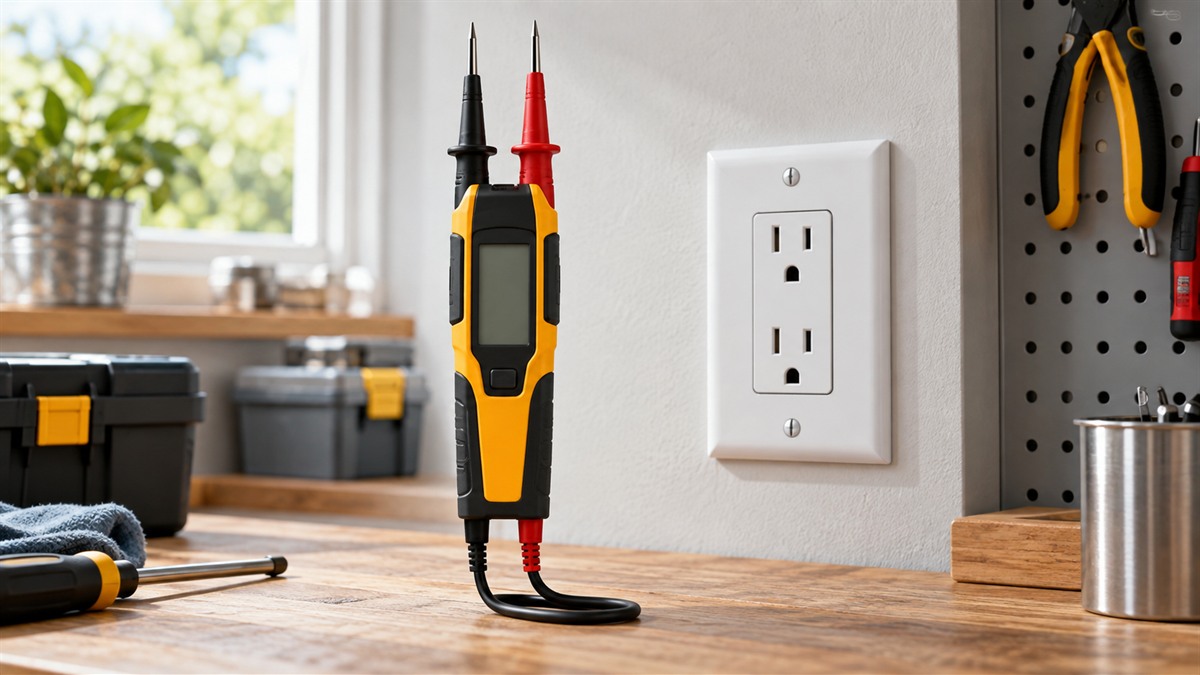
Best two-pole option. The first entry is a two-pole voltage and continuity tester with a stated 12V to 690V span, IP65 water resistance and a buzzer. Its bullets name AC and DC measurement, three-phase phase indication and an RCD test. It suits buyers who want a range and a readout in one handheld tool.
Best for quick outlet probing. The second entry is a handheld voltage and continuity check with a 24 to 600V AC non-contact tip and snap-in leads spaced for a standard outlet. Its power source field reads corded electric, which is unusual for a probe, so confirm how it is powered before use.
1. Voltage Tester, Voltage and Continuity Tester with AC/DC Detection, Volt Meter for 12V-690V AC/DC (Best two-pole option)
Specs from the listing (checked 2026-10-13):
- Model: UT18C
- Power Source: Electricity
- Compatible Devices: Electrical systems and devices with voltage up to 690V AC/DC, CAT III 690V and CAT IV 600V rated equipment
- Item Weight: 280 g
- Style: Digital
Pros
- Listed span starts at 12V and reaches 690V AC/DC
- Two-pole design with continuity and RCD test functions named in the bullets
- IP65 rated for wet or humid areas, per the listing
Cons
- CAT III 690V and CAT IV 600V categories are stated, so confirm the use before connecting
- Several functions are packed into one bullet, so read the manual to learn each mode
Best for: Users who want a two-pole voltage tester with a waterproof body and a buzzer for outlets and wiring.
Skip if: Skip it if you want a plain non-contact pen, since this unit is a two-pole tester.
View on Amazon (affiliate link)
2. Sperry Instruments VC61000 Volt Check Voltage & Continuity Tester, Black & Yellow (Best for quick outlet probing)
Specs from the listing (checked 2026-10-13):
- Model: VC61000
- Power Source: Corded Electric
- Style: Handheld
- Measurement Type: Voltmeter, Ohmmeter
- Item Weight: 3.52 ounces
- Included Components: Volt Check Voltage-Continuity Tester
Pros
- Twin probes cover 24 to 600 V AC and 6 to 220 V DC, with polarity indication
- Circuit Alert non-contact AC detection in the tip (50-600V AC)
- Snap-in leads are spaced to fit a standard outlet for one-handed operation
Cons
- Its Power Source field reads corded electric, so confirm how the tool is powered
- No CAT category appears in its fields, so check the manual before use on mains
Best for: Users who want a handheld voltage and continuity check with snap-in leads for outlets.
Skip if: Skip it if you need a listed CAT category for mains work, since none is shown.
View on Amazon (affiliate link)
How to choose
Choose the two-pole tester when you need a range, a readout and AC and DC measurement. Choose the probe-style tester for quick live checks at outlets and switches, where one-handed leads help.
- Choose the two-pole tester when you need a readout and a stated range for AC and DC work.
- Choose the probe-style tester for quick live checks at outlets and switches.
- Skip either tool if you need a meter for resistance or current, because neither entry is built for that.
Before you order, confirm the stated range, the category, the power source and the lead length. If a field conflicts with the title, ask the seller first.
Safety note. Voltage testers are used around live parts, so read the manual before use and follow local electrical rules. Panel or service work belongs to a licensed electrician. OSHA lists contact with power lines among the most frequent causes of electrical injuries, so keep a safe distance from anything you have not identified.
Worked example: an outlet check route
- Readings: 9 x 2 = 18 readings.
- Time: 18 x 20 = 360 seconds.
- In minutes: 360 divided by 60 = 6 minutes.
A full outlet walk takes about 6 minutes plus setup. If you recheck every outlet once more, the count doubles to 36 readings. Keep the same method for each reading so the results compare.
Common mistakes
- Expecting a voltage tester to give a multimeter-style reading of resistance or current.
- Skipping the category check before connecting the leads to a circuit.
- Trusting one light or one reading as the final answer on a circuit.
- Ignoring the power source field on a corded or battery-powered tool.
- Using a tester outside its stated range.
FAQ
Is a 220 volt tester the same as a multimeter?
No. A voltage tester shows whether voltage is present or reads a set range. A multimeter measures several quantities, and a general reference describes it as a measuring instrument for voltage, resistance and current.
Can a voltage tester check 220 volts?
Both entries list ranges that include 220 volts for AC work. Check the listed range and category on the tool before you use it.
Do I need a non-contact tester?
A non-contact tip detects voltage without touching a conductor. That helps find live wires behind insulation, but it does not measure a value. Use it as one check among several.
What does CAT mean on a tester?
CAT is a classification of live circuits by the IEC, based on the energy available and the impulse voltages present. Pick a tester whose category suits the circuit you will work on.
Why does a residual-current device matter here?
It interrupts a circuit when line and neutral currents are unequal, which indicates leakage to ground.
Is a battery-powered tester better than a corded one?
Neither is better by default. Battery-powered tools need charged cells, and corded tools need a plug. Check the power source field and the manual before use.
When should I call an electrician?
If a check shows voltage you cannot explain on a circuit you cannot identify, stop and call one.
Bottom line
For a 220-volt check, pick a tester whose stated range and category suit the circuit. The two-pole option gives the wider range and the readout, and the probe-style option is the quicker outlet check. Skip any tool whose category you cannot confirm, and leave panel work to a licensed electrician.
Sources
- Test light (Wikipedia): what a test light checks and how non-contact types work
- Multimeter (Wikipedia): what a multimeter measures and how it differs from a voltage tester
- Measurement category (Wikipedia): IEC classification of live circuits
- Residual-current device (Wikipedia): what an RCD interrupts