Temirup 20-Inch Flexible Clamp Meter Review: Range Conflicts and CAT Gaps
As an Amazon Associate we earn from qualifying purchases. Details
If you are considering the Temirup flexible clamp meter, the first question is whether its current range and its rating suit the conductors you want to measure. A flexible clamp wraps around a bundle of cables where a hard jaw cannot reach, which makes it useful in tight spaces, but the listing gives two different current maximums and no CAT rating. This review covers only what the listing states about current ranges, display, probe size, true RMS, auto-ranging, power, weight and service. It does not report any test of the clamp on a circuit, and it does not describe how to take a reading on any live conductor. Use the listing to decide whether the clamp matches your work, and follow the manual and your local electrical rules.
Quick answer
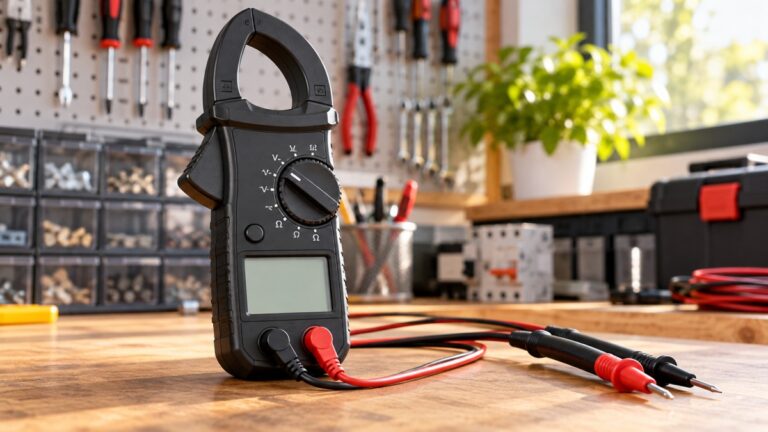
The Temirup is a blue, battery-powered flexible AC clamp meter with a 520-millimeter flexible probe and a clamp diameter of 165 millimeters. The title says 10,000 amps and 6,000 counts, while the specs give a maximum display of 9,999 and a top measuring range of 9,999 amps. The bullets describe true RMS, auto-ranging, data hold, a backlit display and automatic power-off after 15 minutes. The listing gives two AAA batteries, a storage case and a manual. The bullets describe 12 months of after-sale service, and the specs state no warranty. The listing does not state a CAT rating.
What to check in a flexible clamp meter
Four details decide whether this clamp fits. Each one can rule it in or out.
1. Current range and count. The specs give two current bands. The 6-amp and 60-amp ranges have an accuracy of plus or minus 2 percent of the reading plus 5 counts, and the 600-amp, 6,000-amp and 9,999-amp ranges have an accuracy of plus or minus 3 percent plus 5 counts. The title says 6,000 count and 10,000 amps, while the specs give a maximum display of 9,999. These figures conflict, so check the product page for the official count and maximum before you rely on the top of the range.
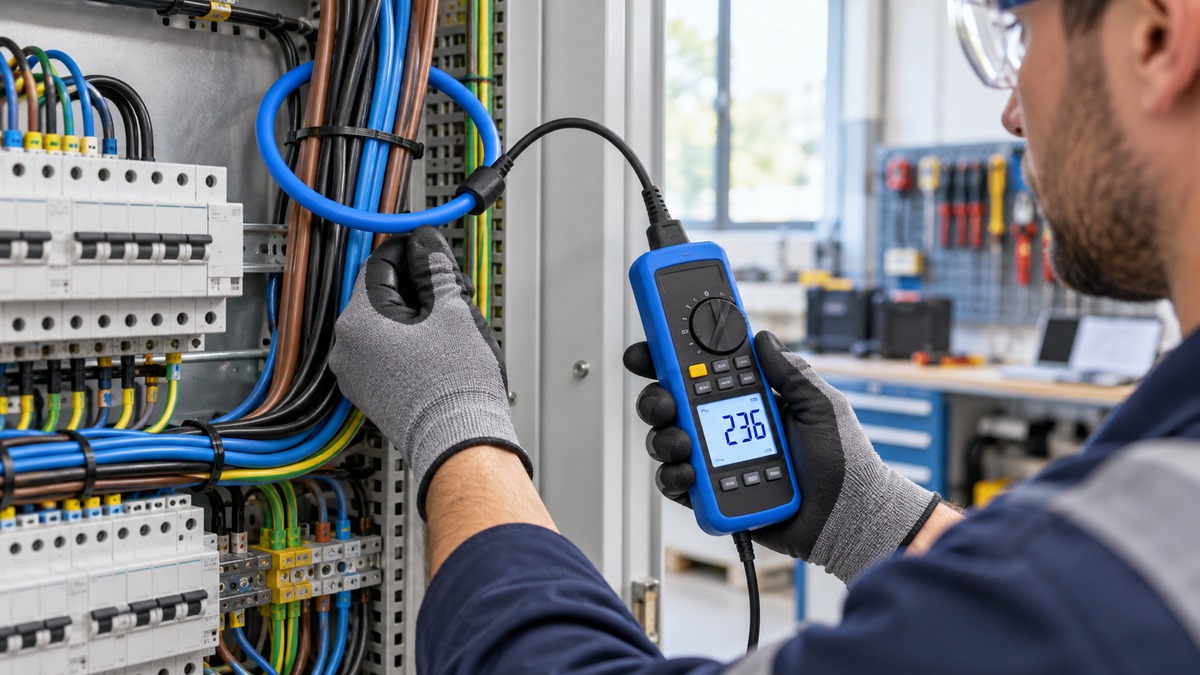
2. Probe and jaw size. The specs give a flexible probe 520 millimeters long and 7.5 millimeters in diameter, and a clamp jaw diameter of 165 millimeters. The bullets say the 20-inch clamp reaches hard spots and wraps around cables. The listing gives the probe length and diameter but not the loop size, so check that the bundle fits before you clamp it.
3. Rating and standards. The listing gives a working height of up to 2,000 meters and a storage temperature of minus 10 to 50 degrees Celsius. It does not state a CAT rating, and the bullets mention only a high-voltage warning and the true RMS function. The CAT system classifies live circuits used in measurement, and the source describes CAT II as circuits directly connected to the low-voltage installation and CAT IV as the source of the high-voltage installation. Without a stated category, do not use this clamp on a circuit where the category matters, and do not call it safe for household mains.
4. Battery, weight and service. The specs give a power supply of two 1.5-volt AAA batteries, and the included components name batteries. The weight is 4.8 ounces for the item and about 120 grams excluding batteries, and the bullets describe 6.6 feet of drop protection. The bullets claim 12 months of after-sale service and 7/24 customer service, but the specs state no warranty.
Use these rules to choose:
- Choose this clamp if you need an AC current reading on a bundle of cables that a hard jaw cannot reach, and you will confirm the range and rating.
- Choose a different clamp if you need a stated CAT rating, because the listing states none.
- Choose a different clamp if you need the top of the range confirmed, because the title and specs disagree.
For related clamp options, the best true RMS digital clamp meter guide covers true RMS designs, and the best AC DC current clamp meter guide covers clamps that measure DC current too.
1. Clamp Meter, AC Electrical Tester with 20-Inch Flexible Clamp,True RMS 6000 Count 10000A AC Current (Review verdict)
Specs from the listing (checked 2026-10-13):
- Maximum Display: 9999
- Measure Range: 6A/60A ±(2.0% of reading + 5 counts) 600A/6000A/9999A ±(3.0% of reading + 5 counts)
- Flexible Probe Length: 520 mm
- Clamp Jaw Diameter: 165mm
- Power Supply: 2×1.5V AAA Batteries
- Weight: Approx. 120g (Excluding Batteries)
Pros
- Flexible probe 520 millimeters long for bundled cables, per the specs
- True RMS and auto-ranging, per the bullets
- Two AAA batteries and a storage case included, per the components field
Cons
- Title and specs disagree on the count and top current
- No CAT rating stated in the listing
- Warranty described only in the bullets, not the specs
Best for: A reader who needs an AC current reading on a bundle of cables that a rigid clamp cannot reach, with the range and rating confirmed.
Skip if: Skip if you need a stated CAT rating, a confirmed top range, or DC current.
View on Amazon (affiliate link)
The Temirup flexible clamp meter
The Temirup is a flexible clamp meter in blue with an LCD display, auto-ranging and an over-range display of OL. The specs list the sampling rate as about three times a second, and the working height as up to 2,000 meters. The model is FC01, and the included components are batteries, a storage case and a user manual. The item dimensions are 8.9 by 2.5 by 1.3 inches.
The meter fits a reader who needs to measure AC current in a bundle of cables where a rigid clamp cannot close, and who will read the display in low light. The bullets describe a true RMS measurement, which the Wikipedia overview of true RMS converters describes as more correct for distorted waveforms than averaging meters.
The listing has several things to check. The title says 6,000 count, while the specs give a maximum display of 9,999. The current maximum is 10,000 amps in the title and bullets and 9,999 amps in the specs. The bullets say “AC current” and do not state a DC function, so do not assume one. The rated current field reads approximately 5 milliamps, which the listing does not explain. The bullets claim 12 months of after-sale service, but the specs list no warranty.
Who should skip it: a reader who needs a CAT rating, a reader who needs a confirmed top range, and a reader who needs DC current.
True RMS in a flexible clamp
The Wikipedia overview of the true RMS converter says simple meters convert an AC signal by averaging a rectified signal and applying a correction factor, which is correct only for a sinusoidal waveform. True RMS gives a more correct value, which holds up better for distorted waveforms. The bullets describe true RMS technology for precise readings, which matches that description.
A true RMS reading still depends on the probe and the bundle it measures. The listing does not state the accuracy for distorted waveforms, so read the accuracy line on the product page before you rely on the reading.
Worked example: how a 40-amp load sits below the 60-amp band
Compare that load with the top of the listed low band, so you can see which range the reading would fall in.
- Top of the low band: 60 amps, from the specs.
- Load in this example: 40 amps.
- Room below the top of the low band: 60 minus 40 = 20 amps.
Check the arithmetic again. 60 minus 40 is 20. The example shows that a 40-amp load stays in the 6-amp and 60-amp band. The listing gives plus or minus 2 percent plus 5 counts for that band, so a reading there carries less error than a reading in the 600-amp band.
What a flexible clamp is
A flexible clamp meter is a coil that wraps around the conductor instead of a rigid jaw. The Wikipedia overview of the Rogowski coil describes an AC measuring device that is a helical coil wrapped around the conductor, with no metal core. The listing does not name the sensing method, so do not assume it is a Rogowski coil from the flexible probe alone. The probe’s length and diameter, 520 millimeters and 7.5 millimeters, describe the coil, not its accuracy.
The listing does not state the probe’s method, so check the product page for it before you rely on the reading.
Protecting the probe cable
The flexible probe is a cable that can be pinched or stretched. OSHA’s wiring rules say flexible cords and cables must be protected from accidental damage, such as from sharp corners, projections, doorways and other pinch points, and supported so they are not damaged in place. Keep the probe away from sharp edges and doorways while you measure, and check the cable for cracks before each use.
Five common mistakes
- Trusting one top range. The title says 10,000 amps and the specs say 9,999.
- Trusting one count. The title says 6,000 count and the specs say 9,999.
- Assuming a CAT rating. The listing states none.
- Clamping a bundle that does not fit the loop. Check the probe and bundle size first.
- Assuming a warranty. The bullets claim service, but the specs list no warranty.
FAQ
What current range does it cover?
The specs list bands at 6 amps, 60 amps, 600 amps, 6,000 amps and 9,999 amps, and the title says 10,000 amps.
How big is the flexible probe?
The specs give 520 millimeters long and 7.5 millimeters in diameter.
What power does it use?
Two 1.5-volt AAA batteries, which the listing includes.
Is it true RMS?
The bullets say so and describe true RMS technology.
Does it have a CAT rating?
The listing does not state one.
Does it come with a warranty?
Bottom line
The Temirup flexible clamp meter suits a reader who needs an AC current reading on a bundle of cables that a rigid clamp cannot reach, with true RMS, auto-ranging and a backlit display. The listing conflicts on its top range and count, states no CAT rating, and gives service terms only in the bullets. Confirm the range and count on the product page, check the bundle fits the probe loop, and do not use the clamp on a circuit where the CAT rating matters.
Sources
- True RMS converter, Wikipedia: averaging meters are correct only for sinusoidal signals; true RMS is more correct for distorted waveforms.
- Measurement category, Wikipedia: CAT II for circuits directly connected to the low-voltage installation, and CAT IV for the source of the high-voltage installation.
- Rogowski coil, Wikipedia: a helical coil for measuring AC or high-speed current pulses, wrapped around the conductor with no metal core.
- 29 CFR 1910.305, OSHA wiring methods (Cornell LII): flexible cords and cables must be protected from accidental damage.